Dear Indian Brands, Gen Z Is Not a Marketing Strategy. It's Your Excuse
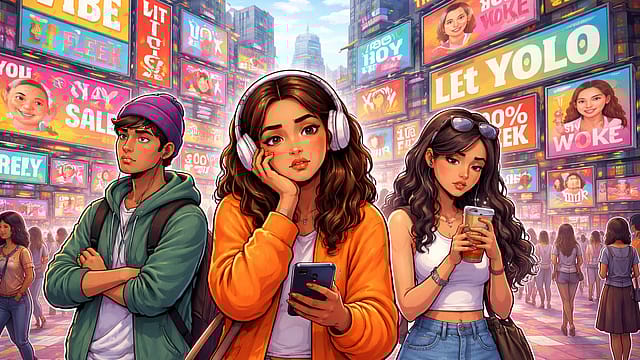
A 22-year-old in Patna and a 22-year-old in Pune share a birth year and a social media platform. Their consumption triggers, price thresholds, and aspiration anchors are miles apart. And yet, somewhere between a strategy offsite and a media plan, both of them became "Gen Z" — a single, convenient shorthand for a generation that Indian brands are simultaneously obsessed with and fundamentally misreading.
A few weeks ago, I was pitching story ideas to my editor — someone who has watched enough brand cycles to know that every generation eventually gets its own deck slide. Millennials got theirs. Before them, Gen X did too. His point was measured, and coming from someone who has seen this industry up close for decades, it carried weight: generational targeting isn't new, it's just marketing's oldest game replayed with new props. The language shifts, the mediums change, a new cohort gets a name — but the underlying logic stays the same. Identify who's coming next. Learn their codes. Sell to them. He's right about that.

Look Who's Talking Regime Change
23 Oct 2026 - Vol 05 | Issue 43
But knowing that Gen Z exists, and actually understanding what Gen Z wants, are two very different things. And most Indian brands have quietly mistaken the first for the second.
The influencer roster changes. The meme format updates. The campaign gets a cleaner sans-serif font and a purpose-led tagline. And somewhere in a boardroom, someone calls that a Gen Z strategy. It isn't. It's cosplay.
Spend enough time reporting on Indian brands and a pattern becomes hard to ignore. Consider Bata. Few brands carry a legacy as deeply embedded in Indian memory — the school shoe, the formal black lace-up, the white canvas sneaker that dressed generations of children with the reliability of a uniform. The company has spent the better part of a decade trying to move past that association. Over 65% of its marketing spend now goes toward digital. Campaigns talk about self-expression, about "making your way." Sneaker Studios have been rolled out across 750-plus stores. All textbook Gen Z moves, executed with visible effort.
And yet, revenue for FY2024-25 grew by just 0.28%. Operating margins slipped once you strip out a one-time exceptional gain. The shoes, by many accounts, are better than they've ever been. But as a marketing professor put it plainly while I was reporting the Bata story — perception tends to lag product reality by years. You cannot influencer-post your way out of a four-decade-old mental association. Bata's own leadership understands what Gen Z wants — self-expression, brands that fit their self-narrative, a clear reason to choose. The insight is exactly right. The gap is between knowing it and actually earning a place in that narrative. That gap cannot be closed by shifting media budgets alone.
What Bata is navigating — and it is hardly alone — is that Gen Z doesn't simply want brands to show up on their platforms. They want brands that make sense to their identity. Those are not the same brief.
Then there is the creator-brand wave, India's most enthusiastic recent answer to the Gen Z question. Punjabi singer Karan Aujla launched Zyro, a zero-sugar energy drink, anchored around the idea of "nothing unnecessary." The global template is familiar — PRIME Energy, built by YouTubers Logan Paul and KSI, demonstrated that online fandom could muscle its way onto retail shelves. Indian brands watched and took notes. The logic seemed transferable.
But what keeps getting discovered is that fandom is borrowed attention. It doesn't automatically create category demand, and it certainly doesn't build the kind of repeat purchase behaviour that makes a brand viable long-term. India's energy drinks market is projected to grow at a modest 2.25% CAGR through 2031. Creator-backed launches are multiplying considerably faster than the market they're entering. The question nobody in the boardroom seems to be asking loudly enough is: does the consumer actually need this — or does the brand just need Gen Z to need it?
That distinction matters more than it appears. One is a consumer insight. The other is a business anxiety dressed up as one.
Not every brand is making this mistake in the same way. Marico's acquisition trail — from men's grooming brand Beardo to plant-based nutrition label Cosmix — reflects a meaningfully different read of the same consumer. Rather than retrofitting existing brands for younger audiences and hoping the repositioning sticks, Marico has been buying into communities that already carry native credibility with the cohort it wants to reach. That's not a marketing fix. It's a portfolio thesis built on the understanding that Gen Z trust, once it exists, cannot simply be manufactured through a campaign. It has to be inherited or earned over time — and acquiring founder-led brands with existing community loyalty is a faster, more honest path to both.
The contrast is instructive. One approach asks: how do we make our brand look Gen Z? The other asks: where does genuine Gen Z affinity already exist, and how do we build around it?
Which brings the argument back to where it started — that conversation with my editor, and the question of whether any of this is actually new.
He is right that generational targeting has always been marketing's oldest game. Brands found their footing with every new cohort that came before. But the brands that actually won each generation didn't just change how they spoke. They changed what they built and who they built it for. The ones that earned Millennial loyalty didn't hand them a TV ad dressed in irony. They gave them something that fit their actual lives — at the right price, through the right experience, with a coherence between what the brand said and what it delivered.
Gen Z is not asking for anything more radical. And they are certainly not asking for a strategy deck with their name on it.
Here's what gets lost when "Gen Z" becomes a buzzword rather than a genuine brief: the sheer complexity of who this generation actually is in India. A brand strategy built on the assumption that Gen Z is a monolith — uniform in aspiration, uniform in spending power, uniform in what they want a brand to mean — is a strategy built on a fiction. When Bata's own Annual Report quietly notes that rural markets outperformed urban ones on the back of aspirational purchases in value segments, it is puncturing the very narrative that most Gen Z marketing is built around. Aspiration in India does not have one face. It never did.
The brands that will earn this generation's loyalty — and hold it — are the ones willing to sit with that complexity rather than flatten it into a font choice and a hashtag. Gen Z doesn't need to be decoded. It needs to be respected as something more than a line item in a media plan.
My editor has seen enough cycles to know that this too shall pass — that in a few years, some newer cohort will get its own deck slide and the industry will pivot accordingly. He's probably right about that as well.
But the brands that treat this moment as a genuine reckoning, rather than a rebrand, are the ones that will still be around to see it.