Scroll, 'Beta', Scroll: Retirement Plan, Unlimited Data & The Last Seen Generation
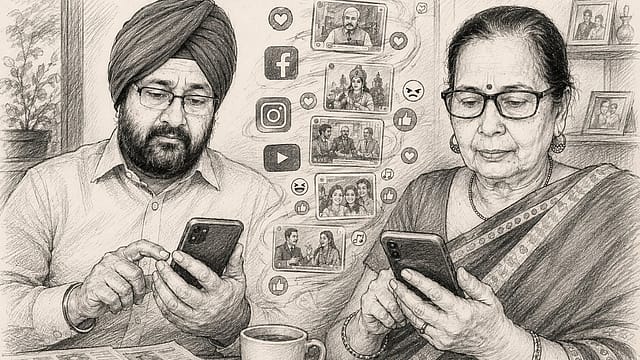
Pushplata scrolls past a political rant, pauses at a bhajan, double-taps a family reel, and keeps going.
Another video loads. Then another. Time blurs. Night spills into morning.
12:40. 1:15. 2:03.
Her Instagram knows her well. It serves her devotion, outrage, nostalgia — one reel at a time. She doesn’t question it. She leans in. She follows 6,000 people approximately.
Mishra lives in Lucknow. The house goes quiet early. The phone doesn’t.
She is 73.
Now, shift cities.
In Delhi, 72-year-old Saurabh Shukla starts his day with Facebook.
News first. Then videos. Then whatever the feed decides. One post opens into another. A clip leads to three more. Hours pass easily. Six, sometimes seven.

The Modi Years
02 Oct 2026 - Vol 05 | Issue 40
A Nation Rebuilt
It fills the gaps between conversations, between routines, between the day itself.
Meanwhile, in Kolkata, Kulbir Singh Sethi scrolls to stay in touch with his children. He stays for everything else.
This wasn’t supposed to happen. Social media in India has long been seen as a young person’s world: fast, loud, restless, and always chasing the next thing.
But quietly, almost invisibly, a different user has entered the feed.
India’s elderly are not just logging on. They’re staying.
Across homes in cities like Delhi, Mumbai and Bengaluru, retired parents and grandparents are spending hours consuming reels, Facebook posts and YouTube Shorts — often introduced to the platforms by their own children and grandchildren.

Neither considers it unusual.
For many older adults, what began as casual digital curiosity slowly evolved into habit, routine and emotional dependence. Family members first created their profiles, taught them how to navigate apps or encouraged them to stay connected online. Over time, the platforms became embedded into daily life.
Research around older adults and technology usage shows a sharp rise in digital dependence among people over 60. Technology has increasingly become a tool for maintaining emotional and social connection, particularly among older adults navigating retirement, loneliness, reduced mobility or changing family dynamics.
From Connection to Compulsion
“In many cases, scrolling is driven by the need for emotional connectedness and relevance,” said Dr. Aditi Govitrikar, psychologist, wellness expert and former Mrs. World. “This phase of life often comes with significant emotional and social changes. Digital media gives people a feeling of belonging, importance and stimulation.”
Unlike younger users, older adults did not grow up in an always-online world. For many of them, social media arrived after retirement, after children moved away, or after social circles shrank. Yet once introduced, the platforms became powerful substitutes for older forms of community interaction.
“Facebook recreates a sense of community that older generations deeply value,” Govitrikar explained. “It makes people feel seen, included and emotionally engaged.”
Taylor Elizabeth, emotional intelligence and etiquette expert and founder of The Elegance Advisor, said social media fills psychological needs that become more visible later in life.
“As people age, their social structures naturally change,” she said. “Retirement, reduced mobility, children becoming independent and shrinking social circles can create feelings of invisibility or disconnection. Social media offers stimulation, communication and relevance with very little effort.”
For many older adults, the phone becomes an all-in-one replacement for conversations, newspapers, social gatherings and entertainment.
When Algorithms Shape Emotions
Experts say the line between healthy engagement and compulsive consumption becomes difficult to identify because algorithms gradually shape emotional behaviour over time.
“Humans adapt to repeated experiences,” Govitrikar said. “If someone constantly consumes fear-driven news, anger-filled debates or emotionally charged content, their emotional baseline slowly shifts. They can become more anxious, irritable or insecure.”
Algorithms, she added, reward emotional intensity.
“The angrier or more emotionally triggered a person becomes, the more similar content they are likely to see,” she said.
This becomes especially significant among older adults who may already spend long hours alone or indoors. Over time, social media can stop being an activity and start becoming an emotional environment.
According to Elizabeth, excessive digital consumption becomes concerning when online interaction begins replacing real-world engagement rather than complementing it.
“The signs are gradual,” she said. “An overwhelming urge to scroll during emotional distress, constantly reaching for the phone when alone, losing interest in previously enjoyable activities, or preferring online validation over real-life interaction.”
Govitrikar pointed to similar behavioural changes: irritability when disconnected, sleep disruption, emotional dependence on engagement, and growing comparison with digitally curated lives.
“If your emotional wellbeing starts revolving around what you see online, it means the digital world is beginning to control your emotions,” she said.
More Than Just Loneliness
Still, both experts caution against dismissing older adults as merely “addicted” to screens.
Loneliness may be a factor, but it is not the entire story.
“There’s a tendency to oversimplify older adults’ social media use as loneliness,” Elizabeth said. “But many are also looking for stimulation, humour, information, nostalgia and cultural participation.”
Govitrikar agreed, noting that emotional isolation can exist even within large families and active households.
“People may still feel unseen or emotionally disconnected despite being surrounded by others,” she said. “Social media temporarily fills that gap.”
The phenomenon also reflects a larger generational transition. Many older Indians who once struggled with smartphones are now active participants in the digital ecosystem — forwarding reels, commenting on politics, joining devotional livestreams and maintaining online communities.
What makes this shift particularly striking is how organically it happened.
Children introduced parents to smartphones to make communication easier. Grandchildren taught grandparents how to watch videos or send messages. Families encouraged older adults to stay “updated” and connected.
Slowly, the digital world stopped being foreign.
The New Digital Retirement
Experts say the solution is not digital elimination, but healthier digital awareness.
“Looking beyond shame and focusing on understanding is the first step,” Elizabeth said. “Instead of mocking older adults for scrolling, families should create more meaningful real-life interactions.”
Simple changes, she argued, can make a difference: calling instead of only texting, involving older adults in conversations, discussing the content they consume, or helping them understand how algorithms shape their feeds.
“The goal is not to remove social media from their lives,” she said. “The goal is to help them use it consciously, positively and in ways that enrich their emotional wellbeing.”
Because for a growing number of India’s elderly, the scroll is no longer just a pastime.
It is companionship, relevance, entertainment and connection — all compressed into the screen they now carry everywhere.