Wendy's Didn’t Whisper. She Roasted: Inside India’s Noisiest Burger Comeback
By the time Wendy’s walked into India, the tables were already taken. McDonald’s had muscle. KFC had memory. Burger King had momentum. And Wendy’s? Too late.
It entered in 2015, one of the last American burger giants to land here. The market had moved on, orders were flowing, and loyalties were set. What followed barely registered. Four stores in four years. Result? Weak recall, a product that didn’t travel, and a model that didn’t fit.
Inside the kitchens, things slipped. Processes felt loose. The product drifted. Even an aloo patty could turn out different from one day to the next. “There were challenges on product, margin and user front,” recalls Ankush Grover. So, scale never came, and recall never built.
By the end of 2020, Wendy’s in India was still gasping. Then Grover and his team stepped in. It didn’t look promising. But that was the point. “The brand was on a ventilator,” says Grover, Cofounder and Global CEO at Rebel Foods. “Usko wahan se nikaal ke zinda karna tha (It had to be revived)."
The Modi Years
02 Oct 2026 - Vol 05 | Issue 40
A Nation Rebuilt
That was the brief.
In late 2020, Rebel Foods took over as Wendy’s master franchisee in India, partnering with Sierra Nevada Restaurants to rebuild and scale the brand.
At first glance, the bet didn’t make sense.
India’s burger market was already crowded, carved up by players who had spent decades building distribution, pricing muscle, and habit. But Rebel wasn’t looking at the burger. It was looking at the system.
Most global QSR brands arrived in India with the same playbook: big stores, high streets, heavy capex, slow expansion. It worked elsewhere. But it dragged here. India didn’t behave like that. “India mein delivery chalti hai (delivery works in India),” reckons Grover. “Real estate is expensive and t takes lot of time to open a store,” he adds.
Rebel Foods’ Playbook: Rewiring Wendy’s Through Cloud Kitchens
That single shift—delivery over dine-in—changed the math.
Rebel already had the backbone: hundreds of cloud kitchens, a supply chain tuned for speed, and a tech stack built to launch brands fast. Where others saw a struggling chain, Rebel saw a brand plugged into the wrong engine. So, instead of building restaurants, they started rewiring Wendy’s into their own system.
The early days weren’t glamorous.
Inside the kitchens, the problems were basic and everywhere. Recipes weren’t standardised. Processes varied from store to store. Even core items lacked consistency. Something as simple as an aloo patty could be boiled, pressed, and assembled differently depending on who was in the kitchen that day. Margins were worse. “What McDonald’s and Burger King were doing on gross margins, and what we were doing—it wasn’t even close,” says Grover. There was no point scaling this.
So, they didn’t. They stopped. Stripped it down. And started again.
The first move was control. The job was simple: standardise the product, simplify the kitchen, fix the unit economics. “We started with the products,” recalls Grover.
The logic was brutally simple: If the product doesn’t work, nothing works. If people don’t love it, they won’t order it. If they don’t order it, the model collapses. Everything else—marketing, expansion, brand voice—would come later. For now, the focus stayed where it had always been weakest: Inside the kitchen.
What came next was a rebuild.
Rebel stripped the menu back. It cut the clutter and locked the recipes, so a burger in Gurugram tasted the same as one in Pune. The aloo patty stopped varying.
Then Wendy’s started building layers. It created an entry point for mass, a reason to trade up, and in between, flavour that felt familiar. Paneer, spice, heat. The Korean range started pulling its weight.
The early signs showed up quietly. Orders steadied, repeat kicked in, and the curve began to tilt. Only then did they move. They skipped high streets and mall corners, and moved into something far less visible: kitchens. Rebel already had hundreds of them—compact, efficient, built for delivery. Wendy’s didn’t need to build from scratch. It just plugged in. A 400 sq. ft. setup could be squeezed to 200. Equipment was rethought, sourced locally, stripped of excess. Costs came down and speed went up. “In the US, a fryer costs $10,000. Here, we got it done for ₹2 lakh,” says Grover.
The math flipped.
What used to take years—real estate, capex, approvals—now took months. Sometimes weeks. Then cities opened up, one after the other. Not with lines outside stores, but with orders ticking in quietly through apps. Most of the network remained invisible. Over 200 locations, barely a handful you could walk into. Roughly 15 dine-in stores. The rest lived in kitchens people never saw.
Roast Culture: How Wendy’s Turned Attention into Recall
And that created a different kind of problem.
Outside Gurugram, customers didn’t quite believe it. “Yeh asli hai ya copy (Is this the real deal or just a copy),” they asked. A global brand, scaling faster than it could be seen, had to first prove it existed. So, the message shifted. Taste and price could wait. First, prove Wendy’s was real. The original American brand, now in India. Get that right, and the rest would follow.
Once that landed, the pace picked up.
There were no queues outside stores. Orders started ticking in. City after city, Wendy’s began to appear on apps before it appeared on streets. Kitchens came online quietly. Menus went live. And the brand started showing up where people were already deciding what to eat—on their phones.
Most customers saw a name, not a store. That changed how the brand grew. Instead of waiting for footfall, it followed demand. Instead of investing in frontage, it invested in reach. New markets opened without the usual ceremony. No ribbon cuttings. No opening-day lines. Just a steady build of orders, repeat, and recall. Within a few years, the network spread across dozens of cities. Over 200 locations. Only a handful you could walk into.
Scale had arrived. But visibility lagged. This meant the job wasn’t done yet. People were ordering. But they still needed a reason to remember. That’s when the brand found its voice.
What emerged was a character. A redhead. Sharp-tongued. And unapologetic. She didn’t announce offers. She picked fights. She didn’t explain the brand. She performed it.
Scroll through Wendy’s India’s feed and the tone is hard to miss—quick jabs, topical humour, comments that feel less like marketing and more like conversation. Sometimes, confrontation. Often, self-aware. “Brand khud ko roast karta hai aur doosron ko bhi (It roasts itself. And it roasts everyone else),” reckons Grover.
Wendy’s, reckon marketing and branding experts, feels like a ‘Queen’s Gambit’ story.
The burger chessboard was crowded, the pieces were established, and then this young, audacious player walks in and starts playing her own game, says Ashita Aggarwal, professor of marketing at SP Jain Institute of Management & Research. In India’s burger market, most of the big players have always been masculine—Burger King, McDonald’s, KFC. Wendy’s shows up as a ‘she’. Young. Sharp. Slightly rebellious. “And instead of fitting in, she leans into that difference,” adds Aggarwal.
That difference showed up everywhere.
The voice carried across platforms. Instagram, X, even LinkedIn. Rivals weren’t named. They were nudged, poked, and turned into punchlines. It was risky. A few posts crossed lines. Some drew pushback. The team pulled back when it had to, then leaned in again. The objective wasn’t noise. It was recall. And this time, people remembered.
That’s when it began to work.
“What Wendy’s got right is building a brand people engage with, not just order from,” says Aggarwal. The digital voice, the community play, the offline experiences—they all feed into each other. And then there’s the Rebel DNA underneath. That ability to move fast, experiment, and plug into an existing system. It doesn’t feel like a legacy QSR trying to catch up. “It feels like a brand built for how people consume today,” she adds.
The Affordability Question: Can Wendy’s Crack Value Like McDonald’s?
The shift didn’t stay online. It spilled out.
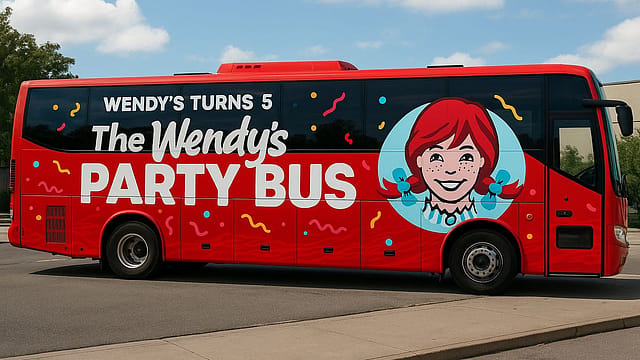
A Wendy’s outlet in Bengaluru turns into a DJ floor. Lights cut through the room. Burgers keep coming. The crowd stays. In another city, a line of superbikes pulls up, riders in red, delivering orders with more theatre than necessary. In Mumbai, a bus rolls through the streets—lit, loud, unmistakable. Inside, music. Food. People who didn’t just order Wendy’s, but chose to spend time with it. Events sold out. Curiosity pulled the crowd. “Samajh nahi aaya, log teen ghante naach rahe the (“I couldn’t believe it, people danced for three hours),” admits Grover. The stores turned into stages.
Another reason why Wendy’s worked lay in how it chose to scale.
“Most QSR brands in India built scale through physical presence,” says Aggarwal. High streets, malls, visibility. Wendy’s flipped that. It built presence first where decisions are made—on screens. The physical layer came later. “That’s a very different playbook, and in today’s market, a far more efficient one,” she adds.
Underneath the noise, the system held. New flavours kept coming. Korean, Chimichurri, Teriyaki. Packaging evolved for delivery, crispness held longer, and heat travelled better. The loop settled in. Each layer fed the next. Product drove orders. Orders built scale. Scale opened room to experiment. And the voice made sure people noticed.
Fast forward to 2026.
Scale had kicked in. The system has held. The brand is visible. Wendy’s India had turned into a ₹200-crore business. Revenue has grown nearly fivefold in three years, and now it has 215 stores in five years. A brand that once struggled to open four outlets now moved across 60-plus cities, adding kitchens and formats as it went.
And the next phase is already underway—pushing deeper into tier II and III cities, opening more cloud kitchens, and adding physical formats to match the digital scale.
Now the question has quietly shifted: Could this hold? Everything that got Wendy’s here—speed, experimentation, a loud voice—comes with a trade-off. Consistency gets harder, control gets thinner, and the margin for error shrinks.
And the playbook starts to get tested.
While cloud kitchens can scale fast, they can also blur the experience. A brand built on delivery has to work harder to feel real, not just available. The same system that unlocked reach can dilute recall if it slips.
The voice has its own edge. Sharp works. Until it doesn’t. Roasting builds attention. It can also burn bridges. The line moves fast. Even the product has to keep up. Flavour drove the first wave. It has to keep refreshing. What feels new today can turn familiar quickly in a market that cycles fast and eats often.
Grover doesn’t overcomplicate it. “You eat ninety times a month. You won’t choose me every time,” he says. People switch. They come back. That’s the game. Stay in the rotation. Stay relevant. Stay worth coming back to.
But the real test begins now.
As Wendy’s moves deeper into Bharat, the question shifts to value. McDonald’s cracked India by owning affordability. Wendy’s has built flavour, voice, and recall. “The next layer is making that accessible without losing what makes it distinctive,” says Aggarwal.
Wendy’s, however, won’t win by going quiet.
On Instagram and LinkedIn, the redhead rarely misses a chance to jump into trending conversations—cracking jokes, nudging rivals, and turning comment sections into a roast arena. McDonald’s ice cream jokes. Burger King digs. Creator threads. Nothing is off-limits.
Not every shot lands. But enough do. That’s fine. Wendy’s never whispered. She roasted. And she’s not done yet.