From Pizza to Police: Inside the Quiet Rise of Roadcast
If they had stuck to their first idea, Roadcast would not exist.
The app worked. But there was a small problem. No one needed it.
Back in 2015, the three founders weren’t thinking about fleets or logistics or safety systems. They were trying to solve something far smaller—and far more familiar: staying connected on the road.
The idea came from experience. Long drives with extended family. Multiple cars moving together. And at some point, almost inevitably, the convoy would break. One car would slow down. Another would take a wrong turn. Someone would stop without telling the others. Calls would follow. Confusion would build.
“There was always this problem,” recalls Rahul Mehra. “When large groups travel together, someone takes a left, someone takes a right—and you lose coordination.”
The Modi Years
02 Oct 2026 - Vol 05 | Issue 40
A Nation Rebuilt
It sounds trivial. But it wasn’t.
There was no easy way to know where everyone was. No simple way to stay connected without constant calls and guesswork.
So, the trio decided to build one.
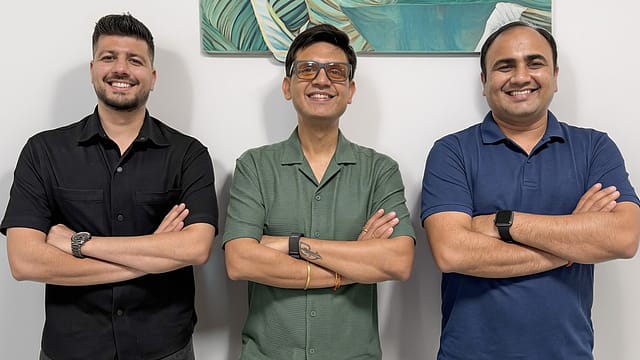
Vishal Jain, who had spent over a decade in advertising, teamed up with Anshul Jain from an IT background and Rahul Mehra, a designer who had worked at Ogilvy. They had different skill sets, but were bound by a similar restlessness—corporate life was stable, predictable, and no longer enough.
The idea they landed on was simple: a real-time location-sharing app that would let people track each other on the move. They called it Roadcast.
The First Pivot: From Failed Consumer App to B2B Logistics
The early days followed a familiar script. Work happened alongside their jobs, salaries funded development and nights and weekends disappeared into building the product. There was no external capital, no large team, and no safety net. Just time, effort, and the quiet belief that this could work.
And technically, it did. The app was fast, accurate, and reliable. It delivered real-time tracking in a way that few products at the time could match. But a working product is not the same as a working business. Downloads came slowly. A few thousand users at best. They tried pushing it through events, outreach, and word of mouth. Nothing really clicked. The app didn’t spread. It didn’t become a habit. It didn’t become essential.
For a consumer product, that’s where things begin to unravel. “We were trying to build it as a social platform,” recounts Mehra. “But getting people to adopt something like that it was very difficult.”
They waited for a spike. It never came. Seven or eight months in, the conclusion was hard to avoid. The idea wasn’t taking off. What they had built was functional. It just wasn’t needed.
That should have been the end. It wasn’t. Because one thing was working: Technology. The core tracking engine was strong—real-time, precise, reliable. It could do far more than what the current use case demanded. But the problem wasn’t capability. The issue was with the direction.
So, they began looking elsewhere.
Around the same time, a different shift was quietly taking shape. Grocery startups were emerging. Restaurants were beginning to experiment with deliveries. Logistics—especially last-mile—was starting to look like a problem worth solving. Tracking, they realised, wasn’t just a consumer need. It could be a business one. “Someone told us—your tech is good, why don’t you try this in B2B?” Mehra recounts. “Delivery companies might actually need it.”
It was a simple suggestion but it changed the course of the company. The pivot began gradually. Conversations first and then small pilots. A few early customers came in—restaurants and delivery-led businesses trying to make sense of their own operations.
For the first time, there was traction. And it was enough to push them to the next decision. This could no longer be a side project. One by one, the founders stepped away from their jobs. Roadcast was now the main thing.
The early signs were encouraging.
Restaurants came on board. Delivery-led businesses began using the product to track their riders, manage routes, and bring some order to what was still a largely unstructured backend. For a young company that had just pivoted, it felt like validation.
Within months, Roadcast had built a small but growing base of customers.
From Early Rejection to Market Collapse: The Pivot That Changed Roadcast
It wasn’t scale yet. But it gave them direction and there was enough belief to aim higher.
The founders began pitching to larger brands—companies with bigger fleets, more complex operations, and the kind of scale that could define the next phase of growth. One of those pitches was to Domino’s Pizza.
It didn’t go as planned. “We had gone to them very early,” Mehra recalls. But there was one problem. They were quite candid and Roadcast was too small. Managing something like the fleet of Domino's would have been difficult. Roadcast wasn’t ready. The meeting ended. The answer was no. They walked out with little more than a reminder of how far they still had to go.
And yet, the business kept moving. More restaurant clients came in. The product kept improving. For a brief stretch, it looked like the pivot had worked.
Then the market shifted. By late 2016, platforms like Zomato and Swiggy began scaling aggressively, not just as aggregators, but as full-stack delivery companies. They were moving beyond connecting restaurants to customers, building their own fleets in the process.
For restaurants, the shift was immediate. Why manage deliveries in-house when someone else could handle it—faster, cheaper, at scale? Result? Outsourcing replaced ownership. And with that, the need for tools like Roadcast’s—at least in that segment—began to shrink. There were fewer riders to track, fewer clients to serve, and the revenue dropped. “It happened very quickly,” Mehra recounts. This was a structural decline. The very market that had given Roadcast its first real traction was being rewritten in real time.
And once again, they were on the wrong side of it. They had a working product, paying customers and a clear use case. And yet, the ground beneath them was shifting again. There’s a point in every startup’s journey where the problem isn’t effort or execution. It's direction. This was that point. They could keep pushing, stretch whatever remained of the market, and hope it stabilised. Or they could step back, and rethink—again.
The question had shifted from whether they could build to whether they were building the right thing.
The answer lay in something they had been overlooking: Vehicles.
Until then, Roadcast had been tracking people—delivery riders through their phones. It worked, but it came with limitations. Phones could be switched off. Apps could be ignored. Data could drop.
At scale, it wasn’t reliable enough.
At the same time, a much larger layer of the logistics ecosystem was still untouched—vehicles themselves. Bikes, trucks, fleets moving across cities and highways, largely untracked, unmanaged, and opaque. That’s where they turned. Instead of relying on mobile apps, Roadcast began integrating with GPS hardware—physical devices installed directly into vehicles.
The White-Label Bet That Drove Distribution
The shift sounds incremental. In reality, it changed everything.
Now, tracking didn’t depend on user behaviour. It became continuous, system-driven, and far more dependable. The use case expanded overnight: From delivery executives to entire fleets.
“We realised tracking through phones had its limits,” says Mehra. If the phone is off, you lose everything. With vehicles, the problem becomes very different and much bigger.
The pivot pulled them into a new world of logistics, transportation, enterprise clients, larger contracts, and longer sales cycles. The product had to evolve quickly. It wasn’t just about location anymore. Businesses wanted visibility, analytics, control—tools that could help them manage operations, not just observe them.
Roadcast adapted. And then came a decision that could have gone either way. Competitors—many of them GPS hardware providers—began reaching out. And it was not to compete, but to collaborate. They wanted to use Roadcast’s software, rebrand it, and offer it to their own customers. In short, it was White-labelling.
For most startups, this is a hesitation point. You risk losing brand visibility. You risk becoming invisible. Roadcast took the call. “If they’re already in the market, why not make them our customers?” Mehra says. “Instead of competing with everyone, we could grow through them,” he adds.
It worked. Within a couple of years, hundreds of enterprises were using Roadcast’s platform—some directly, many indirectly. The company wasn’t just selling to end clients anymore. It was becoming part of the ecosystem itself.
Growth wasn’t explosive yet. But it was steady, layered, and compounding. The business had stabilised. For the first time, it felt like the worst might be behind them.
And then came a turning point. In March 2020, India was hit by Covid.
For most businesses, it was disruption. For Roadcast, it triggered a surge. Logistics became critical infrastructure overnight. Movement had to be tracked, monitored, and controlled. Fleets needed visibility and accountability. And then there were the clients who never stopped: police, ambulances, and other essential services. “During Covid, while a lot of businesses were slowing down, ours kept running,” says Mehra.
The effect was immediate. While others were cutting costs, Roadcast kept its operations intact. Salaries continued. The system held. The same infrastructure they had built through years of pivots was now at the centre of a rapidly expanding need. The market, too, was shifting in their favour. As the government tightened norms around fleet tracking, compliance became a driver. At the same time, a broader shift was underway—away from Chinese software platforms towards domestic solutions.
Roadcast was well positioned. As the lockdowns eased, inbound demand picked up. Companies that had never considered structured tracking systems were now actively looking for them.
Full Circle: From Domino’s Rejection to Investor, and the Road Ahead
Growth followed. Seven years after that early meeting, Roadcast went back to Domino’s Pizza. This time, though, the conversation was different, the product was stronger, and the company had scale.
In 2022, Domino’s—through Jubilant FoodWorks—came on board as an investor. The same company that had once seen them as too small was now backing them.
This moment was a marker in Roadcast's journey. The company had spent years adjusting direction, reworking its product, and rebuilding its market. This investment validated the process.
Today, Roadcast is difficult to place in a single category. It tracks fleets, yes. But it also does more. The platform now sits across layers—logistics, transportation, enterprise mobility, and increasingly, and road safety. From dashcams and driver behaviour analytics to fatigue detection and real-time alerts, Roadcast has expanded into systems that can even prevent drunk driving by disabling vehicles.
The use cases have expanded far beyond what the founders had imagined in 2015: From food delivery and law enforcement to private enterprises and government systems. “From khane to thane (food to police station),” Mehra jokes, almost summing it up in one line. The phrase lands because it’s true. Roadcast sits beneath these systems, quietly powering everything in between.
And it shows in the numbers. Revenue from operations has climbed from just ₹13 lakh in FY16 to ₹3.9 crore in FY20, and further to ₹26.3 crore by FY25-a nearly 7x increase over the last five years. The growth has been steady, built through pivots, product depth, and a largely bootstrapped approach in a market where rivals scaled on venture capital.
What worked for Roadcast was less about loud marketing and more about where it chose to play, reckon marketing experts.
"The company didn’t try to create demand. It followed it," says Ashita Aggarwal, professor of marketing at SP Jain Institute of Management & Research. From moving away from a consumer app to solving for delivery fleets, and then shifting again as the market evolved, each pivot placed it closer to real, paying use cases.
Its sharp B2B positioning—focused on clear utility like tracking and fleet visibility—kept the value proposition simple and easy to sell. “The bigger unlock, however, came from distribution,” says Aggarwal. By white-labelling its software and working with hardware partners, Roadcast scaled reach without building a large sales engine, effectively turning parts of the ecosystem into its own channel.
The ambition now is larger. ₹100 crore is within sight, with plans to scale further and eventually go public over the next few years.
The next phase, however, will test a different muscle.
That approach, though, comes with its own set of challenges. Operating quietly beneath larger systems has meant limited brand recall, especially in a market where well-funded competitors have invested heavily in visibility and category-building. As the company moves up the value chain—towards enterprise contracts, government scale, and road safety solutions—the need for sharper narrative ownership becomes harder to ignore. “It is no longer just about tracking fleets, but about defining what it stands for in a crowded market,” says Aggarwal.
The next phase of growth will likely depend not just on product depth, but on whether Roadcast can step out from behind the system it powers and claim a clearer space in front of it.
Even as that question plays out, the company’s focus is already shifting elsewhere. The bigger bet sits on road safety. India’s roads are among the most dangerous in the world. For Roadcast, the next phase is about preventing mistakes using AI, data, and the infrastructure they’ve already built. “If we can actually reduce accidents, even by a small percentage, that’s a big impact,” says Mehra.
A decade ago, Roadcast began with a small problem on the road. Today, it sits at the centre of a much larger one.
The journey between the two hasn’t been straight. It was never meant to be. Roadcast is still doing what it has always done: adjusting, recalibrating, and moving forward.