Amazon, Escape Plan, and a Founder Who Doesn’t Fear Failure but Questions What’s Next
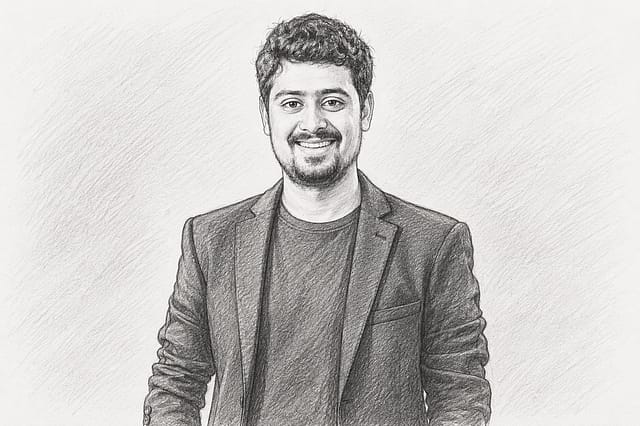
Have you ever failed in your life?
It’s a simple question. The kind most founders tend to deflect, soften, or reframe into something more palatable.
Abhinav Pathak doesn’t.
There’s no visible hesitation. No attempt to reword it into a “learning” or a “phase.” If anything, he leans into it. “Oh, multiple times.”
The answer comes quickly. Almost too quickly. “I have failed many times,” he says. “I have failed so much that now I am not scared of failure.” Pathak doesn’t pause there. Doesn’t circle back. Doesn’t try to extract meaning from it.
For him, failure is a fact. Most founders don’t say this out loud. Failure, in the startup world, is usually dressed up, repackaged as insight, and reframed as progress. It’s rarely left raw.
Zeroing In on ECI
09 Oct 2026 - Vol 05 | Issue 41
Constitutional legitimacy versus political opportunism
Pathak doesn’t do that. There is no attempt to make it sound better than it was. No urgency to extract a lesson. That tells you something about how he processes things. He doesn’t need failure to justify itself. And when you push him a little further—when you ask what actually worries him now—he doesn’t talk about failure at all.
“I fear relevance.”
This time, the tone changes. Not because the answer is dramatic. But because it isn’t. It comes out flat. Certain. Almost like a conclusion he has already arrived at.
From the outside, this shouldn’t make sense.
He sold his first venture, Perpule, to Amazon in a deal valued at over ₹100 crore. His second is scaling fast, pushing toward a ₹400 crore annualised run rate. The numbers are moving. The system is holding.
But Pathak isn’t looking at the numbers. He’s watching what they might be doing to him. That instinct didn’t come naturally. It had to be learned.
IIT Failure, Hard Reset, and the First Pattern That Shaped Pathak
The first time failure hit him, it didn’t look like this. There was no calm. No detachment. No sense of perspective.
It broke him.
In 2010–11, preparing for the IIT entrance, Pathak was doing everything right. Batch topper. Consistent scores. The kind of student who expects outcomes to follow effort.
They didn’t.
He missed the rank he needed for the branch he wanted. Not by much. Ten, twenty marks, maybe. The kind of gap that feels small on paper and enormous when you’ve spent years working toward it. “You cry, you break,” he says.
At that age, there’s no buffer. No way to rationalise it. You’ve put in the work, and the result doesn’t match. That’s all there is. What makes that phase difficult isn’t just the result. It’s the collapse of a belief. That effort guarantees outcome. That if you do things right, things will work out.
When that breaks early, it leaves a mark. And it’s not in the form of doubt. But in the form of recalibration. It took him months to recover. He moved on to NIT Surathkal. Still a strong outcome but just not the one he had planned for.
And then, within weeks, came another realisation. He had chosen Mechanical Engineering. It wasn’t where the future was. Within 30 days, he knew. Computer science opened doors. Mechanical didn’t. The gap was structural.
But this time, there was no reset. No branch change. No second shot. He was stuck. That’s where something shifted. “The biggest learning from that phase was that there is always a way,” he says.
That learning came from friction. Companies like Goldman Sachs weren’t hiring from his stream. The filter was clear. He didn’t accept it. He argued with the placement cell. He wrote emails. Followed up. Pushed until the rule bent. I’m good enough, let me fail your test,” he argued. “But don’t stop me from applying,” he appealed.
It wasn’t a one-off ask. It took persistence. Enough of it that the rule eventually bent. He got the test, cleared it, and landed the job. Outcome secured but the path was far messier than planned.
That pattern would repeat: Build, exit, and detach.
Abhinav Pathak: Perpule, Amazon Exit, and Lessons in Building at Scale
The first company came from what he had seen up close. Self-checkout systems in the US. A simple idea, layered with a technology lens. At that stage, the thinking was still narrow and shaped by what he had been exposed to, what he understood, what felt within reach. “You have seen very small parts of the world,” he says. “Your dimensions of thinking are also very limited.”
So, Pathak built within those limits. In 2016, Perpule started small. A cloud-based point-of-sale system for offline retailers—electronics, fashion, food, groceries. It sat quietly in the background, helping stores run better, faster, more efficiently. Perpule worked. The company scaled. Clients came in. The system found its place in a market that was just beginning to digitise.
What looked like momentum was, in reality, still iteration. By 2021, the outcome was clear enough. Amazon came in with an acquisition offer, and Pathak sold out.
For many founders, this is where things get complicated. The first company. The first real build. Years of work condensed into a single decision.
But Pathak didn’t see it that way. “I have never been so emotional about business,” he says.
He pauses. “The business is bigger than me, and I am bigger than the business.” Then adds, almost as a correction: “This is not my life.”
That kind of detachment is unusual, especially the first time. Most founders negotiate with themselves before they negotiate with a buyer. They stretch timelines. They look for reasons to hold on. Pathak doesn’t seem to do that. For him, the business is an outcome. Not an identity. That distinction sounds simple. It rarely is.
The decision followed. If someone else could take the outcome further—faster—there was no reason to hold on. So, he didn’t. He sold. Clean. No drama. No attachment. And then, just as cleanly, a reset.
Inside Amazon, the lens widened.
Scale is no longer abstract. It’s visible. Systems, processes, distribution—operating at a level most early founders don’t get to see from the inside. For Pathak, it becomes less about what to build, and more about how things actually work when they get big. “I’ve seen both spectrums,” he says. On one end was the early chaos of building from scratch, and on the other end was the discipline of operating at scale.
That contrast shaped how he thinks on four levels. First, it’s always less instinct and more systems. Second, less excitement and more filters. Third, not every idea deserves to be pursued. Fourth, not every opportunity deserves a yes.
That shift didn’t just change what he wanted to build. It changed how he would choose. “We get excited by new ideas very quickly,” he says. “The hardest thing is to say no.” He says it like a correction. “You may have 10 good ideas. Only one will give you the real outcome.” That filter—what to pursue, what to drop—became sharper with experience.
So did how he thinks about people. “You may be Einstein or Elon Musk,” he says. But if you don’t have a team that can think, execute, and move at your speed, you don’t have a chance. What Pathak means is alignment. Because ideas don’t break companies. Execution does. That’s a lesson he learned the hard way. “We trusted too many partners,” he says. “India mein sab bolte hain ‘ho jayega.’ But execution is different.”
Scaling Fast, Questioning Everything, and Living with What Comes Next
The gap between intent and delivery is where most things fall apart. “Everyone will say yes,” he says. “Who will actually deliver is very hard to identify.” That’s where the shift becomes visible.
So, when Pathak decided to build again, he didn’t rush. He waited. For nearly two years, there was no company. No launch. No visible move. Just observation. He studied what scaled. And more importantly, what didn’t. Patterns began to emerge about products and outcomes: What holds, what breaks, and what lasts. That became the lens he would carry forward.
The new company—Escape Plan—moved fast. Within weeks, the system stabilised. Within months, it began to scale.
Capital followed. Earlier this year, it raised $25 million in a Series A round led by Jungle Ventures, with participation from Fireside Ventures and IndiGo Ventures. The Bengaluru-based startup had previously raised $5 million, also led by Jungle Ventures.
The growth showed up just as quickly. By the end of its first full year, it was doing roughly ₹175 crore in revenue, with an annualised run rate pushing toward ₹400 crore. Losses were contained.
What looked clean on paper was still a work in progress inside. Because the speed was engineered. “If the variance was 100%, we would be scared,” he says. “But this is within range. There is a method to the madness.”
A year into his second venture, the numbers are moving. But that’s not what Pathak is watching. “I fear relevance,” he says again.
Read that closely. He isn’t talking about failure. Not competition. Not even speed. But relevance. It’s an odd thing to worry about at this stage. Most founders here are still chasing it—trying to get noticed, trying to prove something works.
Pathak is already thinking about what happens after. Why? Because relevance, once achieved, has a tendency to turn into comfort. And comfort, over time, starts to look like certainty. That’s where mistakes begin to compound. Quietly. Not because the market changed. But because the founder stopped questioning himself.
But even that isn’t what occupies him most. “What I am scared of,” he says, “is that after a point we will tap out the market.” He says it like a number. “Once we cross ₹2,500 crore, growth will slow down to 10–12%. That is natural.”
There’s no panic in it. Just acceptance.
And it’s a different kind of fear. Not of failure. Not of things breaking. But of things slowing down. Predictably. Of knowing, in advance, where the limits might be. And still having to build toward them. That’s the part entrepreneurship doesn’t prepare you for. The uncertainty at the start is obvious. The certainty at scale is harder to deal with.
But it’s still fear. Of the known. Of the unknown. And of the moment when both begin to look the same.