Khan Chacha 3.0: Inside Sidhant Kalra’s Bet to Rebuild a Cult Brand
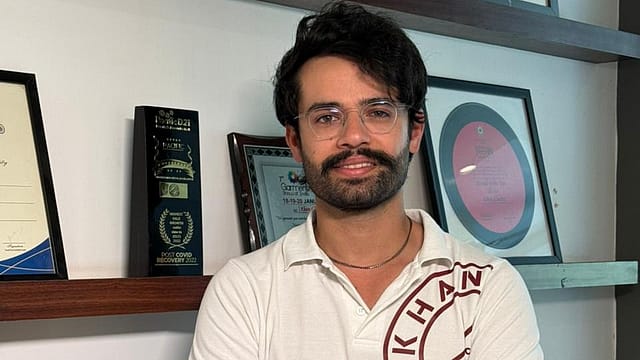
He didn’t take the big swing.
When Sidhant Kalra stepped into Khan Chacha in the middle of 2020, the obvious move was to push harder—open more stores, chase visibility, and grow out of trouble. That’s how most brands play a bad patch.
Kalra went the other way. He started by shutting stores.
The timing couldn’t have been worse. Covid had already hit footfalls. Revenues had slipped to around ₹15 crore. Costs hadn’t. Inside the business, things were beginning to fray—inventory piling up, processes loose, and decisions delayed. The food wasn’t the problem. Everything else was.
And this wasn’t just another QSR.
The Modi Years
02 Oct 2026 - Vol 05 | Issue 40
A Nation Rebuilt
Khan Chacha had been part of Delhi’s food memory for nearly five decades—born as a small stall in Khan Market in 1972, growing into a cult name for kathi rolls and kebabs that defined late nights, college runs, and quick office lunches. Over time, it had moved from street corner to structured chain, without losing the familiarity that made people come back.
That familiarity can be deceptive.
By the time Kalra walked in, the brand still had recall. What it didn’t have was control.
The young entrepreneur didn’t try to fix it by adding more. He cut first. A couple of outlets went. Then a couple more. Locations that didn’t make sense. Stores where the math didn’t hold. It was a slow, deliberate reset—less about expansion, more about survival. At the time, Khan Chacha was a roughly 10-outlet business, concentrated across Delhi and Gurgaon—large enough to carry recall, but still tightly local in its footprint.
Siddhant Kalra’s Journey: From Golf to Rebuilding Khan Chacha
Kalra wasn’t supposed to be here this early. At 16, he wanted to be a professional golfer. He went on to study at St. Andrews in Scotland, drawn as much by the sport as by the degree. After graduating, he drifted briefly to Mumbai, trying his hand at acting—another young man testing a different fairway.
He doesn’t quite come across like someone trying to run a multi-outlet food chain.
In a white polo, sleeves easy, stance relaxed, Kalra carries the air of someone more at home on a golf course than in a boardroom. There’s a certain lightness to him—the way he speaks, the way he listens, the way he moves through a conversation without urgency. The moustache, the glasses, the old-school touches sit lightly on him. But the decisions he describes don’t match that ease. They’re measured, deliberate, almost stubborn—like someone choosing shots carefully instead of swinging blind.

Around him, the Khan Chacha outlet at the upscale Khan Market in Delhi reflects a similar clarity. The walls speak in Hindi. The messaging is blunt—no fillers, no shortcuts, no compromise on meat. It’s not built to impress. It’s built to say one thing clearly: the product matters.
Covid cut that short.
Back in Delhi, the family business needed attention. His father had already acquired and stabilised Khan Chacha after buying out partners in 2019. What Kalra inherited wasn’t a blank canvas. It was a brand with weight—and a business that needed tightening.
In golf, the temptation is always the same: go for distance. But Kalra chose control. And then he began rebuilding, one decision at a time.
The first few months weren’t about growth. They were about figuring out what was broken.
Kalra went to the base kitchen. Not for a day or two. For months. He watched inventory come in and sit. He saw stock expire. He noticed how loosely things were tracked, how easily money slipped through small gaps—over-ordering here, wastage there, no one really accountable for either. “There was a lot of mismanagement,” he says. “A lot of things no one was looking at closely.” In one instance, cartons of soft drinks had simply expired in storage—dead inventory in a business where margins were already thin. It wasn’t a one-off. It was a pattern.
The more he looked, the clearer it became: the issue wasn’t demand. It was discipline.
How Siddhant Kalra Rebuilt Khan Chacha’s Operations
So, he started building it. Every outlet got its own P&L. Every cost, tracked. Every vendor, questioned. Nothing was too small to fix. “My team’s mindset now is—ek paisa nahi chhodna (don’t leave even a rupee on the table),” he says.
Sounds simple. It isn’t.
Khan Chacha had grown over the years on the strength of its product and recall. Systems had come later, unevenly. Kalra flipped that order. Before adding anything new, he wanted the foundation to hold.
The next move was financial. The business was carrying debt to keep operations running and salaries paid. Kalra didn’t want that hanging over the company.
Over the next year, the focus stayed narrow: clear the debt, stabilise cash flows, build a buffer. No shortcuts. No outside capital. Just internal discipline.
By the time that phase ended, the business looked different. Leaner. Tighter. More predictable.
Only then did he turn to growth. But even that came with conditions. He wasn’t going to open stores for the sake of visibility. Not every location made sense. Not every shiny new mall was worth entering. In fact, he began saying no more often than yes. Developers pitched aggressively—low capex, easy entry, quick expansion. The logic was tempting: scale fast, capture presence.
Kalra pushed back. “Capex de denge, but if the outlet doesn’t do sales, what’s the point?” he says. “I don’t want a board somewhere just for the sake of it.” He had seen enough to know how that story ends—high rents, weak footfalls, eventual shutdowns.
So, he walked away.
The same thinking shaped his stance on franchising. At one point, an offer came in: a master franchise deal, with a plan to open 100–150 outlets across India. It was the kind of opportunity most brands chase.
Kalra didn’t even get to the numbers. His first question was simpler: how would they maintain consistency? In a business built on taste, that wasn’t negotiable. “You can’t have 150 people cooking and expect the same product everywhere,” he says. “It doesn’t work like that.”
He had seen it happen with other legacy brands—rapid expansion, diluted experience, and eventually, a loss of trust. So, he said no. In a market where scale is often the headline, Kalra was writing a different playbook—one that moved slower, asked harder questions, and refused easy wins.
Back in the kitchen, the changes were more visible. Not in the recipes. Those, he left alone. “You can’t touch what’s already working,” he says. The chicken tikka—the brand’s biggest seller—continued as is. So did the kakori kebabs, the paneer tikka, the core that brought people in.
Building the Score, One Shot at a Time at Khan Chacha
Instead, he worked around it.
Packaging was redesigned. Delivery—once an afterthought—became central. Before Covid, online orders made up roughly a quarter of the business. That number climbed steadily, now approaching half.
Processes were digitised. Store managers logged daily checklists with photo proof—cleaning, prep, staff readiness. Attendance moved from registers to face-recognition systems. A data team was built—not common for a 20-odd outlet chain—to predict demand, manage peak hours, and reduce wastage.
It was less visible than a new menu. Far more important. Because for Kalra, the goal wasn’t to make Khan Chacha look different. It was to make it run differently.
And slowly, the numbers began to reflect that shift. From ₹15 crore in 2020, revenues climbed to ₹43 crore by 2025–26. Across outlets, the brand now sells roughly 2,000 to 2,500 rolls a day. Today, Khan Chacha operates over 20 outlets, still anchored in Delhi NCR, with a measured expansion into North Indian markets like Punjab.
Growth came. Just not the way most people expect.
In golf, there’s a reason players don’t swing for distance on every shot. Sometimes, the smarter play is to hold back—place the ball carefully, build the hole one stroke at a time, and trust that the score will follow. Kalra seems to understand that instinctively. He isn’t chasing the longest drive. He’s playing for control.
But rebuilding the business was only half the job. The harder question was: what should Khan Chacha become?
For years, the answer had been simple: Rolls. Walk into any outlet, and that’s what most people ordered. Chicken tikka, paneer tikka, kakori—wrapped, quick, familiar. The kind of food you didn’t overthink.
Kalra didn’t want to change that. He wanted to expand it. “People come to us for rolls, and that will always be our core,” he says. “But we also know food. That’s what I want the brand to stand for.”
That meant pushing the edges without disturbing the centre.
New items came in, but carefully. A spicier peri peri tikka roll. New soya variants for vegetarians. Biryanis that had always existed on the menu, but were never really pushed. Even butter chicken—reworked after Kalra personally tried dozens across the city, breaking down what worked and what didn’t. “I must have had 40–50 butter chickens,” he says. “I liked something in each of them, but I didn’t love one fully.”
So, he built his own. Picked the smokiness from one, the balance from another, adjusted the sweetness, and reworked the gravy until it felt right. The kind of dish that didn’t just sit on the menu, but could hold its own. It was calibration, quiet and deliberate.
The Real Test: Can Khan Chacha Scale?
The same thinking showed up in the brand itself. A visual refresh came in—a stamp-like logo, a Hindi wordmark—to reconnect with its roots without feeling dated. Stores began to change format. Some larger, dine-in heavy. Others compact, high-efficiency spaces that could run out of 100–150 square feet.
The idea was flexibility. Not every location needed the same play. And that’s where Kalra saw his real advantage. “We can operate out of 100 square feet and still do serious numbers,” says Kalra. “That’s our strength.” In a market obsessed with size, he was learning to play small and win.
Expansion, when it came, followed a similar logic. The first moves were into culturally adjacent markets like Punjab, where familiarity with Delhi’s food brands already existed—before testing more distant markets.
What also works in Khan Chacha’s favour is something most new-age brands struggle to build: memory. In Delhi, the name doesn’t need explaining. It carries its own shorthand—late nights, quick bites, familiar orders repeated without thinking. That kind of recall is hard to manufacture, and even harder to sustain. “The ambition is to take Khan Chacha beyond Delhi. “Eventually, we want to build it into a pan-India brand,” says Kalra.
For Ashita Aggarwal, that’s where the brand’s real advantage lies, and its biggest test.
“Khan Chacha already has cultural recall,” says Aggarwal, professor of marketing at SP Jain Institute of Management & Research. People know what to expect. “The challenge is staying relevant without losing what made it iconic in the first place,” she reckons.
That balancing act is visible in how Kalra is shaping the brand. The changes aren’t loud. There’s no attempt to dramatically reposition or chase trends. Instead, the focus has been on tightening consistency, improving experience, and expanding the occasions in which consumers engage with the brand—moving it from a quick roll stop to a broader, everyday food choice.
But that strategy comes with its own set of risks.
“The moment you step outside your core market, nostalgia stops working as a moat,” notes Aggarwal. In a new city, you’re just another brand on an app. What brings people back is consistency. "And that’s where most legacy food brands struggle when they scale,” she says.
It’s a challenge Kalra is acutely aware of.
Part of the reason he has resisted franchising and aggressive expansion is precisely this—control. In a category where taste can shift with the slightest variation, scaling without dilution is harder than it looks. And that’s the gap Kalra is trying to bridge—taking a deeply local brand and making it travel without losing what made it work in the first place.
The brand has already had to defend that identity.
In 2023, Khan Chacha approached the Delhi High Court against multiple eateries using variations of its name. The court restrained 24 food businesses from using the “Khan Chacha” trademark and directed food delivery platforms to delist them. It was a reminder of how widely the name had travelled—and how easily it could be diluted.
For Kalra, that risk isn’t theoretical. It’s the line he’s trying not to cross. Because the ambition, clearly, goes beyond Delhi. There is still a visible gap in the market—a premium, consistent, scalable Indian QSR brand that can travel across cities without losing its core. Plenty have tried. Few have managed to hold quality at scale.
Kalra believes Khan Chacha can. The ambition is clear: build Khan Chacha into a pan-India brand. But not by rushing it. Growth, in his view, has to be earned—outlet by outlet, system by system, decision by decision. The pace may look slower from the outside. Inside, it’s deliberate.
In golf, not every hole is won with a long drive. Some are built on placement—reading the course, avoiding risk, and trusting that patience will show up on the scorecard. Kalra is playing that kind of game. The bet is simple. Hold long enough, and it scales. When it does, the brand will still taste the same.