Bata's Long Walk Back to Cool
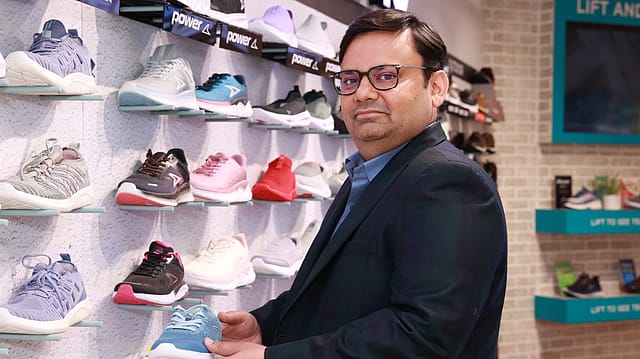
For a brand that once had a near-monopoly on the Indian foot, Bata has spent the last decade doing something unusual: trying to forget what made it famous.
“Bata’s problem is really its perception among customers,” said Ashita Aggarwal, Professor of Marketing at SP Jain Institute of Management & Research.
The school shoe. The formal black lace-up. The white canvas sneaker handed to generations of Indian children with a uniformity that was less fashion and more infrastructure. Bata didn't need to be aspirational because it was simply everywhere — in every town, at every price point, in every family's memory. That ubiquity, for decades, was the brand, but it also fixed the company in consumers’ minds as a functional, everyday label rather than an aspirational one, as Aggarwal suggests.
The Modi Years
02 Oct 2026 - Vol 05 | Issue 40
A Nation Rebuilt
But ubiquity, it turns out, has a shelf life.
The Middle-Age Problem
Today, Bata India's financials tell the story of a company caught between what it was and what it needs to become — and the numbers are sobering. According to Bata India's Annual Report for FY2024-25, revenue from operations for the year stood at ₹3,488 crore — against ₹3,478 crore the previous year, registering a growth of just 0.28%. Net profit came in at ₹328 crore, up from ₹260 crore in FY24, but that improvement was significantly inflated by a one-time exceptional gain of ₹134 crore from the sale of a closed manufacturing unit. Strip that out, and the operating profit margin actually slipped — from 14.7% in FY24 to 12.3% in FY25, per the same report's key financial ratios table. EBITDA margin contracted from 22.52% to 21.07%.
The Annual Report is candid about why. The company "witnessed sluggish demand that carried forward from the previous year," with discretionary consumer spending remaining "majorly subdued during the year under review, further accentuated due to the elections and extreme heat wave." Demand recovery came only in the second half, led not by premium products but by "value segments as retailers registered higher sales of low-priced items," underscoring how the brand continues to see traction in more functional, price-led categories.
The challenge isn't just macroeconomic. Over time, Bata has increasingly come to be associated with school shoes and basic everyday footwear — a narrowing of brand identity that, as Aggarwal points out, makes it harder to stretch into aspirational categories. Even within that core segment, the ground has shifted. Sneakers have entered school and casual use, with brands like Puma and Liberty’s Force 10 competing directly where Bata once dominated.
Young adults and first-time jobbers increasingly chose brands like Puma, Adidas, Nike and D2C sneaker startups — brands that moved faster on design, colour, and trends, while Bata remained more strongly associated with practicality than self-expression. The result: a brand caught in the middle, no longer dominant in value, and not yet aspirational enough for youth.
The Annual Report itself acknowledges as much, noting that "continuous evolution of the product portfolio mix is required to maintain relevance of Bata Brand amongst Millennials and the Gen Z."
Rewriting the Memory
In conversation with OPEN Digital, Badri Beriwal, Chief Strategy and Business Development Officer at Bata India, is measured yet direct in addressing the brand’s perception problem. “Our average consumer age is around 32 years, which means we cater to both younger and older audiences,” he says. He also pushes back against the school-shoe stereotype with a striking statistic: “Over 90% of our sales come from non-school categories. So while the memory of school shoes persists, the business today is far more diversified.”
The reframing matters strategically. However, as Aggarwal indicates, perception tends to lag reality — consumers may see new categories in-store, but long-standing associations often continue to define how the brand is evaluated. A brand can't premiumise or casualise its way to Gen Z relevance if consumers have already categorised it. Which is why Beriwal's read of the younger consumer is precise.
"There are two very sharp trends among Gen Z. One, they are highly discerning — they want a clear reason to buy a product, whether it's quality, comfort, or premiumness. There has to be logic behind their choice. Second, they want self-expression. What they wear should reflect their personality. They are aspirational and believe anything is possible — this is the startup generation."
It's a diagnosis that shapes everything from product design to campaign language. Bata's current campaign, "Make Your Way," is built on exactly this insight. "This generation doesn't want to follow the herd; they want to do things their own way," Beriwal says. "You can see this across their career choices and brand preferences."
The Strategic Pivot
The two words Bata's leadership keeps returning to are "premiumisation" and "casualisation." The Annual Report frames this as the company's central axis: "casualisation and premiumisation of product portfolio targeting higher ASP and expansion in the market share of premium category."
In practice, this has translated into a significant product and retail overhaul across multiple fronts.
On sneakers — the category with the highest current growth — the Annual Report notes that Sneaker Studios were expanded to over 750 Bata and franchise stores during FY2024-25. The Power brand, Bata's athletic and athleisure play, is being built as a standalone entity, with the company creating "awareness about the fastest selling Power Easy Slide collection," which features a hands-free design aimed at the convenience-first consumer. Power apparel, including a light winter and fall collection, was expanded to 100+ stores.
Floatz, Bata's casual washable footwear line, crossed ₹1,000 million in sales during the year, per the Annual Report, and was expanded to 1,500+ doors. Hush Puppies, the global comfort brand in Bata's portfolio, is being repositioned for younger audiences — with comedian and actor Vir Das signed as brand ambassador. Yet, as Aggarwal notes, such sub-brands often operate in consumers’ minds as distinct from Bata itself, limiting their ability to reshape the parent brand’s perception.
Beriwal unpacks the product thinking behind the brand pivot with a sharp category insight: "One key insight is that consumers want formal-looking shoes with sneaker-like comfort. That's where hybrid footwear comes in." He also points to a category-specific win: "We introduced ballerinas in India and even hold the trademark for the term. We've now revamped them with technology-led comfort — the Victoria ballerina collection is a recent example, combining comfort, design, and fashion relevance." The ballerina range, he notes, has seen strong double-digit growth.
Distribution as Moat
If the product story is about aspiration, the distribution story is about scale — and Bata's scale remains its most formidable, and arguably most underappreciated, competitive advantage.
According to the Annual Report, the company retails through a pan-India network of 1,962 COCO and franchise stores. It crossed the milestone of 600 franchise stores for the first time in FY25, with penetration in 490+ unique towns, while the distribution channel was scaled up to 1,550+ towns. Bata now operates one of the largest omni-channel networks in India, covering 1,700+ stores for omni-channel fulfilment — with home delivery services extended to all franchise stores, contributing close to one million pairs of sales annually.
Beriwal contextualises this: "We have around 2,000 exclusive stores — one of the largest retail networks in India, spanning metros to tier-4 and tier-5 towns." And the old distinction between metro and non-metro consumers, he argues, is dissolving. The Annual Report backs this observation, noting that "rural markets outperformed urban areas driven by aspirational purchases and lower inflationary pressures."
Marketing the Reset
Perhaps the most visible transformation has been in how Bata spends its marketing money. "Over 65% of our marketing spend is now on digital, compared to earlier TV-led strategies," Beriwal says. The shift isn't just about channel — it's about architecture. "Instead of relying on one celebrity face, we work with multiple relevant influencers and emerging personalities."
The shift also reflects an attempt to move beyond legacy associations and participate more actively in contemporary culture — a necessary step for brands trying to rebuild aspiration once they have been strongly defined by utility.
The Open Question
The Annual Report, in its outlook section, is cautiously optimistic: "The ability to adapt to market conditions and evolving customer expectations and technological advancements enables your Company to position itself strongly for future growth upon consumption recovery." The qualifier — "upon consumption recovery" — is doing a lot of work in that sentence.
In retail value terms in 2025, Bata holds a 5% market share in India's footwear market, with challenger brands gaining momentum through digital-first approaches, D2C models, and rapid expansion on platforms like Myntra, Flipkart, and Amazon, as per report by Euromonitor.
Bata has survived liberalisation, labour disputes, and the rise of international sportswear giants. What it is navigating now is subtler and perhaps harder: the persistence of legacy perception. As Aggarwal frames it, brands often carry a certain baggage — and when that baggage becomes too deeply embedded, change does not come easily. The Annual Report's own risk section acknowledges that "competition from both domestic and international players, especially at the bottom of the pyramid, is increasing."
The shoes are better than they've ever been. The question is whether a generation raised on drop culture and sneaker collabs will pause long enough to notice.