Bangladesh’s Gen Z Illusion: A New, Hip Label for an Old and Deadly Prejudice
In her seminal study of totalitarianism, Hannah Arendt observed that the gravest crimes against human dignity often survive not through spectacular brutality alone, but through the gradual corrosion of language — the transformation of atrocity into “measures,” murder into “collateral,” and systemic harm into “complex political effects.” Far from the concentration camps of Reich-era Europe, the same problem persists in how violence is described, justified, and rendered thinkable in public discourse. What we call an event shapes how we apprehend it — and how we apprehend it shapes what we allow to happen next.
Violence and Its Labels
Over the past two years, Bangladesh has witnessed a sequence of violent incidents targeting religious and ethnic minorities, meticulously documented by civil society groups and human-rights monitors. According to the Bangladesh Hindu Buddhist Christian Unity Council, there were 2,442 reported incidents between August 2024 and June 2025, encompassing murders, assaults on homes and places of worship, rape, forced occupation of property, and intimidation. Of these, 27 were murders, 20 involved sexual violence, and 59 concerned attacks on places of worship in the first half of 2025 alone. Among emblematic cases, a young Hindu garment worker, Dipu Chandra Das, was brutally lynched by a mob following unverified blasphemy allegations; his body was tied to a tree and set alight.

Zeroing In on ECI
09 Oct 2026 - Vol 05 | Issue 41
Constitutional legitimacy versus political opportunism
These are not abstract statistics; they represent profound disruption — neighbours beaten, families displaced, temples desecrated, community leaders murdered. Yet the language of authorities is striking. Official police reports distinguish between incidents “political in nature” and those “communal,” concluding that the majority should be interpreted as political. While analytically convenient, such framing risks attenuating the human experience of violence, casting harm against specific communities as incidental to political contests rather than as targeted persecution.
Historical Continuities
The Bengal region has long witnessed episodic mass violence. From the communal riots of the 1940s, to the Noakhali massacres in 1946, and the atrocities of Pakistani army in 1971, populations endured murder, rape, looting, displacement, and terror. Contemporary scholarship and diplomatic language frequently referred to these atrocities as “communal tension” or “clashes,” softening the moral gravity of the events and legitimising political narratives. Language matters: to describe historical massacres euphemistically is to slacken the weight of what befell men, women, and children, and to establish a precedent for framing contemporary violence in ways that obscure its human consequences.
The Gen Z Repackaging
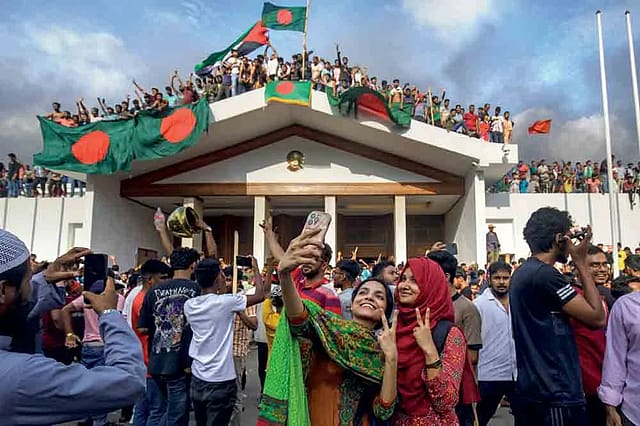
In contemporary Bangladesh, incidents of targeted violence are often described in popular media as “youth unrest,” “political mobilisation,” or “Gen Z activism.” This narrative implies an energetic, impulsive, or digitally mediated movement — casting participants as agents of social energy rather than perpetrators of tangible harm. Yet the reality is direct violence against civilians, including lynching, sexual assault, and destruction of property. The phrase “Gen Z mob” may capture demographics, but it risks reducing accountability and normalising persecution. Whether under the banner of protest, religion, or grievance, the actions remain acts of violence, and the victims remain human.

The brutal state response under Hasina government resulted in some 1,400 deaths and over 11,700 detentions. But since her ouster, only 41 former police officers, out of more than 1,000 accused, have been arrested, and no senior security official has been prosecuted. The old security apparatus remains intact, and the youth-led energy that might have pressed for accountability from the unelected Nobel laureate who has been put in charge of the country or long overdue reforms, has instead morphed into revival of old prejudices against minority communities, who have become increasingly vulnerable targets in public discourse and state-enabled mob violence.
Gandhi, Arendt, and the Framing of Violence
Language alone does not prevent violence, but it profoundly shapes how society perceives it — and what it tolerates. Gandhi, reflecting on the scale of the Second World War, offered a blunt perspective:
"What difference does it make to the dead, the orphans and the homeless, whether the mad destruction is wrought under the name of totalitarianism or in the holy name of liberty or democracy?"
Decades later, Arendt explored how ordinary actors, through routine bureaucratic or rhetorical language, could become agents of extraordinary harm. This insight resonates starkly with leading lights of the Indian and Western press regarding Bangladesh. Many uncritically carry police briefings portraying attacks on minorities not as religious prejudice, but as political reprisals against supporters of the ousted Prime Minister. In effect, lynching, arson, and sexual assault are cast as legitimate political expression or as a normalised by-product of Gen Z’s anti-corruption zeal.
Gandhi and Arendt compel us to see through such linguistic sleight of hand. The rhetoric of convenience — “political violence,” “supporter unrest,” or “Gen Z mobilisation” — conceals a moral deception: it justifies inaction, suppresses outrage, and leaves perpetrators unaccountable. For victims, it offers no comfort that terror stems not from religious prejudice, but from ideological zeal.
A Global Perspective
For those assuming that the dubious repackaging of old ills in a new “hip” avatar is unique to Gen Z or Bangladesh, nothing could be further from the truth. Half a world away, the Syrian dictator Ahmed al-Sharaa — welcomed into the White House and described by President Donald Trump as a “young, attractive guy, tough guy, strong past, very strong past — fighter” — was only a few years ago operating under a different moniker and organisational branding affiliated with Al-Qaeda, designated a terrorist group not just by the U.S., but also by the United Nations and the E.U. Al-Sharaa himself once carried a ten-million-dollar bounty on his head.
Since Syrian President Bashar al-Assad’s ouster — who, it may be worth recalling, was also battling the West’s nemesis Al-Qaeda but never earned a White House invite — al-Sharaa has traded robes for tailored Western suits and trimmed his beard. His transformation of style and rhetoric is the sort of rebranding that would make an ideal Western business-school marketing case study. The dividends have been immediate: past crimes are now forgotten like a bad date, and sanctions have been lifted by Western nations that collectively suffered over 60,000 casualties — dead or wounded — in counterterror campaigns against his former affiliate in Iraq and Afghanistan. Even leading Western media pundits have responded with enthusiasm. Before al-Sharaa had even set foot in the White House, veteran journalist Roger Cohen gushed in The New York Times that under al-Sharaa’s dictatorship “now, many Syrians … are speaking more freely and feel an immense weight has been lifted from their shoulders,” adding cheerfully that “humor, also, is making a comeback in Syria.”
Conclusion: Naming the Unnameable
The moral and intellectual imperative is urgent and unmistakable. When media and cultural elites remain silent or complicit, and politicians avert their gaze—or, worse, deploy questionable labels to justify the unjustifiable—it falls to scholars, artists, activists, citizens, and conscientious journalists to pierce the fog of convenient rhetoric and attend to the lived realities of those whose worlds have been irreparably shattered. History will not judge us by our comfort in rationalising violence; it will judge us by our courage in calling it by its proper name.
As Arendt observed, the first act of resistance is acknowledgment: human suffering cannot be softened, mitigated, or excused by ideology, rhetoric, or political convenience. Only by naming violence with clarity and honesty can society—or the international community—begin to reckon with its consequences, safeguard the vulnerable, and forestall the repetition of history’s darkest injustices. Anything else — no matter how well couched in hipster language or cutting-edge communication devices — remains vulgar and cowardly.