Between the Strait and the Sun: Energy Insecurity in an Uncertain World
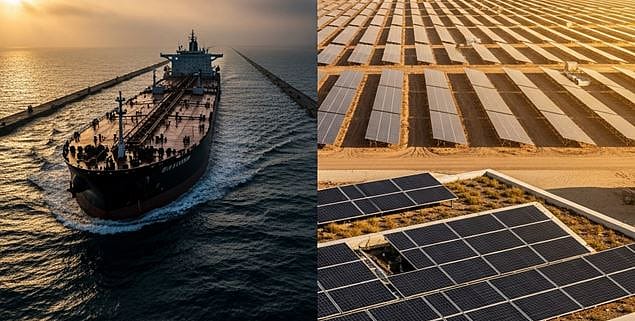
For a long time, oil corridors have shown where power lies in the world. Tankers that go through small sea channels like Hormuz, Bab el-Mandeb, and Malacca have long carried more than just gasoline; they have also carried the weight of the world economy. But today, a new energy geography is taking shape. Solar energy is quieter and can be found on roofs, in deserts, and even in fields in the countryside. But the promise of sunlight hasn't made oil any less important strategically. Recent geopolitical tensions serve as a reminder that the world remains ensnared between two energy realities.
The Strait of Hormuz is still the best example of this conflict. Almost one-fifth of the world's traded oil goes through the narrow waterway that separates Iran and Oman. Tankers from Saudi Arabia, Iraq, Kuwait, and the UAE pass through this passage every day on their way to countries in Asia that need a lot of energy. These flows are very important to India, China, Japan, and South Korea. When tensions in the Gulf rise, whether because of naval fights, sanctions, or political deadlocks, global markets react almost right away.
This flaw reveals an unsettling truth. Even though there have been years of climate agreements and progress in renewable energy, the world economy still depends on oil. Petroleum is very important to transportation systems, airline networks, the petrochemical industry, and even some parts of agriculture. The change in energy may have begun, but it is far from over.

The Liberation of Bengal
05 Jun 2026 - Vol 04 | Issue 74
A silent revolution ends the reign of fear
States' strategic imagination has changed. Many people think of solar energy as both a way to fight climate change and a way to protect themselves. Sunlight is spread out over a wide area, unlike oil, which is found in certain geological formations. Even though some countries don't have fossil fuels, they can still make electricity using solar systems. Decentralization is very appealing in a world where trade routes and supply chains can be challenged at any time.
This makes a lot of sense for countries like India. India gets more than 80% of its crude oil from other countries, mostly from the Gulf region. Every change in West Asian politics has a direct effect on the Indian economy. When oil prices go up, it causes inflation, makes budgets tighter and makes the economy less stable as a whole. Solar energy is a way to slowly lessen this weakness.
India has greatly increased its solar capacity over the past ten years by building large solar parks in states like Rajasthan and Gujarat and encouraging rooftop installations in cities. What started out as an environmental goal has become an economic necessity. Solar power does away with the need to import fuels and keeps the cost of electricity stable over time.
But the idea that solar power can replace oil is very simple. It doesn't happen overnight that energy systems change. In industries where alternatives are hard to find or expensive, oil is still the most important resource. Petroleum is still very important for aviation fuel, maritime trade, and large-scale industrial processes. Even electric cars, which are sometimes seen as symbols of the switch to renewable energy, still use energy systems that in many places still include fossil fuel generation.
Solar energy also has its own geopolitical problems. The global solar industry depends on complicated networks of factories and supply chains. China is now in charge of making solar panels, polysilicon, and other important parts. This concentration has added a new level of strategic dependence, especially for countries that want to quickly build up their renewable energy infrastructure.
The energy revolution doesn't get rid of geopolitical risks; it just changes them. Competition for resources may move away from oil wells and tanker routes and toward mineral supply chains, manufacturing capacity, and control over technology.
It's funny that some of the biggest solar investments in the world are now coming from traditional oil companies. As part of their efforts to diversify their economies, Saudi Arabia and the United Arab Emirates have started to build large solar farms. These nations know that the world's energy system is slowly but surely changing. Oil money is still very important to their economies, but renewable energy is expected to play a much bigger role in the future.
–
The Middle East is a great place to make solar energy because it has a lot of deserts and gets a lot of sun. The area that used to be the world's biggest exporter of oil could become a hot spot for making renewable energy in the next few decades. It could even export green hydrogen or electricity made from solar energy.
Oil is still the most important thing in the world right now, though. The Strait of Hormuz and other maritime chokepoints are still very important to geopolitics. If there is a major problem in this corridor, it could send oil prices around the world through the roof, causing economic chaos on all continents. These kinds of things show how risky it is for countries that import energy to depend too much on one fuel system.
Solar energy can't replace oil right away in these kinds of situations, but it does make people less sensitive to these shocks over time. Adding one megawatt of renewable energy to the national grid means that less fossil fuel needs to be imported to keep the economy going. Over time, this change could change the way we think about energy security in a big way.
The global energy shift does not seem like a fast revolution. It is better described as a change in levels. For decades, oil and solar will coexist, each serving a different purpose in the larger energy picture. Oil will still be the main source of power for transportation and industry, while solar will power more and more electric systems.
Policymakers need to deal with this overlap in a way that doesn't hurt economies or energy markets. In the short term, governments need to make sure that oil supplies are stable. In the long term, they need to spend a lot of money on renewable infrastructure. This balancing act is what modern energy politics is all about.
In the future, oil tankers won't just disappear overnight. Instead, it's a world where solar panels are slowly spreading across the land, but ships still travel narrow sea routes carrying the remains of the fossil fuel era. This is where the world economy is right now, between the Strait and the Sun.
Changes in energy are not always smooth. The politics of energy will stay somewhere between sunshine and water until that balance changes a lot.