India's Offshore Wind Gamble: Can it Compete with China?
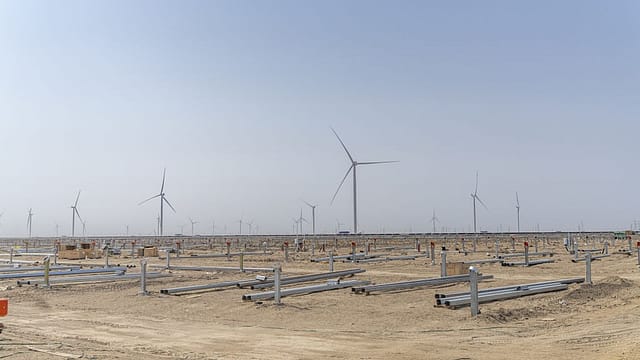
For years, the story of India's renewable energy has been written largely in the sun. Sprawling solar parks in Rajasthan and Gujarat became symbols of the country's clean-energy ambitions, while politicians cast solar power as the bedrock of India's energy revolution. Now, beyond the glare of those panels, another frontier is slowly taking shape along India's coast: offshore wind energy.
This shift is not accidental. It reflects a rising acknowledgement among executives and policymakers that India's renewable future cannot be built on solar power alone. Grid instability, storage constraints, land acquisition disputes, and reliance on Chinese solar supply chains have exposed deep flaws in India's clean-energy strategy. Offshore wind has become both an economic opportunity and a geopolitical necessity.
But India is entering this contest at a time when China already commands the global offshore wind ecosystem. Beijing dominates a major share of the global supply chain for turbines, rare earth processing, subsea infrastructure, and renewable manufacturing. The question is no longer whether India should pursue offshore wind. The real question is whether India can realistically compete with China in one of the most strategically important energy arenas of the coming decades.
The answer may hold the key not only to India's energy security but also to its wider strategic autonomy in a fracturing world order.
India has substantial offshore wind resource potential. The Ministry of New and Renewable Energy estimates that the country has over 70 GW of offshore wind potential along the coasts of Gujarat and Tamil Nadu. These areas enjoy relatively high wind speeds, established port infrastructure, and proximity to major demand centres.

The Second Life of Sanskrit
10 Jul 2026 - Vol 05 | Issue 28
Being classical has become cool
Offshore wind, policymakers argue, holds significant advantages over conventional renewable projects. Unlike solar, it can deliver more consistent generation throughout the day and often offsets solar output cycles, helping to address some of the intermittency problems that still afflict electricity systems dominated by renewables. Offshore wind farms also sidestep many of the land conflicts associated with large solar parks, where agricultural displacement and local opposition have become flashpoints.
More importantly, offshore wind carries strategic implications that extend well beyond power generation. Globally, it is becoming increasingly tied to marine infrastructure, industrial manufacturing, rare earth supply chains, and green hydrogen ambitions. Since the Russia-Ukraine war, offshore wind has moved to the centre of economic and geopolitical planning in Europe, which has been forced to confront the risks of energy dependence. The first major country to fully grasp this connection was China.
China has now emerged as the undisputed global leader in offshore wind deployment. Chinese firms dominate the turbine production and installation sectors, and the country has built the world's largest offshore wind industry in a remarkably short span, backed by enormous state investment. Just as they have come to dominate communications and transportation projects under the Belt and Road Initiative, Chinese companies are now aggressively moving into Southeast Asia, Africa, and parts of Europe to position themselves as global providers of renewable infrastructure.
This dominance poses a serious problem for India. New Delhi wants to scale up renewable energy in order to reduce strategic vulnerabilities, yet much of the world's renewable supply chain remains heavily dependent on China. The risks of this dependency have already been demonstrated in solar. Despite rhetoric about self-reliance and indigenous manufacturing, India still imports a large share of its solar modules and components from Chinese manufacturers. Unless it builds domestic manufacturing capabilities quickly, it risks replicating the same structural dependence in offshore wind.
Compounding the challenge, offshore wind is technologically far more demanding than solar. Offshore projects require specialised vessels, subsea cables, marine engineering expertise, port upgrades, advanced grid integration systems, and sizeable funding streams. These are sectors in which India still has significant capacity shortfalls.
The economic challenge is equally vast. Offshore wind projects demand far greater upfront capital than onshore renewable installations. India's solar sector has grown rapidly on the back of falling module prices and competitive bidding, but even in the most advanced economies, offshore wind remains capital-intensive. Investors often hesitate, as project timelines are long, regulatory clearances are unclear, and returns are heavily dependent on government support mechanisms.
Not all investors have been bullish on India's policy environment. Delays in renewable auctions, payment risks from state discoms, regulatory uncertainty, and infrastructural bottlenecks continue to weigh on the wider energy sector. Offshore wind developers need long-term stability and reliable policy signals, particularly when committing billions of dollars.
There is also the question of maritime infrastructure. Ports capable of handling massive turbine blades, foundations, and installation equipment are central to offshore wind development. For years, China has aligned its industrial and maritime regulations to enable offshore expansion. India's ports are improving, but capacity and purpose-built renewable infrastructure remain uneven.
Yet to write off India's offshore ambitions would be premature. Offshore wind offers New Delhi an appealing strategic path because it intersects with larger geopolitical and economic currents reshaping the global economy.
The United States, the European Union, Japan, and Australia are all actively seeking alternatives to Chinese dominance in renewable energy. Concerns about supply chain concentration have been sharpened by the pandemic, rising geopolitical tensions, and growing anxieties over strategic reliance on China. Western powers increasingly view India as an industrial and strategic counterweight to Beijing.
That is a geopolitical opportunity. By framing offshore wind not merely as an energy project but as part of a broader industrial and strategic partnership, India could attract significant foreign investment and technology collaboration. European nations, especially Denmark, Germany, and the Netherlands, have decades of offshore wind experience and are already exploring ways to deepen renewable cooperation with India.
India's offshore wind push, then, is more than an energy experiment. It is a test of the country's ability to transform from a renewable consumer into a genuine clean-energy industrial power.
What will determine the outcome is not simply whether the turbines reach the water. It is whether India can build the institutions, financial systems, manufacturing capabilities, and strategic relationships demanded by the next phase of the global energy transition.
The struggle over offshore wind in the decades ahead may reveal something larger about the contours of the twenty-first-century world order. The countries that build the green infrastructure of the future may also decide the balance of geopolitical power.