Canada Calling
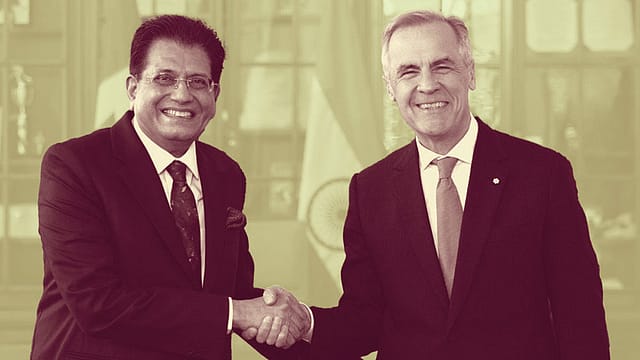
Commerce Minister Piyush Goyal’s visit to Canada for talks on a trade deal and expanding commercial opportunities saw the size of the accompanying business delegation swell to 150 companies by the time he left for Ottawa. In the Canadian capital, he met Prime Minister Mark Carney who has led a remarkable turnaround in ties after the exit of Justin Trudeau. Carney extended the special gesture—usually a visiting minister does not meet the prime minister—in keeping with the priority he has accorded to ties with India. Carney’s visit to India in February proved a game-changer and more visits by Canadian ministers convinced Ottawa of the utility of strengthening cooperation with India. The reset is important from India’s point of view as there is a sizeable diaspora in Canada and the country is an important supplier of high-grade uranium for the Indian nuclear programme.
Goyal was hopeful of moving the ball on a Comprehensive Economic Partnership Agreement (CEPA) and it has been decided that the deal will be concluded by the end of 2026. It will synergise complementary capacities in agricultural products, wood pulp, critical minerals and human talent. There were meetings in Toronto with pension funds, some of which are already invested in India, and others looking for longterm commitments. The Ontario Teachers’ Pension Plan and the Canada Pension Plan Investment Board have invested billions of dollars in India’s infrastructure projects through the National Infrastructure and Investment Fund (NIIF) along with interests in renewable and sustainable energy. On the security side, India is working closely with Canadian authorities to curb criminal gangs, often with Khalistan-ISI connections, operating in Canada and committing crimes in India.
Pakistan’s Trump Moment

Pakistan is finding out that dealing with US President Donald Trump means sudden curve balls. At a moment when Pakistan is looking to benefit from a higher profile due to its role as a mediator in the Middle East war, its army chief Asim Munir was in for a nasty surprise when Trump suggested that once the Iran crisis was over, Arab states and Pakistan could be part of the Abraham Accords that envision diplomatic normalisation with Israel. Media reports said Trump seemed to enjoy the shocked silence and asked if his callers were still on the line. Munir is unlikely to have found any humour in the situation.
Going Dutch
The proposed strategic partnership between semiconductor giant ASML and Tata Electronics for a commercial semiconductor fabrication unit in Dholera is a remarkable turnaround as till a few years ago, the Dutch firm was reluctant to consider investments in India. Lack of local suppliers and other facilities to support a large semiconductor unit were seen as hurdles. But the situation has changed and a new era of cooperation is at hand. Almost every modern chip is printed using photolithography machines made by ASML. The firm’s nanoscale printing technology used to map microscopic circuits onto silicon wafers will be available at Dholera.
Rubio’s Message on Iran
The visit of US secretary of State Marco Rubio to India coincided with reports of the possibility of a breakthrough in The Middle East deadlock. Rubio said some good news could follow, but within hours there were reports that President Trump was holding back. Yet, there are indications that an agreement—even if calling it a ‘deal’ might be a stretch—is on the anvil. Trump is feeling the pressure of a rapidly deepening global energy crisis and while Iran may feel it has the upper hand, prolonged uncertainty will not help its cause either. The smoke signals from Rubio’s interactions in New Delhi are reading more positive than they might look.
Dogs Catch A Delhi Break
Delhi Chief Minister Rekha Gupta’s announcement that all 13 districts of the capital will have a mechanism for reporting and action against cruelty to animals was a much-needed and welcome step. The debate on dealing with stray dogs has raged for too long without sufficient recognition of the need to find humane ways of controlling the population and preventing abuse. The centres Gupta has spoken of will, of course, cater to all animals in accordance with the Prevention of Cruelty to Animals Act.
Decoding the UCC
Home Minister Amit Shah’s assertion that a Uniform Civil Code (UCC) will not in any way impact tribal society at a large event in Delhi was more than a routine assurance. It might indicate plans to defend UCC as more BJP states seek to implement the code. Since only states with BJP governments are likely to consider the UCC, the party needs to ensure the decision is not attacked as a move to undercut constitutional guarantees for weaker sections. Whether the Centre will consider such legislation is unclear, but a relevant Bill will not need a constitutional amendment.
Bengal Clean-Up
Some things have changed quickly following the exit of the Trinamool Congress government from West Bengal. For one, the Border Security Force (BSF) has taken the task of placing border posts and marking land for fencing with alacrity despite efforts of the Border Guard Bangladesh to disrupt the process. For another, private citizens are coming forward with tales of forcible takeover of properties by TMC strongmen and cases are being registered against the tormentors. Land-grab cases top the Janata “durbar” hearings held by Chief Minister Suvendu Adhikari.