Soft Power and Glory: Behold: India showcases its soul at the Venice Biennale
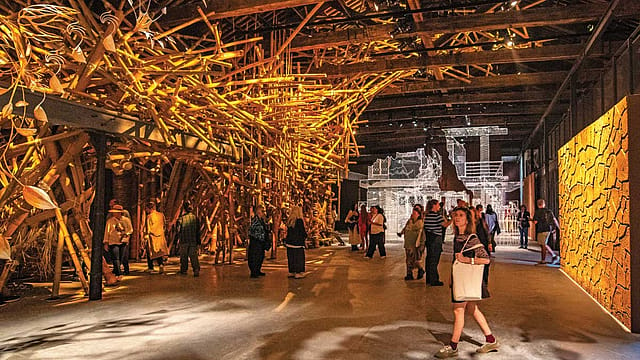
THERE ARE MOMENTS in life when you feel a quiet, almost private satisfaction—the kind that comes not from being proven right but from watching something you deeply believed in finally come alive before your eyes. I had one such moment this week, standing inside India’s National Pavilion at the Venice Biennale, feeling the warm Adriatic air mix with something far more intoxicating: the unmistakable scent of India’s cultural confidence finally finding its global voice.
Let me say this plainly. India was magnificent at Venice this year.
Not competent. Not adequate. Not “for an emerging nation.” Magnificent. Full stop.
Two years ago, I wrote a piece arguing that India’s soft power story was being told by the wrong narrators, in the wrong rooms, at the wrong volume. I said—and I stand by every word—that the Venice Biennale was precisely the kind of stage where India needed to show up, not just participate. To “arrive”. I argued that our culture, our artistic vocabulary, our civilisational depth was not some heritage footnote—it was a living, breathing, contemporary force that the world desperately needed to encounter.
The article stirred some conversation and, as these things go, was promptly filed away.
So, you can imagine the smile on my face walking through the pavilion this week.
India didn’t just show up at Venice. India “commanded” Venice.
Much of the credit for this magnificent outing must go to Amin Jaffer, the curator of the India Pavilion, who has done something genuinely stupendous. Curation at a biennale is not decoration. It is argument. It is the making of a case—about who you are, what you think, what you offer to the conversation of human civilisation. And Amin made that case with rigour, elegance, and with the kind of curatorial intelligence that doesn’t announce itself loudly but lingers in the mind long after you have left the building. The works he assembled, the narrative arc he constructed, the way he allowed India’s artistic present to speak without drowning in its past—this was masterclass-level thinking. The world noticed. And well, it should have.
What made this outing especially thrilling was the extraordinary coalition that made it possible. This is where India’s new story gets genuinely exciting.
The Ministry of Culture deserves enormous credit for understanding that soft power is not a slogan—it is a strategy, and it requires serious partners. And they found them.
Isha Ambani and the Nita Mukesh Ambani Cultural Centre (NMACC) brought to Venice what NMACC has been bringing to Mumbai—a standard of presentation that is word-class without apology. When NMACC throws its weight behind something, the production values, the curatorial ambition and the sheer seriousness of intent rise. You could feel that in every corner of the pavilion. This was not patronage. This was partnership, and there is a meaningful difference.

Then there was Serendipity Arts, led by the quietly formidable Sunil Munjal—an institution that has, over the past few years, built one of the most credible platforms for arts and culture in the country. Serendipity has always understood something that many in India’s cultural ecosystem are still learning: that excellence and accessibility are not opposites, and that you can have genuine artistic rigour while still throwing the doors wide open. That philosophy was evident in Venice.
The Ministry of Culture, NMACC, Serendipity—this is the kind of public-private cultural architecture that India has long needed and rarely managed to build. Watching it function seamlessly at one of the world’s most prestigious cultural arenas was genuinely moving.
And then there was Gajendra Singh Shekhawat. I will be honest—ministers at cultural events can sometimes feel like reluctant guests at their own party. Not Shekhawat. The Union culture minister was in full, glorious flow at Venice. Engaged, enthusiastic, present in the truest sense of the word. He spoke about India’s cultural ambitions not as bureaucratic talking points but with genuine conviction. There was a lightness to him, a pride that was infectious without being jingoistic. When a minister responsible for culture actually “loves” culture, it shows. And it showed.
Here is what Venice confirmed for me this year. India has graduated. Not from talent—we have never lacked for that. But from hesitation. From the apologetic, slightly crouched posture with which we have sometimes presented ourselves on the world’s great cultural stages, half-wondering whether we truly belonged.
We belong. We have always belonged. But now we are beginning to act like it.
Soft power is not built through press releases or diplomatic dinners. It is built in rooms like the one I stood in at Venice— where a work of art stops a stranger in their tracks, where a curatorial idea crosses every language barrier effortlessly, where a country’s soul speaks directly to another human being without needing translation or explanation.
India’s soul spoke clearly at Venice this year.
I said two years ago that this is the kind of soft power we need. Patient, creative, ambitious, collaborative—culture as statecraft, art as conversation, beauty as argument.
Venice 2026 proved me right. And I have never been happier to be proven right in my life.