Fixderma, Shaily Mehrotra and The First Mover's Curse
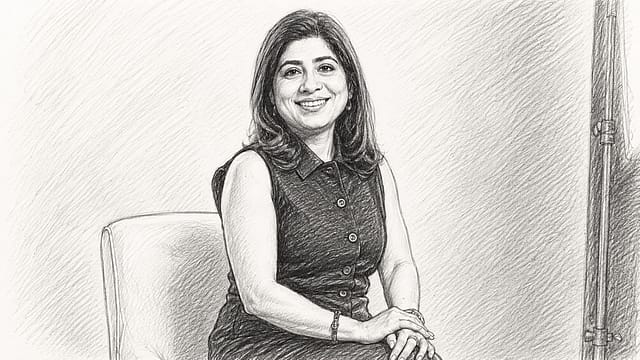
In 2019, a year before the great Indian skincare boom, Shaily Mehrotra made a decision that would cost her a fortune and nearly break her company. She went online.
It sounds unremarkable today, when every skincare brand is born on Instagram and lives or dies on Nykaa's or Amazon’s algorithm. But Fixderma — the company Mehrotra had spent a decade building one dermatologist at a time, one prescription pad at a time — was not that kind of company. Its customers were patients. Its salespeople were doctors in white coats. And when Mehrotra began selling on e-commerce platforms, those doctors turned on her with the ferocity of a guild that had just watched its gatekeeping power walk out the door.
"They said they would ban us," she recalls, sitting with the matter-of-fact calm of someone recounting an old war. "We suffered both sides. Our dermatologist sales went down and we couldn't play online the way we should have. We were scared here, we were scared there. It was like somebody had put chains on our legs — and the chain was the dermatologist."

Zeroing In on ECI
09 Oct 2026 - Vol 05 | Issue 41
Constitutional legitimacy versus political opportunism
While she hesitated, Mamaearth, WOW Skin Science, and a crisp, clinical newcomer called The Minimalist skyrocketed. Fixderma, with better formulations than most of them and eighteen years of hard-won clinical credibility, watched the gold rush from the sidelines.
This is the story of Shaily Mehrotra — serial pioneer, serial early mover, and one of Indian skincare's most stubbornly underappreciated founders. At ₹187 crore in revenue, Fixderma is not a household name. It probably should be.
Fixderma's revenue from operations rose to ₹185.4 crore in FY25, up from ₹145.9 crore in FY24, while net profit declined to ₹3.5 crore from ₹12.8 crore a year earlier, as per regulatory filings accessed from business intelligence firm Tofler.
The Long Way Round
Mehrotra did not arrive at skincare through a straight line. She grew up in Varanasi — Banaras, as she insists on calling it — in a household that was, for its time and place, startlingly progressive. Her mother was completing a PhD when she got married, had been an NCC state cadet, and raised her daughter with a freedom that would have baffled most neighbours. Sleepovers were permitted. Opinions were expected.
She studied English literature, having missed the economics cutoff by two points, then decamped to Delhi for a course in public relations and branding — a field so nascent in India at the time that, as she puts it with some amusement, "nobody knew the full form of PR." Only the Taj Hotel had a PR department. She couldn't find a job.
Marriage, in 1997, took her to Cambodia, and Cambodia changed everything. For six or seven years, she worked across Southeast Asia — in sales, marketing, branding, across multiple industries and multiple nationalities — picking up an MBA in international marketing from the University of Southern Queensland along the way. She failed her first test ("I took it lightly, like any open course in India"), then buckled down. She sold swimming pools to French expats who thought nothing of spending sixteen thousand dollars on a kidney-shaped pool. She learned, watching a woman wave away a receipt without looking at it, how the affluent think about money: they don't. They think about ease.
What she also noticed, everywhere she looked in Southeast Asia, was what India was missing. Standalone baby product boutiques. Moisturisers with active clinical ingredients. Dermaceuticals — the middle ground between a pharmaceutical and a cosmetic — that were ubiquitous in countries with a lower GDP than India but far more sophisticated consumer expectations.
"India was very way behind in skincare," she says simply. "The choice was so less."
Building the Cathedral
Mehrotra moved back to India in 2007 with two young children, a pharmaceutical distribution business her husband ran in Cambodia, and a gap she couldn't stop thinking about. The family's Cambodia business — now a hundred and twenty people strong — would provide the initial funding. She started Fixderma with ₹65 lakhs, in tranches, and a decision that would define the company's identity for years: she would go through dermatologists first.
It was the right call for credibility and the wrong call for speed. Building a dermatologist network is painstaking work — Delhi NCR first, then Punjab, then Mumbai, city by city, clinic by clinic. But it gave Fixderma something that would prove almost impossible to fake: genuine clinical endorsement.
In 2013, frustrated with the quality and packaging of products manufactured on a private-label basis, she visited a skincare plant near New York, came back, and told her team: build this. There was no playbook. The handful of cosmetic manufacturing plants in India were extensions of pharmaceutical facilities — functional, ordinary, uninspired. Fixderma's Neemrana plant in Rajasthan was built from scratch, to a different standard. Today it can produce a lakh tubes a day, with capacity to reach three to four times that on existing infrastructure. The company has manufacturing headroom for ₹500 crore in revenue.
Exports followed naturally — the Southeast Asian connections gave them a ready market — and by 2021, when Fixderma finally took its first institutional funding, the company had been profitable for years. Bootstrapped for thirteen years, growing steadily, unhurried by a term sheet. "Both exports and dermatologist sales are highly profitable," Mehrotra says. "With exports especially, once the distributor establishes your brand in his country, the money comes in advance. Then you just send products."
The Cost of Conviction
The skincare boom, when it arrived, arrived fast. Covid drove Indians indoors and onto social media, and suddenly a generation that had grown up with Fair & Lovely as the beginning and end of skincare aspiration wanted serums, actives, SPF, retinol. The market did not just grow; it transformed.
Fixderma had been building for exactly this moment. But Mehrotra had also, quietly, already made a habit of being too early.
In 2017, she launched Teenilicious — a skincare brand for teenagers, backed by research that would have impressed most consumer goods companies. She brought fifty kids from schools across Delhi, not just the elite ones, to her factory. She sat them in a conference room with prototype products on pillars, different colours, different fragrances, different formats. She had them score each on a numbered sheet. She watched how they talked, what they ordered for lunch (noodles and pizza, with considerable attitude), how they thought about skin. The research was meticulous. The market was not ready.
"We were five, six years ahead," she says. "We launched, went into retail, hired a marketing company — they fooled us — and lost four crores."
The brand sat in limbo for years, too embedded to abandon, too early to scale. Mehrotra often reaches for a popular Milkha Singh joke to explain Fixderma's journey. A thief breaks into the sprinter's house, but Milkha runs so fast that he leaves the thief behind and loses sight of him altogether. The punchline, she says, is that being too far ahead can sometimes be its own disadvantage. Fixderma has spent much of its history in exactly that position.
The same instinct that made her too early with Delicious also made her a pioneer with influencer marketing. When the company began tentatively moving online in 2019, she recruited prominent dermatologists to talk about Fixderma's products — for free, at a time when no one had yet understood that doctors with Instagram accounts could be paid. "They had no clue you could make money out of it," she says. She was using dermatologists as influencers before the category existed.
The dermatological community, predictably, did not see it this way.
The Distributor Disaster
For all the early miscalculations, what nearly derailed Fixderma entirely was not her own misjudgement but someone else's failure to deliver. In FY26 — a year she declines to discuss in financial detail, citing the complexity of the situation — Mehrotra signed with a listed distribution company that presented her with something close to a founder's fantasy: 3.5 lakh points of sale, 55,000 hospitals, national reach, proprietary software.
"I was like, tongue out," she says, not embarrassed to admit it. "Greedy."
The reality was geographically concentrated and operationally hollow. The distributor's actual presence was limited to Maharashtra, Andhra Pradesh, and parts of Karnataka. States like Uttar Pradesh, Bihar, Punjab, Jammu & Kashmir, and West Bengal were effectively blank. Her existing distributors, who had spent years building the Fixderma network, felt betrayed and walked. Returns started coming in from September and continued through February — months of unwinding a relationship that should never have been built. The dent to the business, she says plainly, was severe.
What strikes her as oddly consoling is that she is not alone. When executives from a pharmaceutical company that had been in conversation with Fixderma about a potential stake — heard about her experience, they told her the same distributor had shown them the same presentation, the same map, the same promise. "Don't worry," they said. "This happened with us too."
The Boring Brand That Actually Works
There is a certain irony in the fact that a branding professional built a brand she freely describes as "plain, clinical, boring." But Mehrotra is clear-eyed about this, in the way that only someone who has deeply understood her customer can be.
Fixderma's packaging has not meaningfully changed because Fixderma is in fifty countries, sells through three channels — dermatologists, e-commerce, and retail — and operates in a world where a shade change cascades into chaos. When the company did a limited-edition sunscreen with Delhi Capitals players, including Rishabh Pant, for an IPL sponsorship, nobody bought it. "People didn't even want Rishabh Pant," she says, still faintly astonished. The yellow packaging was alien. Customers wanted what they knew.
Repeat rates on Fixderma's premium range run between 35 and 40 percent — by her description, "almost a gold standard." The customer who finds the brand tends to stay. The challenge has always been finding them in the first place, without a D2C war chest and without the luxury of burning investor capital on performance marketing.
She has views, firmly held, on the brands that did. She admires The Minimalist — for the intelligence of their exit, for the discipline of building a proven team before announcing themselves, for Unilever's quiet involvement from the very beginning. She is less admiring of brands she considers marketing constructs without serious formulations, and she offers a chemist's critique of raw-active products: a carrier exists for a reason. Penetration, feel, nourishment. "Skincare is not always about fixing your skin," she says. "It's also about nourishment."
The company has recently launched exosomes range — among the most expensive products in its portfolio at ₹7,000 a unit, prescribed by dermatologists for anti-ageing — positioning Fixderma at the frontier of actives rather than chasing the mass market. Meanwhile, FCL, the company's premium sister brand launched in 2016 with a dermatologist-focused event that drew two hundred doctors, continues to grow.
What Comes Next
Today Fixderma is an omnichannel business — roughly 35 percent e-commerce, the rest split between exports and the dermatologist channel, with a nascent retail push that Mehrotra describes as "the toughest nut to crack." The target for FY27 is ₹280 crore; her husband considers it ambitious. She does not. Profitability in FY27 is, she says, certain. The margin ambition is double-digit.
On exits and acquisitions — and there are suitors, she says, like a bride with options — she is genuinely undecided. What she knows is the condition: whoever takes the brand forward must take it seriously. "It is an Indian brand made in India with very good intent," she says. "I want it present in every household."
She has been building toward that for eighteen years — through clinics in Delhi and factories in Rajasthan, through doctor networks that tried to shut her out and distributor relationships that failed her, through teen brands launched too early and influencer strategies nobody had yet imagined. She has been right about most of it. She has paid for almost all of it.
That, perhaps, is the most honest thing about Shaily Mehrotra: she does not mistake suffering for sainthood, or early mistakes for cautionary tales. She mistakes them, very precisely, for data.
"We had a habit," she says, "of wanting to make the best products. We had a lot of big ego about that. We always thought: something is missing. And whenever I get a chance, I work."
She is still working.