Passion to Pay Cheque: Creator Economy Is India’s New Middle-Class Pursuit
Twenty years ago, India's middle class had a fairly straightforward definition of success.
Become an engineer. Become a doctor. Crack a government examination.
A decade later, another profession entered the aspirational lexicon: entrepreneur.
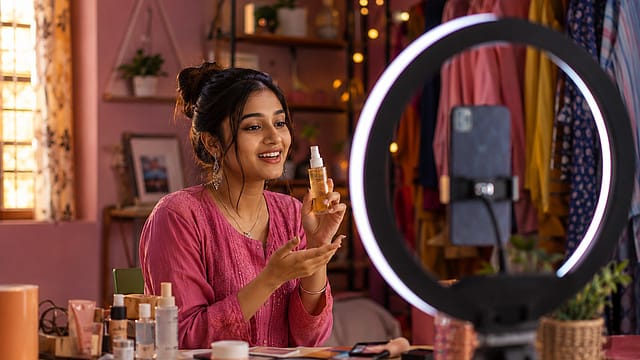
Today, somewhere in a Tier-3 town, a parent is watching their child record a skincare video on Instagram, edit it on a smartphone and speak into a ring light purchased online for less than ₹1,000. They may not fully understand it, but increasingly, they are beginning to accept it as work.
India's creator economy has become too large to dismiss and too fragmented to fully understand.
According to a report by the Indian School of Business' Srini Raju Centre for IT and the Networked Economy (SRITNE) and creator platform HashFame, India had 4.12 million creators in 2025, up from just 960,000 in 2020. More tellingly, 66% of them now come from non-metro India.
The Modi Years
02 Oct 2026 - Vol 05 | Issue 40
A Nation Rebuilt
At first glance, these numbers merely confirm what anyone with an Instagram account already knows: there are creators everywhere.
Look a little closer, however, and a different picture emerges.
This isn't a story about influencers. It is a story about India creating an entirely new category of work.
The appeal is remarkably simple. Unlike previous waves of aspiration, becoming a creator requires very little upfront investment. A smartphone, an internet connection and the possibility, however remote, of finding an audience are often enough.
"We've lowered the barriers to entry dramatically," Anirudh Sridharan, co-founder of HashFame, said. "People can start with almost no capital, and if they find the right audience and connect with brands, there is genuine earning potential."
In a country where economic opportunity remains unevenly distributed, possibility itself can be a powerful incentive.
The creator economy has followed a familiar Indian trajectory. It began in the metros and quietly moved elsewhere.
In 2020, India's largest cities accounted for the majority of the country's creator base. By 2025, non-metros represented 2.72 million creators, growing 6.4 times over five years compared with 2.6 times for metros. Uttar Pradesh now accounts for the largest share of creators at 13%, followed by Maharashtra at 12%, while Rajasthan and Karnataka have emerged as significant creator hubs.
In some ways, the creator economy resembles every other major economic shift India has experienced over the past two decades. Consumption moved beyond the metros. E-commerce moved beyond the metros. Digital payments moved beyond the metros.
Now, content creation has too.
That migration is forcing brands to rethink who speaks for them.
"Creators have become an increasingly important route to market for businesses and a trusted source of information for consumers," Dr. Madhu Viswanathan, Associate Professor of Marketing and Executive Director at SRITNE, said.
The shift goes beyond advertising budgets.
"Celebrities are largely a one-way medium. That's marketing," he said. "Social media, on the other hand, is a communication channel where two parties can interact."
It is a deceptively simple observation.
Celebrities broadcast. Creators converse.
A celebrity tells consumers what to buy. A creator answers questions in the comments section, shares personal experiences and builds communities around shared interests. One creates awareness. The other creates trust.
Trust, increasingly, is proving to be a valuable currency.
The report found that average engagement rates among Indian creators rose from 1.8% in 2020 to 7.2% in 2025. Non-metro creators consistently outperformed metro creators on engagement, suggesting that proximity, whether cultural, linguistic or geographical, matters more than follower counts.
More than 80% of non-metro creators belong to the nano and micro categories, with follower counts ranging from 1,000 to 100,000. These are not internet celebrities. “They are people with audiences large enough to influence decisions and small enough to maintain relationships,” Sridharan said.
That distinction matters because it points to where the creator economy is headed.
For years, brands treated creator marketing as an extension of celebrity endorsements. The assumption was simple: bigger audiences produce bigger results.
But India's next creator boom may have very little to do with celebrities.
"Not everybody wants to tap into influencers with lakhs or millions of followers," Sridharan said . "Think of your local cafés, shops and businesses. Every business needs some sort of promotion and advertising."
That market remains largely untapped.
Consider the neighbourhood economy. Every salon wants more appointments. Every coaching institute wants admissions. Every boutique wants footfalls. Every café wants to be discovered.
For decades, these businesses relied on flyers, local newspapers and word of mouth.
Today, they need Instagram.
And Instagram needs creators and these creators are called hyper-local creators.
The next big opportunity in creator marketing may not come from multinational corporations. It may come from millions of small businesses spending a few thousand rupees at a time.
Yet, for all the enthusiasm surrounding the creator economy, there is one uncomfortable truth: most creators have little idea how to monetise their audiences.
"One of the biggest challenges is that creators simply don't know how much to charge," Sridharan said. "Many are excellent at creating content, but they have little understanding of pricing, negotiations or building a sustainable business around their audience."
The report offers evidence of that uncertainty.
Campaign participation among non-metro creators grew from 38,000 in 2020 to 408,000 in 2025. However, the campaign-to-creator ratio declined from 0.37 to 0.10 over the same period. Put simply, more creators are finding work, but most are doing only one campaign annually.
India's creator economy has solved participation.
It has not yet solved livelihoods.
The report estimates that nano creators completing two campaigns earn approximately 29% of the average rural salaried wage and 20% of the average urban salaried wage. Micro creators undertaking five campaigns come much closer to earning a sustainable income.
This suggests that for most Indians, content creation is unlikely to replace traditional employment anytime soon. Instead, it may become something else: supplementary income.
That, perhaps, is a more realistic way to think about the creator economy.
Not everyone driving for a ride-hailing platform does it full time. Not every online seller operates a large business. Likewise, not every creator will become a full-time influencer.
There is space for all of them.
"For some, this will become a career. For many others, it will remain supplementary income," Viswanathan said. "Both outcomes are equally valid."
That may ultimately be the creator economy's most important contribution. It has expanded India's definition of work.
If creators become India's new storefronts, some categories are better suited to the format than others.
"Products in beauty, personal care and FMCG naturally lend themselves to creator-led discovery, particularly in Tier-2 and Tier-3 markets," Viswanathan mentioned. "These are relatively affordable purchases where consumers actively seek recommendations before buying."
Large discretionary purchases may still remain concentrated in urban India. But a face wash, a lipstick or a packet of snacks? Those decisions are increasingly being influenced on social media.
That trend is already visible. FMCG accounts for 24% of creator campaigns in India, followed by e-commerce at 18% and BFSI at 12%. Beauty and personal care continue to emerge as particularly attractive categories as consumer spending rises beyond the metros.
Language will shape the next phase of growth as well.
While Hindi accounts for 42% of India's creator base, regional languages collectively represent 58%. Markets such as Bhojpuri and Kannada remain under-monetised despite strong creator participation.
The creator economy's biggest contradiction, however, is that it has created entrepreneurs without ownership.
Creators build businesses on platforms they do not control. Algorithms change. Formats evolve. Reach fluctuates. Entire categories of content can rise and fall in a matter of months.
"The opportunity is very real, but it isn't stable," Sridharan and Vishwnathan said. "Creators are dependent on platforms whose incentives are different from theirs. Platforms want users to spend more time online because that's how advertising grows. Algorithms change constantly, and you'll never completely decode what will work over the long term."
In many ways, creators are building businesses on rented land.
And yet, despite all its uncertainties, the opportunity remains undeniable.
Somewhere in Patna, a food creator is recommending the city's best litti chokha. In Mysuru, someone is reviewing a new face wash in Kannada. In Jaipur, a creator is helping a local café attract customers.
None of them may become famous.
That may not matter.
Every generation invents a new answer to an old question: What do you do for a living?
India's newest answer is still finding its words.
For now, it is simply this:
"I'm a creator."