Why Is FSSAI Cracking Down on Liquor Brands? What It Means for Consumers
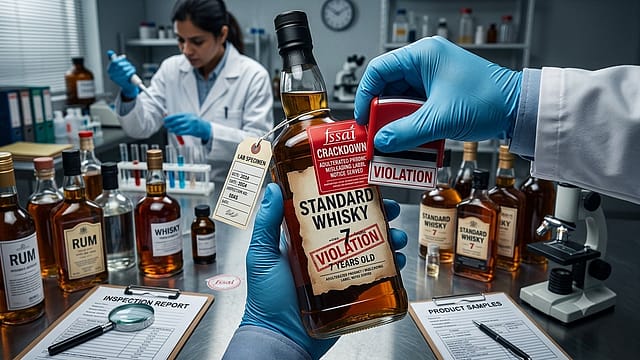
India's food safety regulator has turned its attention to the liquor industry.
The Food Safety and Standards Authority of India (FSSAI) has initiated action against several alcoholic beverage manufacturers after finding alleged violations involving artificial flavouring, misleading labels and inaccurate age claims. The regulator says some products marketed as standard rum or whisky were made using practices that could mislead consumers and violate existing food safety regulations.
Here's what the crackdown is all about.
Why has FSSAI taken action against some liquor manufacturers?
FSSAI says it found that some manufacturers were adding external flavours that mimic the natural taste and aroma of rum or whisky and then selling those products as standard rum or whisky. According to the regulator, this violates food safety regulations because consumers are led to believe they are buying a standard alcoholic beverage when, in reality, the product has been artificially flavoured.
The Vanguard
21 Aug 2026 - Vol 05 | Issue 34
BJP Rearmed for 2029
What exactly did the regulator find?
Laboratory tests on samples of rum and whisky from multiple manufacturers detected artificial or nature-identical flavours that replicated the beverages' natural flavour profiles. FSSAI said these added flavours masked the products' natural characteristics, making them substandard under existing regulations if sold as standard rum or whisky.
Is FSSAI banning the use of flavours in alcohol?
No. The regulator has clarified that flavouring substances are permitted under food safety regulations when there is a legitimate technological reason for using them. The issue, FSSAI says, is the practice of adding rum flavour to rum or whisky flavour to whisky to artificially recreate or enhance the beverage's defining taste and aroma.
How should such products be labelled?
According to FSSAI, products made using these flavouring practices should not be sold simply as "Rum" or "Whisky." Instead, they should carry labels such as "Rum-flavoured Spirit" or "Whisky-flavoured Spirit", with their true nature clearly disclosed on the front of the package so consumers are not misled.
What is the controversy over the '7 Years Old' claim?
FSSAI also questioned the age claim made by one rum brand that described its product as "7 Years Old Blended." The regulator's investigation found that the blend primarily consisted of neutral, unaged spirit, while the matured rum component accounted for less than 5% of the product. Under the Food Safety and Standards (Alcoholic Beverages) Regulations, 2018, the age stated on a blended spirit must be based on the youngest spirit in the blend, not the oldest.
Does this affect the entire liquor industry?
No. The Health Ministry has clarified that the enforcement action is directed only at manufacturers found violating the regulations. It added that many companies continue to produce standardised alcoholic beverages in compliance with prescribed food safety norms.
Why does this matter for consumers?
The regulator says consumers deserve to know exactly what they are buying. If a product uses added flavouring or does not meet the standards of a traditional rum or whisky, its label should reflect that accurately. FSSAI says clear labelling prevents misleading marketing, protects consumer choice and ensures manufacturers compete on a level playing field.
(With inputs from ANI)