FIIs Tiptoe Back Into India as Stock Valuations Lose Their Froth
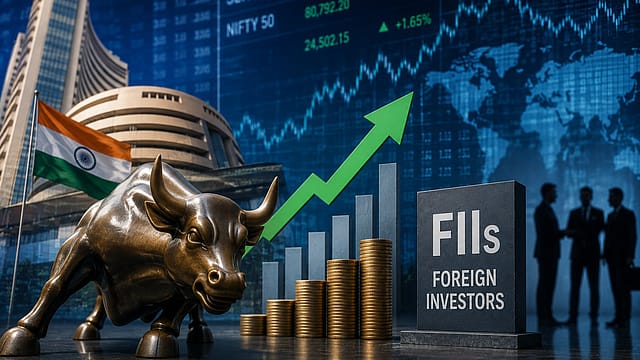
Foreign investors may finally be looking at India again.
After months of heavy selling, foreign institutional investor flows turned positive in July, following a slowdown in withdrawals in June. Jio BlackRock Asset Management believes the shift could mark the beginning of a turnaround in foreign investor sentiment.
The change arrives alongside something overseas investors have been waiting for: a less expensive Indian market.
India’s 12-month forward price-to-earnings ratio has retreated to approximately 20 times, close to its 10-year average, after trading at a sustained premium. The country’s valuation relative to other emerging markets has also returned to its long-term average of around 1.4 times, according to Jio BlackRock’s August macroeconomic outlook.

Rise of the Pivotal Power
18 Sep 2026 - Vol 05 | Issue 38
The BRICS declaration is a strategic victory for Modi
That combination of returning flows and cooling valuations has raised the possibility that much of the pessimism surrounding India has already been priced in.
Foreign investor exposure to India remains near historical lows. But Jio BlackRock noted that similar troughs in the past were followed by recoveries in both capital flows and markets. If that pattern repeats, the current positioning could leave room for foreign money to return.
Domestic investors, meanwhile, have kept buying.
Consistent inflows into domestic mutual funds cushioned the market during the foreign sell-off, reducing volatility and preventing overseas withdrawals from inflicting deeper damage. That support has changed the structure of the Indian market, making it less dependent on the movements of foreign capital.
The longer-term investment case rests heavily on manufacturing.
Citing Morgan Stanley projections, the report said India’s manufacturing gross value added could climb from $519 billion in 2025 to $1.5 trillion by 2035 under the base-case scenario. In a more optimistic outcome, it could reach $2.05 trillion.
But the emerging recovery signal comes with a warning.
Urban and rural consumer confidence has fallen to its lowest level since September 2023. Prolonged weakness could squeeze discretionary spending, slow corporate earnings and complicate the case for a sustained market rebound.
The report also pointed to risks outside India. The Nasdaq-100 underperformed the S&P 500 in July by its widest monthly margin since the dotcom bubble, underlining the vulnerability created by the heavy concentration of global investment in a handful of technology giants.
For India, July’s FII return is an encouraging signal, not yet a decisive reversal. The next test is whether foreign investors keep buying once the first attraction of cheaper valuations fades.
With inputs from ANI