UNTOLD | Meet the Screenwriter Who Builds Rockets
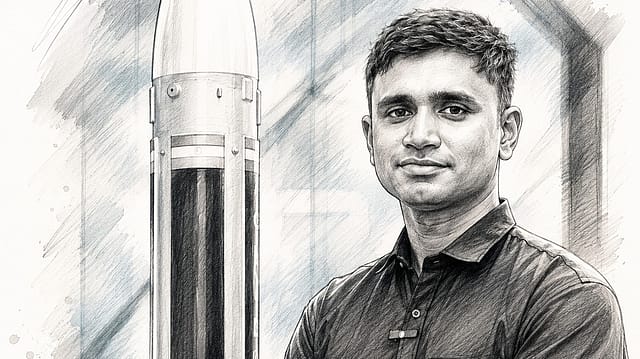
FADE IN
White.
A blank screen.
Nothing moves. Nothing speaks. Just a white frame hanging in silence, daring the audience to wait.
Then a voice.
"The first minute has to startle the audience."
Another pause.
"It doesn't have to be shocking. It just has to make people curious enough to stay."
The white dissolves.
A digital clock appears.
00:00:11
Eleven seconds.
Somewhere inside a mission control room, nobody breathes normally anymore. Hundreds of eyes are fixed on a stream of numbers that refuse to care about human hope.
Engineers stare at their monitors. Fingers hover above keyboards they no longer control. Beyond this point, the rocket is making its own decisions.

Greening the Future
23 Jul 2026 - Vol 05 | Issue 30
Securing a sustainable India
Outside, cameras wait. Inside, silence does.
00:00:10
Ten seconds.
Months of preparation. Thousands of calculations. Years of engineering. All compressed into a countdown that now belongs to a machine.
Nobody looks away. Not now. Not after everything it took to reach this moment.
00:00:09
Nine seconds.
The room has rehearsed this sequence countless times.
Every command. Every response. Every contingency. Every failure.
The world remembers the launch. Engineers remember the tests that never became one.
00:00:08
Eight seconds.
A computer notices something.
Tiny. Almost invisible. Not enough to alarm a spectator. Enough to stop a rocket. It refuses permission.
The countdown stops.
ABORT. ABORT. ABORT.
Nobody screams. Nobody slams a table. Nobody moves.
Outside, the headlines are already writing themselves. Another failed launch.
Inside, nobody uses that word.
Tests fail. Systems fail. Assumptions fail. People don't. Not today. Not after coming this far. Not after spending years convincing a sceptical ecosystem that private rockets belonged in India. Not after hearing the same verdict, over and over again.
"This won't happen here."
Eleven seconds.
Strange, really. It had taken almost a decade to arrive here.
CUT TO: New Jersey. Evening.
A classroom begins to fill after office hours.
Most people walk in carrying backpacks. One man walks in carrying another life.
By day, Wall Street. By night, film school.
EVERYTHING WAS GOING ACCORDING TO PLAN
While colleagues discuss promotions, bonuses and the next rung on the corporate ladder, he spends his evenings learning why some stories stay with an audience while others don't. He writes. Shoots short films. Learns to edit. Wins a screenwriting competition. The next morning, he is back at his desk as though none of it ever happened.
Nobody in that classroom could have guessed where those lessons would eventually take him. Years later, they would help him persuade investors, engineers, policymakers and complete strangers to believe in something they couldn't yet see.
The most important story he would ever tell began with a rocket that refused to leave the ground. Cameras came much later. And unlike every screenplay he had ever studied, he wouldn't get to write the ending first.
There was no sign of rockets. Not yet.
If you had walked into Srinath Ravichandran's office in New York a decade ago, you would have found a man doing exactly what ambition was supposed to look like.
He had done everything right. An electrical engineering degree. A master's in financial engineering. A career on Wall Street. The kind of résumé that reassures parents, impresses recruiters and convinces the world that life is proceeding exactly according to plan.
It was. And that was the problem.
Around him, colleagues chased promotions, bonuses and bigger offices. Conversations drifted towards the next role, the next firm and the next pay cheque. As the years passed, the conversations changed. Promotions gave way to marriages. Marriages gave way to children. Life had found its script, and everyone around him seemed perfectly happy playing their part.
Ravichandran wasn't.
The discomfort was difficult to explain because nothing was actually wrong. He liked engineering. He enjoyed finance. The work challenged him. The money was good. Every sensible argument pointed in one direction: Stay.
Yet with every passing year, another question became harder to ignore. Is this really what I'm going to do for the rest of my life?
The answer didn't arrive inside a boardroom or on a trading floor. It arrived quietly, as curiosity often does. The answer was: Space.
It began with reading. Rocket launches. Propulsion systems. Orbital mechanics. Reusable launch vehicles. One article became ten. Ten became a hundred. Curiosity became habit. Habit became obsession. The deeper he went, the more one thought refused to leave him alone. What if this wasn't just fascinating? What if this was what he was supposed to build?
The idea stayed with him for months. Then years. He didn't romanticise it. He interrogated it. Could he actually do this? Was he qualified? Was he being unrealistic? Or was he simply postponing the only question that mattered?
Years later, Ravichandran would look back on that period with surprising clarity.
Looking back, the word he reached for wasn't courage. It was necessity. "If I didn't give this an honest shot," he would say, "I knew I'd regret it for the rest of my life."
THE OUTSIDER IN THE RIGHT ROOM
The decision sounded irrational to almost everyone else.
Here was a man who had spent nearly a decade building one career. Now he wanted to begin another from absolute zero. Not in software or consulting or finance. He wanted to build rockets.
And if that sounded improbable, the next decision sounded impossible. He chose to build them in India. He was coming home.
But the plan wasn't India. Not at first.
If rockets had become an obsession, America was where they lived. So, instead of returning home, Ravichandran packed his bags and headed west to Los Angeles. No, it was not Hollywood. He wanted something that felt even more cinematic: Space.
By then, Los Angeles had become the centre of a quiet revolution. Governments were no longer the only ones dreaming about space. A new generation of founders and engineers was beginning to prove that rockets could be designed, built and launched by private companies. Space was becoming a business.
For Ravichandran, there could not have been a better place to learn. He attended meetups. He listened. He asked questions. He stayed back after conversations. He came to listen, to understand the people building rockets, the companies funding them, and the invisible machinery that turns impossible ideas into industries.
There was only one problem. He looked like he had wandered into the wrong room.
Around him stood aerospace engineers. Rocket scientists. People with doctorates. People who had spent years speaking a language he had only just begun to learn. He had spent the better part of a decade on Wall Street.
The outsider knew it. So did everyone else.
Even getting inside SpaceX was impossible. Security restrictions kept visitors away. The closest he came was standing outside its gates.
Oddly, that never bothered him. He wasn't there to tour a factory. He was there to test a belief.
And every conversation pushed him in the same direction. Nobody treated rockets as fantasy. Nobody laughed at the idea. Nobody asked whether private companies belonged in space. They spoke about propulsion, manufacturing, customers, launch windows and costs with the casual confidence of people discussing any other business.
Until then, space had lived in his imagination. Los Angeles gave it an address. It showed him that rockets could be products. That launch vehicles could have customers. That an ecosystem could grow around an idea ambitious enough to frighten almost everyone else.
The excitement lasted only until someone asked the obvious question. Why would you leave? Why would you return to a country with no private space ecosystem, no policy framework and no obvious path forward?
It was a fair question. Stay. Stay where the talent was. Stay where the capital was. Stay where the industry already existed. Almost everyone he met arrived at the same conclusion. India could wait.
COMING HOME TO A COUNTRY THAT DIDN’T BELIEVE ‘YET’
But, Ravichandran couldn't.
Somewhere between Wall Street and Los Angeles, another resolve had quietly taken shape. If India didn't have an ecosystem, someone would have to build one. The decision made perfect sense to him.
It made almost none to everyone else. Why would anyone leave Wall Street to build rockets? The question followed Ravichandran everywhere. Friends asked it. Colleagues asked it. People he had just met asked it. Sometimes it came wrapped in curiosity. More often, it arrived as disbelief.
He never blamed them.
On paper, he was walking away from a life most people spend years trying to build. An engineering degree. A master's in financial engineering. Nearly a decade on Wall Street. A career with momentum. A future that looked increasingly predictable. Most people call that success. Ravichandran called it unfinished.
There was another conversation he couldn't postpone: His parents. They had watched him leave India, study abroad and build a career that finally seemed settled. Now he was telling them he wanted to come back and build rockets.
There wasn't much evidence to support the decision. No thriving private space sector. No policy certainty. No successful blueprint to point towards. Just conviction. His parents could have asked him to stay. Instead, they chose something harder: Trust. "They supported me," he says. "Whether they were okay or not... they supported me."
Then came another conversation. This one mattered just as much.
Around the same time, he met the woman he would later marry through a common alumni network. Most first meetings begin with safe subjects. Where do you work? What do you do? Where do you see yourself?
Ravichandran skipped all of that. "Don't see me as a finance guy," he told her. Wall Street was ending. India was next. He wanted to build rockets.
There was no backup plan. No comfortable detour. No promise that the story would end well. It wasn't the sort of conversation people rehearse before the beginning of a relationship. But he believed something simple. The truth is easier to carry than an explanation.
People often imagine that entrepreneurs give up money. Money is usually the easiest part. The harder sacrifice is certainty. Wall Street came with a map. Entrepreneurship came with a compass. One could show him exactly where he might be five years later. The other couldn't promise where he would be five months later. He chose the compass. Not because it pointed towards success. Because it pointed towards the only question he still wanted to answer.
Could India build private rockets? Almost everyone believed they already knew the answer. He had decided to find out for himself.
India wasn't waiting for him. There were no red carpets. No investors searching for rocket companies. No founders swapping notes over coffee. No playbook.
In many ways, there wasn't even an industry. When Ravichandran began speaking about private rockets, the reactions were remarkably consistent. It won't work. It isn't possible. Not in India. Sometimes the words changed. The meaning never did. This was 2018.
LEARNING TO SELL THE DREAM, NOT JUST THE ROCKET
The policy framework that would later encourage private participation was still years away. For anyone trying to build a space startup, the answer was almost always the same: No. Investors hesitated. Potential partners hesitated. Even people who admired the ambition struggled to imagine the outcome.
The resistance came from unfamiliarity, not malice. Private rockets belonged to somewhere else. America. Not India.
For many founders, those conversations would have slowly chipped away at confidence. For Ravichandran, they produced a different question. Had he explained the idea well enough? That distinction changed everything. He never walked out of a meeting thinking the dream was impossible. He walked out wondering whether he had failed to communicate it.
The problem, in his mind, was translation. That mindset became a quiet advantage. Every rejection became another draft. Every difficult meeting became another rehearsal. Every sceptical investor became another audience that needed a clearer story.
Years earlier, in a classroom in New Jersey, he had learnt that a screenplay succeeds only when the audience believes what it is seeing. He was now discovering that entrepreneurship demanded the same discipline. Only the audience had changed.
There was another challenge: Finding people. Not employees but believers. Building a deep-tech company wasn't like assembling a software startup. You couldn't simply hire smart generalists and expect them to figure things out.
Rocket science demanded specialists. People who had spent years mastering one tiny corner of a giant problem. Convincing them to join was another story altogether. Why leave established organisations for a company that hadn't built anything yet? Why bet a career on an industry that barely existed?
There were no perfect answers. Only conviction. And conviction, Ravichandran was learning, spreads slowly. One conversation at a time.
Ravichandran understood rockets. He didn't yet understand venture capital. There is a difference. An engineer walks into a room wanting to explain how something works. An investor walks into the same room wanting to understand why it matters.
For a long time, Ravichandran spoke like the engineer. He loved the technology. The propulsion. The manufacturing. The elegance of solving difficult engineering problems. He assumed everyone else would too.
They didn't.
Some meetings ended politely. Some ended quickly. Some never led to another conversation.
The idea wasn't failing. His explanation was. Investors had a different question. Could this become a business? The question wasn't: Can this rocket fly? It was: Can this company?
Looking back, he is candid about that mistake. He had spent too much time explaining the product and too little explaining the outcome. Too much time on technology but not enough on the trajectory. Too much time on rocket but not the return.
That lesson changed the way he told the story. He didn't become less technical. He became more fluent. Instead of beginning with propulsion systems, he began with the problem. Instead of describing engineering, he described customers. Instead of asking people to admire the rocket, he asked them to imagine the industry around it.
INSIDE AGNIKUL’s CULTURE OF CONVICTION
The difference was subtle. The response wasn't.
Years earlier, in a classroom in New Jersey, he had learnt that every screenplay begins with one question. Why should the audience care? He now found himself asking the same question before every investor meeting. Belief, he was discovering, has a structure too.
The audience changes. The principle doesn't. That shift reached beyond fundraising. It shaped hiring. The people he needed weren't looking for jobs. They already had them. Many worked inside respected organisations. Some had spent years becoming specialists in fields that only a handful of people fully understood. Leaving those careers for an unproven startup demanded more than a salary. It demanded trust.
So, Ravichandran learnt to tell another story. He began talking less about Agnikul's present and more about its future. One engineer at a time. One investor at a time. One conversation at a time. Because industries aren't built the day a rocket flies. They begin much earlier. The day enough people decide to believe the impossible deserves a chance.
If building a rocket was difficult, building the team to build one was harder. People often imagine founders as solitary figures chasing impossible dreams. Reality is messier. Companies are built in arguments, decisions and disagreements. And the quiet confidence that tomorrow morning, everyone will still walk into the same room.
For nearly a decade, that room included Moin SPM. The two founders couldn't have been more different. And that’s precisely the point. One naturally leaned towards certain problems. The other towards different ones. Neither tried to become the other. Together, they tried to build something neither could have built alone.
Nine years together guaranteed disagreement. Strategies changed. Priorities shifted. Ideas collided. There were disagreements. Many of them. Sometimes over engineering, sometimes over business, and sometimes over what should happen next.
From the outside, disagreement often looks like instability. Inside a startup, it can be a sign that people care enough to argue.
The important part wasn't avoiding conflict. It was knowing what never changed.
For Agnikul, that anchor was remarkably simple. Get the rocket into the sky. Everything else was negotiable. That was clarity. The debates could become intense. The destination never did.
Ravichandran has a habit when conversations reach a dead end. He prefers movement over perfection. His co-founder once described it to him bluntly. Sometimes, choosing not to decide is also a decision. The line stayed with him. Not because it was profound. Because it was true.
Founders often wait for certainty. Rocket companies don't have that luxury. Sometimes you choose. You learn. Then you choose again.
That rhythm slowly became part of Agnikul's culture. Discuss everything, question everything, and then execute. The company wasn't trying to build the perfect rocket on paper. It was trying to build one that flew. That difference sounds small. Inside a startup, it changes everything.
THE COURAGE TO BEGIN THE COUNTDOWN AGAIN
Years later, when the countdown would finally begin and hundreds of decisions would have already been made, none of them would have time for another debate. The rocket would decide. The founders could only watch.
By the spring of 2024, Agnikul had reached the point every space company dreams about.
The rocket was ready or at least, ready enough to answer the only question that mattered. Would it fly?
The answer seemed only days away. Then came the first countdown.
The team went through the familiar ritual: Systems, checks, telemetry, weather, clearances.
The clock began its march towards zero.
Then, nothing. The launch was called off. Disappointment lingered only briefly. This was rocket science. Tests were meant to expose problems before rockets did.
The team went back to work. They fixed what needed fixing. Prepared again. Waited again. The second countdown arrived. Again, the rocket stood ready. Again, the clock began to fall. Again, abort. Then another. And another. Every attempt ended the same way.
The headlines saw delay. The engineers saw data. Those are very different things.
Outside the launch site, people had started asking familiar questions. What's going wrong? Why can't they launch? Is something fundamentally broken?
Inside Agnikul, the questions sounded different. What is the rocket trying to tell us? The difference mattered. One side was searching for blame. The other was searching for answers.
Between March and May, the team prepared for launch five separate times. Each attempt demanded almost the same discipline. The same checklists. The same concentration. The same hope.
Then came May 28. Everything looked different. The countdown moved smoothly. The rocket cleared one milestone after another. People in Mission Control had begun allowing themselves a dangerous emotion: Relief.
Then came T-minus 11 seconds.
The flight computer noticed something. Not a human. Not an engineer. The rocket. It decided something wasn't right. It stopped itself.
ABORT. ABORT. ABORT.
There are failures that happen because something breaks.
This wasn't one of them. The system had worked exactly as it was designed to. That was the paradox. The rocket had refused to fly because it had protected itself. The engineers understood that. The world rarely does.
Outside, another story was already taking shape. Fourth aborted launch. More delays. Questions over Agnikul.
Inside Mission Control, Ravichandran's thoughts had already moved somewhere else. Not to the rocket but to the meeting that would follow. He now had to convince the review committee that this would not happen again. Certainty wasn't the point. The responsibility was.
Later, he would say something that explains those weeks better than any launch report ever could. People often think rocket launches are about fire. They aren't. They're about patience. The courage to stop. The discipline to wait. And the confidence to begin the countdown all over again.
ROCKETS DON’T REMEMBER APPLAUSE
May 30, 2024. Mission Control.
The countdown had become familiar. Almost too familiar. Nobody celebrated seeing it again. Everyone respected it. By now, every person in the room knew the ritual by heart. The monitors. The checklists. The calls. The silence.
Then came the moment where the humans quietly stepped aside. From that point on, the rocket would make the decisions.
The countdown continued. No one looked away. Not after the previous attempts. Not after T-minus 11 had become a memory nobody wanted to relive.
Zero. Ignition. For a brief instant, nothing else existed. Not the cameras outside. Not the headlines waiting to be written. Not the years it had taken to reach this morning. Just a machine doing exactly what thousands of people had spent years asking it to do: Fly.
It did. The control room erupted as uncertainty finally gave way to evidence.
Yet even celebration arrived differently for different people. One engineer barely looked up. His mind was already racing ahead. What comes next? Another wasn't celebrating at all. He kept staring at the flight data, quietly comparing every number against months of calculations.
Someone else admitted later that relief had refused to arrive until the rocket crossed the 45-second mark. Until then, one thought had kept looping through his head. What if something still goes wrong? The applause sounded the same. The emotions did not.
Ravichandran watched it all unfold.
Years of engineering, years of rejection, years spent explaining an idea many people believed belonged somewhere else. For a few moments, none of that mattered. The rocket had answered the question everyone else had been asking. India could.
But success has an odd habit. It changes the question.
Yesterday, people wanted to know whether Agnikul could build a rocket. Tomorrow, they would ask how many. That is the quiet bargain every breakthrough signs. The finish line disappears the moment you reach it. Outside, the country celebrated a successful launch. Inside Mission Control, another feeling quietly settled over the room: Work. Because rockets don't remember applause. They only remember the next countdown.
The morning after a successful launch, people often imagine founders finally relaxing.
Ravichandran has never really thought that way. Looking back, he is surprisingly unsentimental about his journey. He doesn't dwell on sacrifices. He talks about mistakes. One, in particular, still stands out. For too long, he believed great technology could speak for itself.
It couldn't. He had learnt to explain propulsion. He still had to learn how to explain possibility. The difference changed the company.
There was another lesson.
Long-term thinking sounds glamorous. Living it rarely is. Every founder says they think decades ahead. The harder discipline is waking up every morning and making decisions that honour those decades without being consumed by today's distractions.
Asked what he would tell his younger self, Ravichandran doesn't talk about fundraising or hiring or even rockets. His answer is unexpectedly simple: Start earlier. Don't wait. Don't spend years wondering whether the idea deserves a chance. Give it one.
Years ago, Ravichandran went to film school to learn how stories begin. Life gave him four aborted launches. Relentless rejection. A rocket that refused to leave the ground.
The rest, he wrote himself.