CXO Unplugged: From Skechers and Tupperware to Timex, Deepak Chhabra's Leadership Playbook
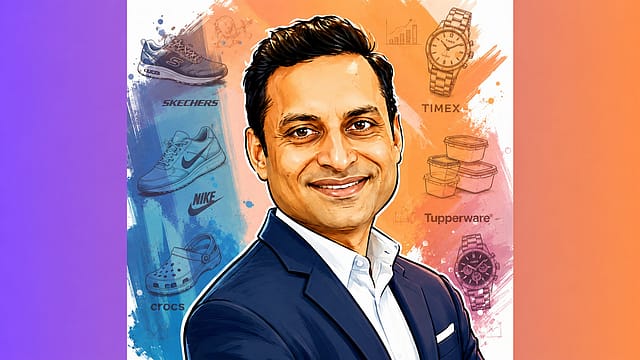
There is a moment during my conversation with Deepak Chhabra when the managing director of Timex India says something that almost sounds unfashionable in today's corporate world.
"I believe the best way to succeed is to dirty your hands."
Most executives spend their careers moving away from the ground. The higher they rise, the more meetings replace market visits and dashboards replace conversations with customers. Chhabra seems to have travelled in the opposite direction. Even after nearly three decades in consumer businesses and leadership roles across brands such as Skechers, Nike, Crocs, Tupperware and now Timex, he still believes the fastest way to solve a business problem is to leave the boardroom.
That philosophy explains almost every decision he has made, even if he doesn't describe it that way himself.
It explains why a man trained as a footwear technologist ended up running companies across completely unrelated industries. It explains why he spends most of his first month in a new organisation travelling rather than settling into his office. It explains why he is comfortable admitting failure. And it explains why Timex India, under his leadership, has grown from roughly ₹250 crore to nearly ₹800 crore in revenue while increasing profitability many times over.
Greening the Future
23 Jul 2026 - Vol 05 | Issue 30
Securing a sustainable India
Ironically, none of this was part of the plan.
When Chhabra graduated as a footwear technologist in the late 1990s, the intention was straightforward. Coming from a family deeply involved in the footwear business, he wanted to gain professional experience for a year or two before returning home to modernise the family enterprise.
"I wanted to take all the risks at somebody else's expense," he says with a smile. "Learn, make mistakes, build connections and then start my own thing."
The return never happened.
Instead, something unexpected did.
He discovered that he could think like an entrepreneur without owning the business.
"I never felt I was working for someone else. It always felt like my own business."
That single sentence perhaps explains his career better than any résumé ever could.
Learning Before Leading
Ask Chhabra whether moving from footwear to kitchenware and then to watches was difficult, and he almost dismisses the premise of the question.
Products change, he says. Consumers don't change as much as we think.
Businesses still revolve around supply chains, pricing, distribution, margins and understanding why people buy what they buy.
"The only thing you really have to learn is the product."
Whenever he joins a new organisation, he follows a ritual. Instead of spending weeks inside conference rooms, he spends nearly twenty days travelling, meeting distributors, retailers, suppliers and customers.
He is convinced strategy becomes meaningful only after seeing reality.
The conviction comes from an unlikely place.
Years ago, during hotel management training, he was handed a tray carrying four glasses balanced on one hand. It looked simple until he tried lifting it himself.
Only then did he understand the lesson.
"You can't ask people to do something if you don't know how it is done."
That belief has stayed with him throughout his career.
Corporate India often celebrates strategy. Chhabra talks far more about execution.
His approach is refreshingly uncomplicated. Build a broad direction, begin quickly, learn continuously and adjust along the way.
"The key is failing fast."
Not because failure is desirable.
Because delayed failure is expensive.
Every Turnaround Starts With One Question
Across three decades, Chhabra has switched industries several times. Yet there is a pattern to every move.
He isn't attracted by categories.
He is attracted by businesses with unrealised potential.
Tupperware was one such opportunity.
Most Indians knew the brand. Almost every household had used its products. Yet the business remained locked inside a decades-old direct-selling model where customers often waited close to two weeks to receive an order after multiple interactions with a sales representative.
Consumers had changed.
The business had not.
Chhabra pushed Tupperware into retail stores, supermarkets and online marketplaces. At the same time, he expanded the portfolio beyond plastic into steel, ceramic, glass and melamine.
On paper, the move looked contradictory.
Why would a company famous for plastic invest in alternatives?
His answer reflected how he thinks about consumer behaviour.
"If we don't offer those categories, we won't be able to sell plastic either."
Consumers, he realised, wanted choice.
Once they had it, many still chose Tupperware's premium plastic because they finally trusted that the company wasn't forcing a single solution.
The business grew rapidly.
But the transformation also exposed one of the biggest mistakes of his career.
Thousands of women who depended on Tupperware's traditional selling model suddenly found themselves competing with organised retail and e-commerce.
"I solved the consumer problem but failed my own sales force."
It is not a story many CEOs would volunteer.
Chhabra does.
Perhaps because he also talks about what followed.
The company created neighbourhood "tuck shops" inside sellers' homes, helped many become online marketplace sellers and trained others to earn through digital referrals. Some still left.
The experience changed how he viewed transformation.
Growth, he realised, is rarely just about numbers.
It is about people who have to live through that change.
Why Timex Is Betting On Fashion, Not Time
The obvious threat to every traditional watch company is the smartwatch.
Chhabra isn't convinced.
He believes the industry misunderstood what watches had become.
"Nobody checks the time on a watch anymore."
People wear watches, he says, because they express personality.
That is why Timex has remained focused on fashion watches while participating selectively in smartwatches.
He believes the next breakthrough will not be another screen on the wrist but hybrid watches that quietly combine health tracking with traditional design.
For him, technology should disappear into the product, not dominate it.
The philosophy mirrors his broader leadership style.
Consumers rarely buy products.
They buy how products make them feel.
Success, Regret and Perspective
For someone who speaks confidently about business, Chhabra becomes noticeably quieter when the conversation turns personal.
His elder son now works with Google in Canada. His younger son is studying.
Looking back, he believes ambition came at a cost.
"I gave them everything except my time."
It is perhaps the most revealing moment of the conversation.
Not because it is dramatic.
Because it is honest.
The same honesty appears when he reflects on his own leadership evolution.
Earlier in his career, he admits, he micromanaged. Today, he consciously avoids forming permanent opinions about people.
"Judge the task, not the person."
He believes employees perform better when they are trusted to recover from mistakes instead of being defined by them.
His view of Gen Z follows the same logic.
"They're not rebellious," he says. "They simply know what they want."
Give them ownership instead of instructions, and they usually surprise you.
More Than A Career Story
Toward the end of our conversation, Chhabra talks about one of his favourite indulgences.
Fast cars.
Driving on an open highway, he says, clears his mind in a way little else does.
It is tempting to end his story there.
But perhaps that misses the point.
After spending almost thirty years building businesses across industries, Deepak Chhabra still refuses to believe that success comes from elaborate strategy documents or perfectly designed organisational charts.
He believes it comes from understanding details others overlook, questioning assumptions everyone else accepts and staying close enough to the ground to know when reality has changed.
That may not be the most fashionable management philosophy today.
It is, however, the one that has quietly shaped a career built not around industries or products, but around one enduring idea.
Execution is never glamorous.
But, as Chhabra's journey suggests, it is often where transformation begins.