The Man Who Wants Liberty to Outlive the Bansals
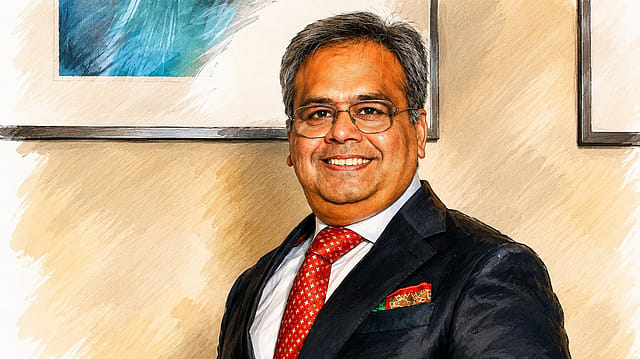
When Anupam Bansal returned from Milan in the early 1990s after studying footwear design, he imagined an India that was ready to dress differently. Footwear, he believed, could become more than a functional purchase. It could reflect personality, aspiration and style, much like it already did in Europe.
The market had other plans.
Most Indians were looking for one dependable pair of shoes that would last for years — a black leather shoe worn to work, weddings and family functions. Fashion was a luxury reserved for imported labels; domestic brands were expected to deliver durability, comfort and value.
The Age of Anger
31 Jul 2026 - Vol 05 | Issue 31
A raging generation makes the government relent. What's next?
"People just wanted a good mechanised shoe that would last five years," Executive Director of Liberty Shoes recalls in an interview with OPEN Digital. "One black shoe that goes with everything. There wasn't much appetite for fashion."
Looking back, he doesn't think Liberty was making the wrong products — it was introducing them too early. Consumers willing to pay for design preferred multinational brands, while the larger Indian middle class remained deeply value-conscious. The company had correctly identified where the market would move, but arrived there before its customers did.
That lesson stayed with Bansal. Today, as sneaker culture dominates social media and brands chase younger shoppers with limited-edition drops, Liberty has focused on remaining relevant to the broad Indian consumer rather than chasing every trend — a philosophy that runs through his story of navigating a family enterprise across one of the most dramatic periods in India's consumer history.
The youngest voice in the room
Bansal often describes himself as the family's experiment.
He was the youngest among nearly a dozen members of the second generation, growing up in a business where responsibility fell to those much older than him. That gave him unusual freedom — but it also meant his opinions carried the least weight.
"The advantage of being the youngest was that I had no stress," he says. "Everyone else was carrying responsibility while I was still a kid. The disadvantage was getting your point of view accepted."
His education reflected that difference: the first in the family to attend boarding school, the first to move to Delhi for higher studies, the first to study abroad — each a small departure from tradition, exposing him to environments very different from Liberty's manufacturing base in Karnal.
By the time he graduated, Liberty was preparing for its public issue in 1994, and the company entrusted him with marketing the IPO across Tier-II towns while senior executives focused on larger cities — an early education that reinforced the role he would eventually play: not to preserve the status quo, but to bring back ideas from outside.
While Karnal remained the centre of manufacturing, Bansal built his understanding of the business from Delhi, where marketing, retail and consumer behaviour became his natural interests. "My upbringing was very different from the rest of the family," he says. "Living independently in a metro gave me a different way of looking at the business."
The contrast often created healthy friction. The older generation had built Liberty through manufacturing excellence and operational discipline; Bansal, influenced by global exposure, wanted to make the company younger, more fashion-conscious and more consumer-centric — a balancing act made more urgent by an India that, after opening its economy in 1991, was welcoming international brands, organised retail and a new generation of consumers.
Building a market that didn't yet exist
If Liberty's products sometimes arrived before consumers were ready, the company's retail strategy was equally ahead of its time.
When Bansal was asked to build Liberty's retail business in the early 2000s, branded footwear was still largely sold through neighbourhood multi-brand outlets that had little incentive to prioritise established brands, and customer experience was rarely part of the conversation. For Bansal, relying entirely on such retailers meant surrendering control over the brand.
"It needed investment," he says. "We had to build stores in malls and in the right locations because multi-brand outlets wouldn't give you the visibility or the brand experience you wanted."
The decision reflected a broader shift as shopping malls redefined urban consumption. Adidas and Reebok, meanwhile, entered India with entry-level products aimed at building market share, while Liberty continued offering its strongest products — often at higher price points than its multinational rivals.
"People find it surprising," Bansal says. "But there was a time when our shoes were priced above Adidas and Reebok because they were bringing their lowest-end products to India while we were bringing our best."
Those experiences changed how he saw the Indian consumer: there was no single market, only multiple Indias moving at different speeds. The challenge wasn't predicting trends — it was recognising when the country was ready for them.
Reinventing Liberty
If the first decade of Bansal's career was spent understanding the market, the next was spent rebuilding the company itself.
Around the turn of the millennium, Liberty confronted multiple transitions at once. The founding generation passed away within a short span, leaving the second generation to steer the business through uncertainty just as India's footwear industry was opening up — manufacturing de-reserved, organised retail gathering pace, multinational brands turning aggressive. For many legacy companies, the instinct was to defend what already existed. Bansal believed Liberty had to do the opposite.
"We had to move from a family legacy-owned business to a corporate one," he says. "Everyone had to start behaving like an employee of the company rather than an owner. The business had to become generation-less."
It was a quiet transformation, one that rarely finds its way into annual reports but fundamentally alters how companies survive across generations. Processes replaced instinct: SAP was introduced, organisational systems strengthened, succession planning treated as seriously as sales or manufacturing. The objective was to ensure the institution could outlast any one family member.
The same philosophy informed another decision Bansal considers transformative: for years, Liberty's brands were owned by family-controlled partnership firms and licensed to the listed company. In 2018, he pushed to bring those brands under the company's ownership instead.
"I wanted brand ownership to sit with the company as an asset, not with the family," he says.
The distinction may appear technical, but it reflects a larger shift: a brand should belong to the institution that creates value around it, not to individual family ownership.
The decisions that cost him sleep
Ask Bansal about the biggest setbacks of his career, and he doesn't point to quarterly earnings or failed product launches. Instead, he speaks about decisions that carried consequences for years.
The first was Liberty's retail expansion during the organised retail boom of the late 2000s. Confident that modern trade would reshape the footwear business, the company invested aggressively and entered a joint venture with Kishore Biyani's Future Group. The timing proved unfortunate — the global financial crisis disrupted consumer spending and the business struggled to generate returns.
"Retail was riding high at the time," he recalls. "We lost a significant amount of money over one or two years."
The second disappointment was closer to home. Bansal spent years working on a plan to simplify Liberty's ownership structure by acquiring the partnership entities and consolidating them within the listed company. Despite considerable effort, it never reached completion.
"I worked hard on that transaction and wasn't able to complete it," he says. "That also gave me a lot of sleepless nights."
Both setbacks reflect the same instinct that has guided Bansal's career: a willingness to reshape the business before circumstances force it to change.
"You don't give up," he says. "You don't become overly aggressive either. You hold on to your vision and wait for the right moment."
Competition wasn't always the hardest part
It is tempting to assume that Liberty's greatest challenge has been competing with global sportswear brands. Bansal sees it differently: the harder task has been managing change within a large business family while preserving relationships outside the boardroom.
"We've learnt to disagree respectfully," he says. "The challenge is how you respect someone and still have a different point of view when it matters."
That philosophy has grown more important as the family has expanded across generations. The objective is not to eliminate disagreement but to build a culture where it strengthens decision-making rather than weakening trust.
His admiration for his father also reflects that belief. Bansal lost him at a relatively young age, but one lesson has remained central to the way he approaches business.
"What I learnt best was bringing the emotional quotient into business," he says. "Relationships with employees, vendors and customers should go beyond transactions."
It stands in contrast to the data-driven language of modern management. For Bansal, institutions are ultimately built on relationships, not spreadsheets alone.
The customer India keeps forgetting
For someone who has spent three decades studying the footwear business, Bansal is surprisingly reluctant to make sweeping statements about Indian consumers. Ask him about Gen Z, the demographic dominating every marketing presentation today, and he responds with a caveat.
"Gen Z is a great trend to chase," he says. "But I wouldn't want to build our whole marketing strategy around it."
The comment isn't a dismissal of younger consumers. It is a reminder that India rarely behaves like a single market. A 22-year-old in Bengaluru has little in common with someone of the same age in a Tier-II town — their incomes, aspirations and choices differ, and a young professional's disposable income is often directed towards travel, gadgets or eating out before it finds its way into considered purchases such as footwear.
"Liberty Shoes finds itself at a defining moment in its 70-year history," said a brand consultant who did not wish to be named. "It operates in a market where consumers no longer buy footwear solely for comfort or affordability, but for identity, status and self-expression. The company's challenge is not manufacturing, distribution or even competition. It is proving that a brand built for one generation can remain relevant to the next without losing the trust of the customers who built it."
For Liberty, that makes the consumer over twenty-five a more stable proposition. "They're more conscious, more aware and more mindful," Bansal says. "We're focused on the considered buyer."
Beyond demographics, Bansal has grown sceptical of companies that design products for people who look like themselves rather than for those who actually buy them.
"I keep telling people at Liberty to stop merchandising for themselves," he says. "The way we live and the people we meet are completely different from the people who buy our shoes in large numbers."
In metropolitan India, consumers may look remarkably similar irrespective of geography. But venture even fifty kilometres outside those cities, Bansal argues, and behaviour changes dramatically: price sensitivity, occupations, climate — even the product itself has to change.
"The South customer is very different from the North customer," he says. "Foot shapes are different. The way people dress is different. Someone who wears a dhoti every day in a coastal region isn't necessarily looking for closed shoes."
There is no average Indian consumer — only multiple Indias, each demanding its own understanding of value and utility.
Modern tools, old fundamentals
The same instinct for balance shapes Bansal's thinking about technology. AI, he believes, will change how businesses operate, and Liberty has encouraged its adoption — but he is wary of professionals who mistake speed for understanding.
"I promote AI in the company," he says. "But if you don't know your accounting fundamentals, you can't properly run AI."
His concern isn't with technology itself but with the temptation to bypass first principles. A calculator simplifies arithmetic, just as AI can accelerate analysis, but neither replaces the need to understand the logic behind the answer — a philosophy that echoes throughout his career, returning always to the idea of balance: between family and professionalism, governance and entrepreneurship, technology and human judgement, fashion and functionality.
The next reinvention
Liberty Shoes enters its next phase at a time when the Indian footwear market is more competitive than it has ever been. In FY26, the company reported revenue from operations of ₹739.99 crore, up 9.5 per cent, while net profit declined 17.5 per cent to ₹11.19 crore. Bansal's immediate target is to push past the ₹1,000 crore revenue mark by strengthening retail and expanding online.
Yet when asked what worries him most, he doesn't mention competitors, input costs or fashion trends. His answer returns to the institution he has spent his career building.
"What genuinely worries me," he says, "is whether we can successfully hold the whole family together and make sure everyone feels they have a stake."
It is a revealing answer from the leader of a listed consumer company in one of India's fastest-changing markets. After three decades adapting to liberalisation, organised retail, global competition and shifting consumer behaviour, the uncertainty that occupies him most is not external. It is internal.
Perhaps that is because Bansal has already learnt one lesson the hard way: markets eventually catch up, consumers evolve, fashion changes. The ideas that seemed premature in the 1990s can become mainstream a generation later.
Institutions, however, require constant reinvention. For one of India's oldest footwear companies, that may prove to be the most enduring test of all.