The Spice Is in the Name: ZOFF Wants Indians to Rethink the Whole Spice Shelf
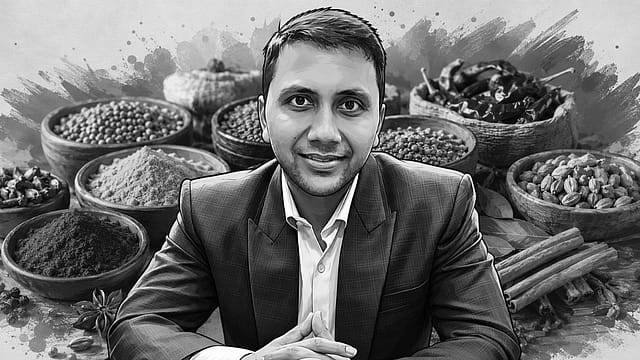
The spice market is already awake when Akash Agrawalla walks in.
The lanes are narrow. The air is thick. Sacks of red chillies lean against walls. Turmeric sits in yellow mounds. Coriander seeds spill from gunny bags. Black pepper glistens under the light. Somewhere, cumin is being scooped into a plastic bag.
The smells arrive before the people do. Earthy. Sharp. Sweet. Hot. A little chilli catches in the throat. A little cumin hangs in the air. A trader plunges his hand into a sack and pulls out a fistful of whole spices. The customer looks at them, asks the price, bargains for a while and buys them. That is the entire transaction. There is no brand conversation. No provenance or laboratory report or question about how long the spice has been sitting there or how it was stored. Just: "Bhaiya, khade masale de do."
Rise of the Pivotal Power
18 Sep 2026 - Vol 05 | Issue 38
The BRICS declaration is a strategic victory for Modi
And Agrawalla sees the problem. The consumer knows what the spice is. She doesn't necessarily know "whose spice it is."
For decades, Indians have bought whole spices this way. They have travelled through mandis, wholesalers, neighbourhood stores and kitchens with remarkably little branding attached to them. Spice powders gradually became consumer brands. Whole spices largely remained commodities.
Everest had a name. MDH had a name. Catch had a name. But the cumin sitting in a generic packet could be almost anonymous.
Agrawalla thinks that is strange. Not because India needs more spices. Because it needs to know more about the spices it already buys.
That thought sits at the heart of ZOFF Foods, the Raipur-based company he started in 2018. “The category was operating almost as it had 40 years ago,” Agrawalla says in a conversation with OPEN Digital. “Consumers had brands for spice powders, but when it came to whole spices, there was very little organised play.”
It was not an obvious place to look for disruption. That was precisely what made it interesting.
A CATEGORY WAITING TO BE CRACKED
Consumer businesses in India have spent years reinventing themselves.
Shampoos became sachets. Snacks became brands. Coffee moved from tins to capsules. Grocery moved from kiranas to apps and back again.
Spices? A box was still a box. A packet was still a packet. And whole spices were often still sold loose or in generic packaging.
Agrawalla saw a market that had become comfortable with its own inertia. His opportunity was not to invent another spice. It was to organise the category around something consumers were increasingly demanding elsewhere: trust. But trust, he argues, cannot be manufactured by saying the word often enough. “Trust cannot be created merely through marketing by repeatedly saying that a product is pure or safe,” he says. “We wanted to demonstrate the quality of our product instead of simply talking about it.”
That explains ZOFF's fixation on the whole spice. Look at the cumin, pepper or cardamom. Before the spice becomes powder, it is still recognisable. The product itself can become part of the pitch. The proposition is almost disarmingly simple: don't just tell consumers that the product is good. Show them. That distinction matters in a category where consumers have traditionally had little information about what they are buying.
How old is the spice? What grade is it? Where did it come from? How was it stored? What exactly went into the packet?
For much of the unorganised market, the consumer simply does not know. And yet the numbers make the blind spot difficult to ignore.
India's overall spices market is enormous. IMARC estimates it at around ₹2.2 lakh crore in 2025. Agrawalla's own pitch is even more specific: roughly half of that market is represented by spices in whole form, creating a tens-of-thousands-of-crores opportunity in a category that has historically had relatively little organised branding.
That is the white space ZOFF wants. Not necessarily another Everest. Something different. A brand that makes the spice itself part of the evidence.
FROM COMMODITY TO CONSUMER BRAND
The hardest part may not be selling the spice. It may be persuading the consumer to care.
Agrawalla says the biggest challenge is behavioural. Consumers have been buying whole spices for years without necessarily thinking about quality or brand. They know the ingredient. They don't always know the company behind it.
That habit is deeply embedded. The customer asks for cumin. The retailer gives cumin. The transaction ends. Changing that requires more than a packet redesign. It requires education.
ZOFF's emerging proposition is, therefore, less 'buy our product' and more 'know what you are buying.' Its upcoming consumer communication is built around that idea: know your brand.
The logic extends beyond spices. A consumer may happily pay a little more for a recognised packaged product if the perceived risk of the unknown is higher. But in traditional retail, a cheaper alternative can easily win because the consumer may not know what distinguishes one product from another.
That is the battle ZOFF is trying to fight. And increasingly, it is fighting it online. The company says around 70% of its revenue comes from whole spices. E-commerce and quick commerce helped ZOFF build its early reach, allowing a relatively young brand to get in front of consumers without first having to construct the kind of distribution machine that established FMCG companies possess.
There is another signal that Agrawalla watches closely: Search.
When a consumer begins by searching for “jeera” and increasingly ends up clicking on ZOFF, or starts searching for the brand itself, something has changed. The company is no longer merely selling an ingredient. It is becoming a name.
Agrawalla sees that as a sign that the consumer is beginning to move from product-led behaviour to brand-led behaviour. That matters. Because ultimately, the ambition is much bigger than getting one more packet into one more kitchen. He wants the consumer to remember the name.
THE ₹200-CRORE QUESTION
ZOFF has crossed the ₹100-crore revenue mark, reporting ₹103.7 crore in operating revenue in FY25, according to regulatory filings accessed through Tofler.
The number is meaningful. But the harder number is profitability.
The company has continued to invest in marketing, distribution, people and brand building, widening its loss even as revenue has grown. Agrawalla says the business is improving, but the immediate focus is still on building the machine.
That machine is getting bigger. ZOFF raised $2 million in a pre-Series B round led by existing investor JM Financial Private Equity, with participation from Aman Gupta. The money is being used to strengthen distribution and build the next phase of the company. Because the internet can create discovery. It cannot put a packet into a kirana shop. And in spices, availability can matter as much as awareness. You can know ZOFF. You can search for ZOFF. You can even want ZOFF. If the neighbourhood store does not have it, the customer may simply pick up something else. That is why the next battle is offline.
THE KIRANA PROBLEM
There is a delicious irony here. A company that built itself through digital channels is now investing in one of India's oldest distribution networks: the neighbourhood retailer.
But ZOFF is trying to do it differently. Recently, Meesho acquired Kirana Club, a platform that has built a network of retailers across Tier 2, Tier 3 and smaller cities and ZOFF wants to use that technology to connect directly with retailers, allowing them to order products through an app rather than relying entirely on a conventional distributor chain.

For ZOFF, the attraction is obvious. India is too large to build a traditional distribution network everywhere quickly. But a tech-enabled retailer network can potentially take the brand deeper into places where national brands may have awareness without equal accessibility. That could become one of the more interesting pieces of ZOFF's growth strategy. The company is not merely trying to compete with the giants. It is trying to find a route around them.
THE NEXT PINCH OF GROWTH
There is another consumer behaviour Agrawalla is watching: Time. Whole spices deliver flavour. They also demand time. They need to be selected, measured, roasted or cooked depending on the dish. For someone who grew up with a kitchen routine, that is normal. For a younger consumer rushing through a weekday dinner, it can feel like work.
That is where ZOFF's ready-to-cook products come in. The company has expanded into gravies, marinades and other convenience products, betting that the consumer who wants the flavour of spices may not always want the labour that comes with them. The opportunity is particularly interesting among younger consumers, including those increasingly making household purchasing decisions. Agrawalla sees a generation that is digital-first, more conscious about what it consumes and less attached to the purchasing habits of its parents.
But he does not believe that consumer exists only in India's metros. The digital consumer is also sitting in Tier 2, Tier 3 and rural India. The content may have to change. The influencer may have to change. The language may have to change. The consumer does not. They still want something that tastes good. They still want something they can trust. And increasingly, they have the money and the means to choose.
That may ultimately be ZOFF's biggest bet. Not that Indians will suddenly abandon the kirana. Not that whole spices will disappear from traditional retail. Not even that every consumer will become obsessed with provenance. The bet is smaller. And therefore harder.
That one day, when somebody walks into a store and asks for cumin, the next question might not simply be: “How much?” It might be: “Which brand?” That would represent a profound change in a category that has survived for generations on familiarity, habit and trust in the person behind the counter.
Agrawalla is trying to move that trust one step further. From retailer to brand, from commodity to product, from claim to proof, and from spice to name.
The market is already crowded. The giants are already there. The consumer already has choices. What ZOFF is betting on is that there is still one thing missing from the shelf. A reason to look twice, at the spice, at the packet, and finally, at the name.