Boy, Oh Boy! Pulsar’s ‘Bad Boy’ Can’t Kick the ‘Definitely Male’ Habit
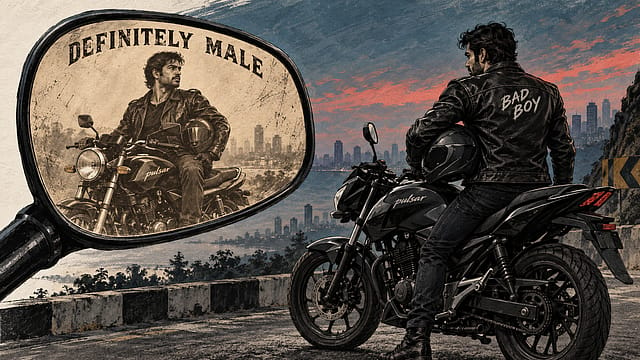
The nurses are back. The white sheet is back. And the boy beneath it appears to have acquired a reputation.
Twenty-five years after Pulsar made a motorcycle’s sex the punchline of its launch advertising, Bajaj has returned to the scene. In the latest campaign, Ogilvy’s anniversary sequel revisits the two nurses and the covered machine to introduce the new Pulsar 150.
Then: “It’s a boy.” Now: “It’s a bad boy.”
It is an economical sequel. One additional word supplies the update. Recognition does the rest: an old joke, a familiar setup, a machine with an attitude.
But between those two boys sits a more interesting story. Pulsar’s original declaration was “Definitely Male”. Its subsequent vocabulary became “Definitely Daring”, a proposition Bajaj was already using in an official social post in 2024. The adjective could now describe anybody with an appetite for a spirited ride.
Zeroing In on ECI
09 Oct 2026 - Vol 05 | Issue 41
Constitutional legitimacy versus political opportunism
Yet when the brand reaches into its memory for an anniversary, the boy returns.
That is the useful contradiction here: a brand can retire a tagline faster than it can retire the fantasy that made the tagline work.
Gender-neutral, with a male lead
The tension becomes sharper beside Bajaj’s own account of Pulsar.
“The brand is completely gender-neutral,” Sumeet Narang, president, marketing, Bajaj Auto, reportedly said in a recent interview. He pointed to women Pulsar riders and distinguished the brand’s creative expression from the people it targets. He also described its original expression as “perhaps perceived as definitely male.”
“Perhaps” is doing some work there. The audience did not have to excavate an obscure subtext. The original tagline announced the gender.
Still, Narang’s distinction deserves consideration. Giving a motorcycle a male personality does not prevent women from buying or enjoying it. A woman can love a Pulsar’s looks, performance and attitude without treating its advertising as an instruction about her place in the world.
But advertising does more than identify who may transact at a dealership. It helps establish who appears naturally at home in a product’s imagined world.
A brand can welcome everybody as a customer while repeatedly picturing one kind of person as the owner of its pleasures. That gap between commercial access and imaginative belonging is where this film becomes worth examining.
“A brand’s stated target audience and its symbolic world can move at different speeds,” says Ashita Aggarwal, professor of marketing at SP Jain Institute of Management & Research. Removing an explicitly gendered tagline broadens the proposition, but consumers also learn who the brand is for from the roles, rewards and relationships its advertising repeatedly shows.
The question is what happens when a brand with an inclusive description of itself repeatedly finds its most recognisable personality in a boy.
Macho likes an audience
Pulsar’s original device was unusually literal: it gave the machine a sex. The anniversary supplies that machine with a more mischievous personality. The nurses have a crucial role in both versions. They identify what the motorcycle is.
Read as advertising, their recognition helps certify its masculinity. The women participate in the joke, but the joke revolves around the male identity of the object they encounter.
This is a more precise criticism than simply complaining that an ad contains women. Their presence alone tells us remarkably little. The useful question is what they get to do.
Do they choose the machine? Understand it? Control it? Experience the thrill? Or does their response establish how desirable the machine—and, by association, its imagined owner—must be?
In the familiar macho sales fantasy, admiration becomes another promised feature. The purchaser acquires a vehicle, but is invited to imagine acquiring a more impressive self alongside it. Somebody else’s approving attention completes the transaction.
That is why the woman matters to this kind of masculine performance. She supplies an audience for it.
The same distinction applies to men. A male rider need not want to be a menace, a conqueror or the most conspicuous person at a traffic light. He might want skill, escape, company, beauty, or simply the pleasure of a well-taken bend. There is considerable emotional territory between a mileage calculation and a bad-boy audition.
Boys, men & category’s casting department
The tempting shorthand is to put the Bullet in the grown-man corner and Pulsar in the boy-with-swagger corner. As a reading of masculine archetypes, that makes sense: gravitas in one register, youthful provocation in another.
It should remain a reading, however. “Bullet for men” is not being offered here as a verified advertising line, and neither brand’s entire history can be reduced to one masculine type.
The more useful observation is how easily a motorcycle discussion becomes a discussion about varieties of manhood. Before anyone has asked about riding, the casting department has begun sorting the personalities.
Indian two-wheeler advertising has also challenged that allocation. Hero Honda Pleasure’s campaign with Priyanka Chopra asked, “Why should boys have all the fun?” The question gave women an explicit claim to pleasure and independence.
It was a scooter campaign. That detail opens another question: does the category’s imagination become more comfortable with women’s freedom when it can assign that freedom a separate vehicle?
No single scooter ad answers that. But the comparison exposes a creative choice. A brand can invite women into enjoyment directly. It can also keep them nearby while somebody else occupies the centre of the fantasy.
The distinction is agency. A woman enjoying power for herself changes the story more substantially than another woman being impressed by it.
When being nice sold motorcycles
The global history offers an instructive reversal.
Honda’s American campaign, “You meet the nicest people on a Honda”, deliberately widened the picture of who a motorcyclist could be. Honda’s own history describes an American market burdened by an outlaw image. Its advertising showed women, couples and families using the Honda 50, presenting motorcycling as an ordinary, accessible pleasure.
The comparison has limits. A small Honda in mid-century America faced a different commercial problem from a performance motorcycle in contemporary India. Niceness is not a universal creative prescription.
What travels across those differences is the strategic choice. A familiar stereotype can make an ad immediately legible. Challenging it can make the product imaginable to people who had previously considered themselves outside its world.
Pulsar’s sequel adds badness to an established boy. Honda found an opportunity in making the motorcycle less dependent on the outlaw.
Neither decision is dictated by an engine. These are stories companies choose to tell around machines.
Royal Enfield offers a useful counterweight to the masculine shorthand, too. Its Build. Train. Race. programme gives women opportunities to develop motorcycles and compete on them.
The editorial distinction is straightforward: participation lets skill carry the argument. Power need not lose its appeal when a woman exercises it. The machine does not require a softer personality to accommodate her.
Give nostalgia its due
There is a strong defence of the Pulsar film, and it deserves more than a ritual paragraph about the other side.
An anniversary is an invitation to remember. A distinctive old commercial gives a brand something a generic montage cannot: a scene people may recognise before the logo arrives. A sequel can reward those viewers, reconnect them with a younger version of themselves and introduce the joke to people who missed it the first time.
The callback also depends on specificity. Replace every recognisable element and the pleasure of recognition disappears. A brand is entitled to revisit its history without making every anniversary film a declaration about the whole of society.
Nor is “bad boy” necessarily an endorsement of dangerous riding or bad behaviour towards women. In advertising, the phrase can simply signal mischief, confidence or styling. Claims of harm, backlash or commercial failure would require evidence that this creative reading does not supply.
The film can, therefore, work as nostalgia and still deserve scrutiny as a present-day choice.
The audience’s fondness for an old idea explains why a brand retrieves it. It does not settle whether the idea has evolved. That is the challenge for a company whose contemporary proposition gives it more room than its original tagline did.
What would daring look like?
“Definitely Daring” has possibilities that “Definitely Male” closes down. Daring can belong to different bodies, ages and temperaments. It can describe learning a difficult skill, taking a first long ride or finding the confidence to join a community.
None of that requires draining motorcycling of speed, muscle, humour or desire. Those are human attractions. Treating them as exclusively male would reproduce the very assumption being questioned.
“The opportunity is to broaden who gets to experience the brand’s core promise,” says Aggarwal. Women need not be shown rejecting power or performance. Giving them expertise, choice and enjoyment within the story can expand the meaning of the brand without weakening its character.
The creative opportunity is to let more people possess those pleasures within the story. That involves more than changing the gender of a protagonist or adding a rider for a final group shot. It means letting choice, expertise and enjoyment determine who matters in the film.
An anniversary also offers an opportunity to show what has changed around a recognisable scene. The familiar setup can remain while the relationship to the machine develops. Recognition gives the audience a way in; a genuinely different perspective gives it somewhere to go.
Pulsar has found a neat new word for its returning boy. The more interesting next chapter would expand the people who get to live its promise.
The motorcycle can keep its muscle. The imagination needs more room.