The Spy Who Loved Ketchup: How Brands Bonded with the Bond Moment
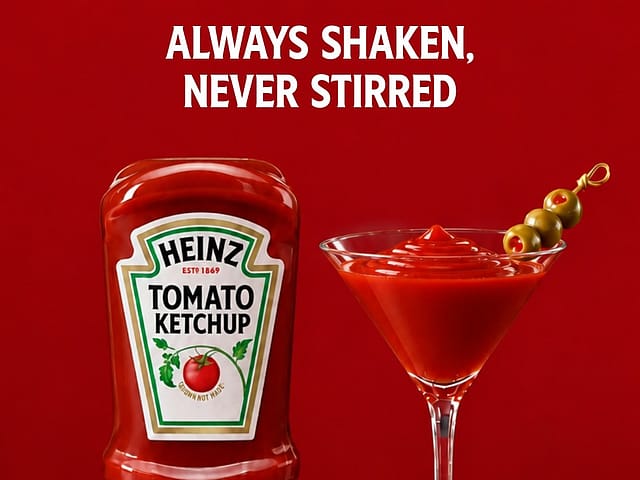
Heinz has served James Bond a drink that ought to get somebody fired.
There is a martini glass, a cocktail pick threaded with olives and enough red sauce to suggest that dinner has suffered a security breach. Beside it stands a bottle of Heinz Tomato Ketchup. The backdrop is red. The drink is red. Somewhere, a very expensive bartender is considering witness protection.
“Always shaken, never stirred,” says the creative. The Instagram caption introduces the suspect: “The names Ketchup… Tomato Ketchup.”
What a gloriously filthy thing to do to good taste.
With Robert Pattinson announced as the new James Bond, Heinz UK & Ireland has found a way into the tuxedo without needing to photograph the man wearing it. It has taken a ritual from cinema and connected it to a ritual from the kitchen. Shaking a ketchup bottle suddenly acquires an MI6 security clearance.

The Wealth Issue 2026
06 Nov 2026 - Vol 05 | Issue 45
Portraits of Dreamers and Doers under 35
The martini is ridiculous. The connection is exact.
That is why this little red intervention deserves more attention than the usual parade of brands introducing themselves surname first. You recognise Bond, remember Heinz and mentally perform the action that joins them. A condiment has managed to make a spy’s most famous drink order sound like product copy.
Amazon MGM Studios announced Pattinson’s casting on November 16, with Denis Villeneuve directing the next film. That gave social teams around the world a fresh face and an extraordinarily well-stocked prop cupboard.

The drink, the dinner jacket, the gun-barrel opening, the cars, the name delivered twice: Bond arrives with a collection of recognisable habits. An advertiser can remove the actor and still leave enough evidence for everybody to identify the character.
For brands, that is an irresistible invitation. It is also a trap. Once everybody has access to the same joke, speed buys a place in a very crowded queue.
Heinz gets ahead because its product has something to do there. The bottle has earned its place beside the glass. There is even a pleasing social afterlife underneath the post. Intuit supplies “license to dip”; Valspar Paint UK admires the red; Quorn offers a crispy accomplice. A ketchup martini has become a small networking event.
The comments are amusing, although the image would survive perfectly well without them. That distinction becomes useful as the rest of the Bond party arrives.
Toblerone brings two names and a reason to sell you both.
Its creative shows a man in a dinner jacket holding two personalised bars. One says Edward. The other says James. Pattinson’s vampire from Twilight and his newly announced spy are reunited in the confectionery aisle. The caption points out that people can personalise the bars, even when those people happen to be the same person.
There is a proper little commercial mechanism inside the gag. Bond’s introduction makes names topical; Toblerone has a product that puts names on packaging. Pattinson’s career supplies the demonstration. Somebody in the comments asks whether the bars are being sold. That is one person’s response, rather than evidence of a sales stampede, but it is precisely the question the creative invites.
The actor changes identities. The wrapper changes names. Chocolate gets a job in the story.
FamilyMart Malaysia takes a more cheerfully undignified route. A man adopts the spy’s weapon-ready pose while holding a Hokkaido Milk Cream Bun. The artwork introduces the bun and adds that it has been “purchased 007 times today”. Treat that as the brand’s joke, rather than an audited sales disclosure.
The pleasure lies in the casting. This is a serious face attached to an unserious assignment. Cinema’s most elaborately equipped operative has been sent out with a cream bun. The enormous distance between the pose and the purchase is doing the work.
Mercedes-AMG Petronas F1, meanwhile, appears to have a complaint for the casting department.
“Russell, George Russell,” begins its post. Its own candidate drives fast cars and looks good in a suit. The team knows who its first choice would have been.
This is affectionately partisan nonsense, backed by enough truth to be funny. A racing team has a real driver who already inhabits part of Bond’s fantasy: speed, tailoring, controlled danger and a camera waiting somewhere nearby. Mercedes can use the announcement to advertise its own leading man.
It also supplies something a congratulatory post usually lacks: a point of view. The decision has been made, and the team is still lobbying for George. There is no need to invent a dispute with the producers to enjoy the sulk.
The Indian streaming accounts find their opening in Pattinson’s employment history.
Netflix India posts his Bruce Wayne image with “The name is Wayne, Bruce Wayne”. Prime Video India reaches for Twilight and introduces Pattinson under his own name. The new Bond announcement becomes an occasion to retrieve the old crush and the old cape.
There is a competitive reading here, though neither post establishes a coordinated exchange. Each platform is steering the attention towards a version of Pattinson it can put on its own social stage. Amazon has announced his future as Bond. Netflix India can still get into the conversation through Gotham.
The joke also catches something about how audiences consume stardom. A casting announcement cannot make Edward Cullen disappear. Viewers carry earlier roles into the next one, along with the crushes, jokes and arguments attached to them. Streaming accounts can turn that accumulated memory into another reason to revisit a film.
PlayStation takes a more direct interest in the vacancy.
“Bond, the role is yours on PS5 in 007 First Light,” says its post. Everybody watching the casting spectacle is offered a chance to play. The game has its own Bond, portrayed by Patrick Gibson; this is a timely pitch for an existing title, rather than an announcement that Pattinson is in it.
That is a neat change of perspective. All the excitement has been about one man getting the part. PlayStation hands the controller to the customer. There is somewhere for the attention to go after the smile.
Google reportedly goes into the product itself: a Pattinson search triggers a shaking results page and falling citrus peels. Bond’s drink order becomes an interruption to the very act of looking him up.
Heineken has considerably more history at this party. Its response places a beer beside a martini and offers a choice: “Shaken? Stirred? Or ice cold? We don’t judge.” The brand’s own archive dates its Bond partnership to 1997.
That history changes the reading. A newcomer is borrowing the furniture; Heineken has sat in the room for years. Its beer offers a different answer to a famously particular order. The association gives the joke a backstory, even as Heinz’s absurd red glass threatens to steal the drinks trolley.
And then there is the wrist.
Jaeger-LeCoultre named Pattinson a global ambassador on September 2. Omega first appeared on Bond’s wrist in GoldenEye in 1995. The actor arrives with one watch relationship; the character brings another.
Reuters reports that the unveiling showed Pattinson without a watch, and that Amazon MGM said it was too early to comment on possible brand partnerships. The casting does not establish which watch Bond will wear. There is no confirmed displacement to announce.
Still, the question exposes the commercial machinery underneath the memes. A wrist in a Bond film can carry years of association. The brands attached to the performer and the brands attached to the role have interests that may require careful accommodation.
That makes the ketchup martini rather more delicious. While the luxury business studies where an expensive object might sit on the next Bond, Heinz has found a useful place for a supermarket bottle in the public’s imagination.
The harder question for all these posts comes after the applause. A funny reference can leave the audience remembering only Bond. None of the creatives, by itself, tells us whether people will buy more ketchup, choose a console or renew a subscription. The evidence here supports a judgement about the ideas, rather than a verdict on their business results.
But some ideas give the brand a much better chance of being remembered. Heinz has the shake. Toblerone has the personalised wrapper. PlayStation has a role the customer can actually play. Their products help the joke happen.
Bond has spent decades making ordinary purchases look like clues to an extraordinary life. Now the social teams are having their turn at rearranging the evidence. A cream bun becomes a weapon. A chocolate wrapper becomes a casting sheet. A ketchup bottle moves behind the bar.
Heinz’s coup is that the bottle still looks entirely at home there, however appalling the drink.
For now, 007’s most entertaining new accessory belongs beside a plate of chips.