From Blinkit to YouTube, Everyone Wants a Piece of GTA 6
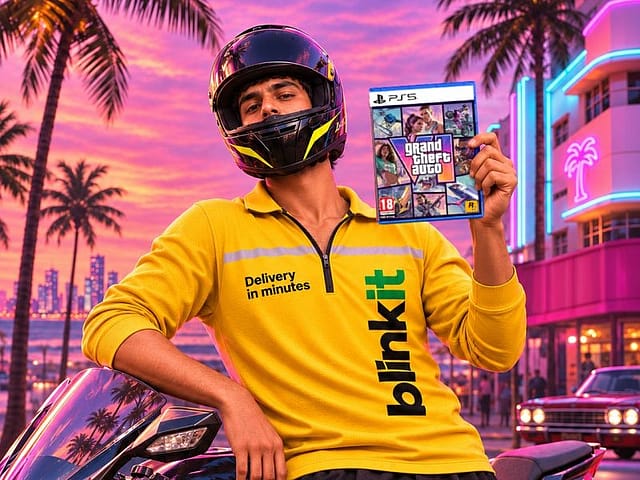
Blinkit has built its business on the promise that you do not have to wait. A packet of chips, a phone charger, a last-minute ingredient for dinner: place an order and it could be at your door in minutes. On November 18, the quick-commerce platform added a rather different item to its catalogue. Grand Theft Auto VI.
The game, which releases on November 19, will be available in select neighbourhoods across 11 Indian cities through Blinkit. There is a small catch for anyone expecting a disc: the box contains a download code. The game itself cannot be played until launch day. The packaging, however, is designed to be collectible.

The Wealth Issue 2026
06 Nov 2026 - Vol 05 | Issue 45
Portraits of Dreamers and Doers under 35
Blinkit CEO Albinder Dhindsa announced the listing with a joke about offices seeing suspicious sick leaves. It was a neat way of acknowledging what has become an unofficial part of the GTA 6 launch: people may have to find a reason not to go to work.
There is something striking about a video game appearing on a platform better known for delivering milk and groceries. It says as much about the scale of anticipation as it does about the ambitions of quick commerce. Blinkit is not merely selling a game. It is trying to own a moment when a customer wants something immediately and is willing to pay for the convenience.
The question is whether that moment can be turned into a repeatable business. A blockbuster game can create extraordinary demand on launch day, but it is not a daily-use product. For Blinkit, the listing is also a way to demonstrate that its delivery network can stretch beyond essentials into high-interest, time-sensitive purchases.
The game has given businesses plenty of time to prepare. The last instalment, Grand Theft Auto V, arrived in 2013. Since then, its successor has become a fixture of internet culture, gaming conversations and online speculation. There have been trailers to dissect, screenshots to scrutinise, release-date theories to debate and memes about the seemingly endless wait.
GTA 6 is set in the fictional state of Leonida, with Vice City at its centre, and follows protagonists Lucia and Jason. But the appeal of the franchise has never been limited to its plot. GTA gives players an expansive virtual world in which they can drive, explore, take on missions and create their own diversions. It is part crime drama, part sandbox and, for many players, a world they return to long after completing the main story.
That distinction matters commercially. A conventional game may generate excitement around its release and then settle into a sales cycle. GTA has the potential to remain a source of entertainment long after launch, because players do not experience it in exactly the same way. Some will follow the story. Others will explore the map, experiment with the game's possibilities or watch creators turn their gameplay into elaborate online narratives.
The audience has already been gathering. A YouTube Culture and Trends report put pre-release GTA 6-related video views at 40 billion. The figure is not a count of unique viewers, nor does it mean all those views came from official trailers. But it gives an indication of the attention surrounding a game that most people have not yet been able to play.
For Rockstar Games, the developer, that attention is an extraordinary marketing asset. For everyone else, it is an opportunity to build a business around the audience.
The creator economy is waiting
One of the biggest opportunities may lie beyond the game's sales. Gaming creators have learnt that a popular title can become a content engine. A game provides the setting; the creator supplies the personality, commentary, challenges and stories that keep viewers returning.
Vishal Parekh, COO of CyberPowerPC India, sees GTA VI as more than a major release. “GTA VI is much more than a game launch; it is likely to become a cultural moment for the global gaming industry,” he said in our previous story.
He believes its open-world format could create opportunities for a new generation of Indian creators. “Because GTA is built around open-world exploration, storytelling, roleplay, and player-driven experiences, it creates endless possibilities for content. Much like BGMI helped create a generation of competitive gaming creators in India, GTA VI could help shape the next generation of entertainment-first gaming creators in India.”
The distinction between competitive gaming and entertainment-first content is important. Competitive titles tend to revolve around skill, rankings and tournaments. GTA offers a different proposition. Players can inhabit characters, invent situations and build stories within the game. A creator might turn an ordinary drive through the virtual city into a comedy sketch, a roleplay episode or a continuing story involving other players.
India has seen this kind of audience behaviour before. Nishant Patel, Senior Vice President at NODWIN Gaming, recalls how GTA V gained renewed attention after PUBG Mobile was banned in India.
“When PUBG Mobile got banned in India, some of the most watched creators picked up GTA V Online, which led to a resurgence in the game's popularity,” he says. “GTA V was everywhere. Even vernacular streamers on Facebook ran custom mods while engaging with viewers in chat.”
The point is not simply that players moved from one game to another. They found a new format for entertaining their audiences. GTA V Online, the multiplayer version of the game, allowed creators to participate in shared virtual worlds, often using modifications and roleplay to create their own shows.
That history explains why Indian creators are preparing for GTA 6 well before launch. Parv Singh, better known as Soul Regaltos, remembers his reaction to the official confirmation: “I was genuinely excited when I saw that GTA 6 had finally been officially confirmed,” he says. “GTA is one of those franchises that gamers across generations have grown up with.”
Sunny Jha, who streams as Pitaji Playz, is looking at the storytelling possibilities. “My focus will be on immersive roleplay, strong storytelling, and creating content that feels fresh and entertaining,” he says.
Arpit Wadhawan, aka 8bit Headflicker, began preparing as soon as the release date was announced. “The moment the release date was officially announced, I started preparing for it,” he says. “I didn't want to miss out on the launch experience.”
For creators, preparation is not just a matter of buying the game. It can involve upgrading computers, planning formats, working out collaborations and deciding how to stand out when thousands of streamers are playing the same title. The first few days may bring a surge of viewers, but the more valuable opportunity is to turn that attention into a community that stays.
Sagar Nair, Head of Incubation at LVL Zero Incubator, describes the longer-term possibility. “For India's gaming ecosystem, GTA VI is likely to become a case study in how world-class intellectual property can sustain audience engagement, community participation, and monetisation over a decade-long lifecycle,” he says.
There is, however, a practical limitation. GTA 6 is launching first on PlayStation 5 and Xbox Series X|S. Rockstar has not announced a PC release date. That matters in India, where a large number of gaming creators and players use PCs. The initial audience that can play the game will therefore be smaller than the audience that can watch it. A later PC release could widen participation, but the console-first launch creates an immediate divide between those who can play and those who can only follow.
Brands want to join the conversation
The anticipation has also created an unusual marketing opportunity. Brands do not necessarily need to sell a game to benefit from its popularity. They need to find a way to enter the conversation without looking as though they have arrived late to it.
In Malaysia, ChipsMore! used the GTA 6 wait as the basis for its '18 Unrestricted' campaign, playing on the game's adult rating and the culture of anticipation around its release. In London, Selfridges has tapped into the franchise's visual world through a GTA-inspired retail and merchandise experience. Restaurants and businesses in Miami, the real-world city that has long influenced Vice City's look and atmosphere, have also used the game's aesthetic to attract attention.
These activities are not all the same thing. Some are formal brand campaigns; others are businesses borrowing the visual language and cultural associations of GTA. The distinction matters because a reference to the game does not automatically mean an official partnership with Rockstar.
But the marketing logic is clear. GTA has a recognisable visual identity, a large audience and a long history of online conversation. For brands trying to reach younger consumers, being part of that conversation can be more valuable than placing another conventional advertisement.
The game has also become a meme in its own right. For years, internet users have used the phrase “We got [something] before GTA 6” to joke about the game's delayed arrival. The joke has turned the wait into a shared cultural experience. Even people who do not play the franchise have encountered the anticipation around it.
That is a useful lesson for marketers: a game can become culturally relevant well beyond the people who buy it. But there is a risk in treating every viral reference as a commercial opportunity. Audiences are quick to spot brands that force their way into a conversation they do not understand.
The business beyond the game
The economic activity around GTA 6 is not confined to advertising and content. A major game release can influence spending on consoles, gaming computers, monitors, headphones, controllers and internet connectivity. It can create opportunities for hardware makers and retailers, while food and beverage brands may target people spending long hours playing or watching streams.
There is also the question of work. The idea of taking a day off to play a video game may sound like a joke, but it reflects how gaming has become part of mainstream entertainment. Companies have begun acknowledging launch-day enthusiasm through promotions and workplace initiatives. Logitech, for instance, has used the release as a peg for its Game Day initiative. Indian companies such as ChairsCarte and INDE have also announced holidays around the launch.
These gestures are attention-grabbing, but they should not be confused with evidence of a large economic impact. A day off, a viral campaign or a quick-commerce listing does not by itself establish how much additional money the game will generate for the wider economy. That will depend on actual game sales, hardware purchases, advertising budgets, creator revenues and how long the audience remains engaged.
The commercial opportunity is also unevenly distributed. Rockstar and its parent company Take-Two Interactive own the intellectual property and stand to benefit directly from game sales. Hardware companies, platforms, retailers and creators are competing for the spillover. Brands may get visibility, but converting that visibility into sales is another matter altogether.
For India, the creator opportunity could be particularly interesting. A large audience already watches gaming content, and GTA's open-ended format gives creators more room to experiment than a game built around a fixed competitive structure. But access to expensive consoles, hardware and reliable connectivity will influence who can participate. The game's popularity may be global; the ability to make money from it will depend on local infrastructure, audiences and business models.
GTA 6 has spent 13 years building an audience without being available to play. That is an unusual commercial advantage. By the time the game arrives, the conversation around it is already enormous.
Blinkit wants to deliver the box in minutes. Creators want to turn the game into years of content. Hardware makers want players to upgrade. Brands want a place in the conversation. Each is looking at the same release and seeing a different business opportunity.
The game belongs to Rockstar. The scramble around it belongs to everyone else.