The Business of Brainrot: Can India's Microdramas Turn Mindless Watching Into Money?
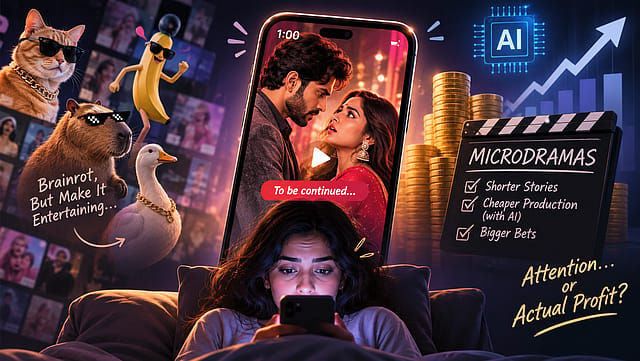
The internet has made celebrities out of dancing vegetables, AI-generated animals and videos that are difficult to explain to anyone who has not spent three hours scrolling through them. Now, the same appetite for the bizarre, the exaggerated and the instantly consumable is finding a new format: microdramas.
These are soap operas on a stopwatch. Episodes last barely a minute or two, plots move at improbable speed and every ending is designed to make the viewer surrender another minute.
There is a serious business developing around what might appear to be unserious entertainment. Indian companies are investing in short-form serialised storytelling, experimenting with AI-generated shows and attracting capital from established global entertainment players.
Yet the industry's biggest opportunity may also be its biggest problem. When content becomes cheaper to produce and easier to replicate, what exactly makes one platform worth paying for over another?

The Wealth Issue 2026
06 Nov 2026 - Vol 05 | Issue 45
Portraits of Dreamers and Doers under 35
The question is particularly relevant as the Indian market begins to attract substantial capital. In June, audio entertainment company Pocket FM shut down Pocket TV, its microdrama experiment, after five months. ShareChat, through its short-video and entertainment ecosystem, is investing in the format and using AI to reduce production costs. Meanwhile, EloElo Group, the company behind Story TV, raised $80 million in November in a funding round co-led by Hornbill Capital and NBCUniversal. The investment reportedly values the company at approximately $500 million.
These developments represent different approaches to a market that is still finding its commercial footing. Pocket FM's retreat highlights the difficulty of retaining viewers. ShareChat sees an opportunity in changing production economics. EloElo is building a larger entertainment and technology business around the format.
But perhaps the first mistake in evaluating microdramas is expecting audiences to behave like discerning film critics.
The internet has already established that people will watch content simply because it is outrageous, amusing, emotionally manipulative or difficult to look away from. The popularity of AI-generated absurdities, repetitive memes and what is commonly called brainrot suggests that entertainment does not always need to be intellectually demanding to command attention. The viewer is not necessarily looking for a masterpiece. Sometimes, the requirement is simply to be entertained for the next 60 seconds.
Microdramas understand this rather well. Their stories borrow from the familiar vocabulary of Indian television: wealthy families, secret identities, revenge, betrayal, forbidden relationships and improbable inheritances. But instead of allowing a plot to unfold over several weeks, they compress its emotional highs into a succession of short episodes. The cliffhanger becomes the hook, and the next episode becomes the reward.
The format is not necessarily replacing television. It is competing with everything else on the phone.
A market growing faster than its business model
According to Lumikai's State of India Interactive Media Report 2025, India's microdrama market was worth approximately $300 million in 2025 and could reach $4.5 billion by 2030. Redseer Strategy Consultants' September 2026 estimates put the market at approximately ₹2,300 crore in FY26, with a projection of ₹23,500-25,500 crore by FY32.
Redseer estimates that around 40 million Indians have paid for microdrama content at least once, while 15-17 million are monthly paying users. Its estimates also suggest that episode consumption has grown substantially, reaching approximately 800 million episodes a day in June 2026.
These are impressive numbers, but market projections should not be mistaken for realised revenue. Different research firms use different methodologies, periods and definitions of the market. Downloads, monthly active users, paying customers and episode plays are not interchangeable measures.
The distinction matters because microdrama platforms are trying to build a business out of an audience that has grown accustomed to free entertainment.
Most platforms offer a few episodes without charge before asking viewers to pay through subscriptions or in-app purchases. The model is designed around the cliffhanger. Just when a character is about to reveal a secret or confront an enemy, the viewer is asked to unlock the next episode.
It is an effective acquisition and monetisation mechanism, but it does not guarantee customer loyalty.
A viewer might spend ₹10 to finish a particularly engaging series and never open the app again. Another might watch hundreds of episodes without spending anything. Both contribute to engagement, but their value to the platform is very different.
A 2026 study by Meta and Ormax Media found that subscription renewals and pricing structures were among the concerns preventing viewers from paying. Many consumers were comfortable spending small amounts on entertainment but reluctant to commit to another recurring subscription.
This is where Pocket FM's experience becomes relevant. Its CEO Rohan Nayak identified long-term retention as a bigger challenge than acquiring users. The company's retreat from Pocket TV does not establish that the microdrama format has failed. Pocket FM described the venture as a beta experiment that was not material to its business. But it does illustrate that attracting an audience and building a profitable entertainment platform are separate exercises.
The industry will eventually have to disclose more than downloads and viewing minutes. Customer acquisition costs, subscriber churn, repeat purchases and lifetime customer value will matter considerably more.
AI changes the production equation
Artificial intelligence could make this business considerably more attractive.
A conventional microdrama series, despite its short episodes, requires writers, actors, directors, production crews, locations and post-production. ShareChat has said that a traditional series costs approximately ₹15-20 lakh to produce. Its AI workflows have reduced production costs by around 40%, with a longer-term target of 70%.
The company is also investing ₹100 crore in AI microdramas, building tools and bringing creative directors and engineers together. Its ambition is to increase the number of titles it can produce while lowering the cost of experimentation.
EloElo is pursuing a similar strategy. Founder Saurabh Pandey has said that AI is involved in approximately 70-75% of the company's production workflows, including script assistance, visual effects and localisation. The company has developed Dolphin AI, a creative suite intended to streamline the process.
There is a distinction, however, between AI-assisted dramas and entirely AI-generated entertainment. Using AI to dub a human-performed series into several languages is different from generating its characters, performances and backgrounds. The former improves the efficiency of conventional production; the latter could fundamentally alter its economics.
More interestingly, AI may make it possible to test stories that would previously have been too expensive to produce. A platform could experiment with different plots, genres and regional adaptations without committing substantial budgets to each title.
But cheaper production does not necessarily mean better entertainment.
ShareChat has reported that approximately 50% of viewers who begin its AI-generated dramas reach episode 20, compared with around 60% for live-action shows. This is a company-reported comparison rather than an independently audited industry-wide finding, but it suggests that audiences may still distinguish between the two formats when it comes to sustained engagement.
That gap could narrow as technology improves. After all, the quality of AI-generated video has changed considerably in a relatively short period. It would be premature to assume that today's limitations will determine tomorrow's audience preferences.
There is also a potential problem of oversupply. If everyone can produce hundreds of dramas cheaply, the market could be flooded with similar stories. The advantage would then move away from production capacity towards discovery, distribution and storytelling.
AI can produce a billionaire's secret daughter. It cannot guarantee that millions of people will care about her.
The advertising opportunity
Subscriptions are not the only way to monetise the format. Advertising could eventually become a much larger part of the business.
Redseer estimates that advertising revenue in India's microdrama market was approximately ₹24 crore in FY26. It projects this could reach ₹5,000-5,500 crore by FY32, as more viewers consume free, ad-supported content.
The opportunity is attractive. Microdramas offer brands a narrative environment rather than just another short-video placement. A product can become part of a character's lifestyle or a storyline, while brands could sponsor entire series.
But advertising projections are not actual advertising revenues. Advertisers will need reliable audience measurement, evidence of attention and a reason to believe that viewers remember the products they see. Too many interruptions could also damage the viewing experience.
Platforms with existing distribution may have an advantage. ShareChat can potentially use its wider social media ecosystem to introduce dramas to audiences without relying entirely on paid app downloads. Standalone platforms have to spend considerably more to acquire and retain users.
This is one reason the competition may not be limited to specialist microdrama companies. Established entertainment platforms have distribution, advertising relationships and existing content libraries. Startups, meanwhile, can build their operations around mobile-first storytelling from the beginning.
What exactly are investors buying?
EloElo's $80 million fundraise is significant because it suggests that global entertainment investors see an opportunity beyond a passing content trend.
But the company is not merely selling access to a library of short dramas. It is attempting to combine content, audience data, distribution and AI-assisted production. Story TV has more than 5,000 titles across six languages, according to the company. EloElo also operates other products, including the microlearning platform Master and AI companion platform Voxy AI.
Pandey has said that the company has achieved positive unit economics at the user level. That is encouraging, but it does not establish that the overall business is profitable. The company has not disclosed sufficient financial details to independently evaluate its valuation or the contribution of individual businesses.
The distinction is important. Positive unit economics mean that an individual customer can generate more revenue than the direct cost of acquiring and serving that customer. Company-wide profitability also depends on salaries, technology, marketing, content investment and other overheads.
There is another challenge. Microdramas are built around familiar plots that can be copied quickly. A successful story about revenge or a secret inheritance is not necessarily a defensible intellectual property asset. If platforms cannot develop distinctive characters, franchises or recognisable storytelling styles, they risk becoming interchangeable catalogues of similar content.
The comparison with OTT is tempting, but the economics are different. OTT platforms sell access to libraries and premium programming. Microdrama platforms are often selling the continuation of a story, episode by episode. Their success may depend less on how many titles they have and more on how many viewers return after finishing one.
Perhaps the industry should stop worrying so much about whether people will watch brainrot. The internet has already answered that question. People will watch bizarre, repetitive and sometimes remarkably low-effort content in extraordinary quantities. AI-generated videos are another demonstration that production polish is not always a prerequisite for popularity.
The harder question is whether that attention can be owned, monetised and sustained.
Microdramas have demonstrated that audiences will surrender a minute to a story about a billionaire, a betrayal or an improbable family secret. AI could make producing those stories considerably cheaper. Advertising could bring in viewers who refuse to pay. Investors are willing to finance the experiment.
But the next measure of success will not be how many episodes a platform can put out or how many people watch them. It will be how many viewers come back, how much they spend and whether the company makes money after paying for their attention.
In the microdrama business, the audience may be perfectly happy with a ridiculous story. The financial model, unfortunately, cannot afford to be one.