The Human Side of Titan’s ₹17,495-Crore Jewellery Business
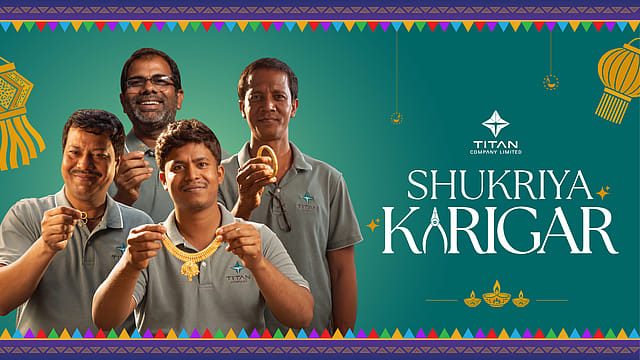
A piece of jewellery usually arrives with a story. It could be a bride’s necklace, a mother’s gift to her daughter or a ring marking a particularly memorable question. The person who made it, however, rarely gets a speaking part. Once the jewellery reaches the showroom, the karigar tends to disappear behind the glass counter, the brand name and the price tag.
Titan Company wants to change that, at least for a few minutes this Diwali.
Its new campaign, Sukriya, Karigar, puts the people behind the jewellery at the centre of the story. Conceptualised with Ogilvy, the film follows four karigars as they work on pieces meant for different occasions: a child’s first pair of earrings, a necklace for a bride’s mother, a ring to express love and a kada marking a new beginning. The artisans imagine the people who will eventually wear their creations, giving the making of jewellery a human story beyond the familiar business of buying and gifting.

The Wealth Issue 2026
06 Nov 2026 - Vol 05 | Issue 45
Portraits of Dreamers and Doers under 35
The campaign recognises more than 16,000 karigars who contribute to Titan’s jewellery-making ecosystem. It is an unusually direct acknowledgement of the workforce behind a business whose public face is built around retail brands, collections and celebrity campaigns. And it arrives at a time when the numbers behind that business are looking rather shiny themselves.
Titan’s jewellery business reported total income of ₹17,495 crore in Q2FY27, a growth of 24.1 per cent over the year-ago quarter. Domestic income rose 20.8 per cent to ₹16,343 crore. Tanishq, Mia and Zoya together recorded domestic income of ₹14,935 crore, up 19.9 per cent, while CaratLane grew 31.3 per cent to ₹1,408 crore. Domestic jewellery EBIT increased 53.1 per cent to ₹2,281 crore, with the operating margin improving to 14 per cent from 11 per cent a year earlier.
The international business also grew, with income more than doubling to ₹1,152 crore. That figure, however, needs some context: it includes Damas, which Titan acquired in the previous quarter, making the international comparison less straightforward.
The broad picture is clear. Jewellery remains a significant growth engine for Titan. But behind every new collection and every expanding retail network is a production chain that depends on skilled hands. The campaign makes those hands visible; the company's manufacturing and vendor network explains why they matter.
Titan's manufacturing footprint includes facilities in Hosur and Pantnagar, a product development centre in Mumbai and Karigar Park in Midnapore. CaratLane also has manufacturing facilities in Mumbai and Chennai. This is not simply a matter of producing more pieces. Jewellery-making involves detailed work, precision and consistency, even as designs and consumer preferences change.
For Titan, the effort to improve the environment in which this work happens predates the Diwali film. The company says it established India's first Karigar Centre in Hosur in 2014, with a focus on providing artisans a safer and more supportive workplace. Its initiatives extend to manufacturing units and vendor partners, with standards covering safety, hygiene and workplace amenities, supported by regular assessments. It also introduced training programmes for women karigars last year.
"Our karigars bring years of experience, knowledge and extraordinary attention to detail to their work. Supporting them means creating conditions in which their craft and livelihoods can thrive," says Sharad, Chief Manufacturing Officer, Jewellery, Titan Company Limited.
He adds that the company's efforts focus on "better workspaces, skill development, wellbeing and opportunities for karigars to work closer to their families". The last point is worth noting. Craftsmanship is not just about the finished product; it is also about the conditions under which the person making it lives and works.
Titan has also set out broader expectations for its partners under Pragati, a programme launched in July 2025. Its FY30 goals include extending a 4P 2.0-equivalent framework to all vendors, with at least 50 per cent of domestic production covered by it. The company has not disclosed in its Q2 presentation how much of its vendor network is currently covered or how much progress has been made towards that target.
Separately, Titan says its Design Impact initiative has supported 32 craft enterprises and covered 3,863 artisans. These are not the same group as the more than 16,000 karigars featured in the campaign. The distinction matters when measuring the reach of individual programmes.
Sirish Chandrashekar, Head of Corporate Brand at Titan, says the film is intended to recognise the connection between the artisan and the person who eventually wears the jewellery. "Jewellery becomes deeply personal through the memories it holds. ‘Sukriya, Karigar’ takes us to the karigar who imagines those moments while creating each piece," he says.
There is a neat idea at the heart of the campaign. A jeweller sells a product, but a karigar makes the object that becomes part of someone's memory. The distinction is easy to overlook in a market where the conversation is often dominated by gold prices, diamond preferences, wedding purchases and brand positioning.
Still, a Diwali film can only do so much. A thank-you is a gesture; better working conditions, training and more secure livelihoods are the harder measures of appreciation. Titan's stated vendor targets and its work with karigars offer a starting point, but the real test will be how widely those commitments translate into everyday practice.
For now, Sukriya, Karigar gives the maker a place in the frame. In an industry where the finished piece gets admired and the person behind it often goes unnoticed, that is a story worth telling.