An Apple a Day, a Loom to Pay: Raw Mango's Big Business of Indian Craft
There are easier ways to make money in fashion than working with handloom. The looms are slow, the skills are specialised, the supply chains are complicated, and the consumer has to be persuaded that a piece of fabric is worth considerably more than its raw material. You could, of course, put a celebrity in an expensive lehenga, throw in some embroidery and call it luxury. The market understands that language rather well.
Sanjay Garg chose a harder one.
In 2008, he went to Chanderi in Madhya Pradesh and began working with four weavers. There were six saris. No grand fashion empire, no elaborate celebrity machinery, no particularly obvious reason to believe that this would become a ₹100-crore business. Just a designer interested in what could happen when you stopped treating an old textile as a relic and started treating it as a material with possibilities.

The Wealth Issue 2026
06 Nov 2026 - Vol 05 | Issue 45
Portraits of Dreamers and Doers under 35
That decision would become Raw Mango.
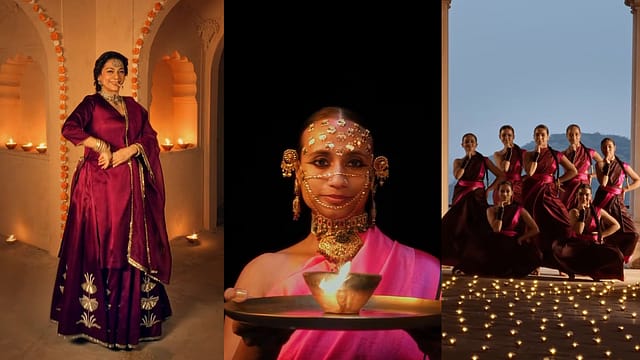
Nearly two decades later, the label is directing a Diwali film for Apple. In Step Into the Light, dancers move through the corridors of Tijara Fort in Rajasthan, dressed in Indian textiles, to a folk reinterpretation of Roop Suhana Lagta Hai, a song that will be familiar to anyone who remembers the 1990s. Juhi Chawla appears. The film is shot on the iPhone 18 Pro. Garg directs.
It is a peculiar but rather elegant meeting of worlds. One company sells a phone that costs more than many people's monthly salaries. The other sells saris that can cost as much as a decent holiday. Both have understood something about modern consumption: people don't always buy the thing. They buy what the thing says about them.
But there is a difference between making something desirable and making a business out of it. Raw Mango's FY25 numbers offer a useful reminder.
Revenue reached ₹100 crore, up from ₹54.1 crore in FY24, as per regulatory fillings accessed from business intelligence firm Tofler. That is an impressive 85 per cent jump. Net profit, however, moved from ₹2.5 crore to ₹2.6 crore. Gross margin fell from 48.4 per cent to 26.5 per cent. The business is selling considerably more fabric, but the money left after the exercise is not growing at anything like the same speed.
There is a story in that gap. And it is probably more interesting than another account of how Indian craftsmanship is finally receiving the recognition it deserves.
Because craftsmanship has been deserving recognition for centuries. Recognition, unfortunately, does not pay the electricity bill, compensate a weaver or automatically produce a healthy balance sheet.
The question is what happens when you try to turn a slow, intricate, human process into a modern luxury business. And whether the business can grow without eventually becoming the very thing it set out to challenge.
The business of making handloom desirable
When Garg started Raw Mango, Indian designerwear was largely associated with elaborate embroidery, occasion dressing and the visual language of bridal couture. Handloom occupied a different conversation, often centred on heritage preservation, artisan livelihoods and government-led craft initiatives. There were exceptions, but making handloom aspirational for a contemporary consumer was not an obvious commercial proposition.
Garg, who studied at the Indian Institute of Crafts and Design in Jaipur and the National Institute of Fashion Technology in Delhi, approached the problem from the textile rather than the garment. His engagement with Chanderi gave him an opportunity to experiment with a fabric known for its lightweight, translucent quality. Instead of treating its traditional characteristics as limitations, he explored what could be done with its yarn, colour, weave and borders.
The proposition was almost mischievous in its simplicity. What if a sari did not need embroidery to look expensive? What if the weave itself could do the talking?
Raw Mango subsequently expanded into Mashru, Banarasi brocade, Jamdani and other textile traditions. But the design philosophy remained consistent. The loom was not a museum exhibit. It was a design tool.
This was a meaningful departure from the idea that Indian luxurywear needed to be visually elaborate. A handwoven sari in an unusual colour combination could make its point without a small army of embroiderers and a kilogram of embellishment. The appeal lay in the material and the thought behind its construction.
The brand also challenged the idea that a sari was primarily an occasion garment. Its designs could be worn with contemporary blouses, jackets and other everyday clothing. The sari was not being rescued from irrelevance; it was being offered a different wardrobe.
Of course, Raw Mango did not invent contemporary handloom fashion. India has a long history of designers, cooperatives and craft practitioners working to make traditional textiles commercially relevant. What it did was give textile-led design a particularly recognisable aesthetic and a premium retail proposition.
Selling a world, not just a wardrobe
Raw Mango's more interesting achievement may be that it made cultural knowledge commercially desirable.
Its campaigns rarely follow the familiar fashion-advertising formula of putting a celebrity in a beautiful location and asking the consumer to admire the clothes. Projects such as Cloud People and Other have drawn on surrealism, symbolism and even biology. The latter explored aposematism, the phenomenon through which animals use conspicuous colours to warn predators. Heer drew on the shared cultural history of Punjab and its wedding traditions.
These are not merely collections photographed for a catalogue. They are attempts to build a world around the clothes.
There is a commercial logic to this. A garment can be copied, a colour combination reproduced and handloom itself is hardly exclusive to one label. But a recognisable design language, supported by a coherent cultural identity, is harder to replicate. Raw Mango is selling the ability to identify with that world.
Its stores extend the proposition. Garg's interest, as per several interviews available, in architecture, interiors, furniture, music and objects has meant that the brand experience does not end with the clothes. Its retail spaces are often housed in former residential properties, with the architecture and interiors forming part of the experience.
This is familiar territory for luxury businesses. A store is not merely a place to complete a transaction; it is where the customer encounters the brand's worldview. The more successfully a label creates that world, the less it has to compete on the utility of the product alone.
But there is a difference between creating a desirable world and demonstrating that consumers will keep paying to enter it. That is where the numbers become interesting.
The ₹100-crore milestone comes with a margin problem
Raw Mango's sales increased from ₹30.5 crore in FY21 to ₹100 crore in FY25. The latest year was particularly strong, with sales rising from ₹54.1 crore in FY24 to ₹100 crore in FY25. Total revenue stood at ₹100.5 crore.
The profit numbers suggest a less celebratory interpretation. Operating profit increased from ₹4.3 crore to ₹5.3 crore, while net profit moved from ₹2.5 crore to ₹2.6 crore. The reported net profit growth was just 3.04 per cent.
Gross margin fell from 48.4 per cent to 26.5 per cent. Operating margin declined from 7.9 per cent to 5.3 per cent, while net margin dropped from 4.6 per cent to 2.6 per cent. EBITDA was reported at ₹5.3 crore, up 24.39 per cent.
The contrast is difficult to ignore. Revenue has nearly doubled, but net profit has barely moved. Raw Mango is selling considerably more, but retaining a smaller proportion of its revenue as profit.
The figures do not establish why margins have fallen. Changes in product mix, input costs, pricing, inventory, retail expansion or other expenses could be involved. It would be convenient to blame the economics of handloom, but that would be premature without examining the company's cost structure.
The balance sheet offers some context. Net worth increased from ₹13.7 crore to ₹16.8 crore, while borrowings remained broadly stable at ₹8.2 crore. The debt-to-equity ratio improved from 0.6 to 0.5. Working-capital days declined from 109 to 70.
For Raw Mango, the challenge is no longer simply to establish that consumers will pay for handloom. It is to determine how much of that willingness to pay can be converted into sustainable profits.
Is luxury becoming a popularity contest?
The Apple collaboration makes the question of luxury particularly interesting.
Luxury has traditionally depended on a combination of quality, craftsmanship, scarcity, reputation and the ability to command a price premium. But contemporary luxury marketing has another appetite: visibility.
Brands want to be seen, discussed, photographed, tagged and circulated. Influencer gifting, celebrity associations and early product access have become part of the machinery that keeps products in public conversation. Apple's own product launches have increasingly involved selected creators and reviewers receiving early access to devices. There is a tension here. Luxury derives part of its appeal from exclusivity, while digital marketing wants the product everywhere.
The more people see something, the more familiar it becomes. Familiarity is good for sales, but it can be less useful for a brand trying to maintain a sense of rarity.
Raw Mango's proposition is somewhat different. Its exclusivity does not depend primarily on restricting access to a logo or creating a waiting list. It comes from the design and production process. A particular handwoven textile cannot necessarily be reproduced at the speed of a factory-made garment. Its value is tied to the knowledge, labour and time involved in making it.
This is why Raw Mango is better understood as a premium, luxury-positioned design house than casually grouped with established global luxury conglomerates. Its prices, design authorship, craft relationships and cultural capital support a luxury proposition. But the distinction between a luxury identity and a luxury business is worth retaining.
There is also a risk in romanticising craft. Handmade does not automatically mean sustainable, fairly paid or commercially healthy. The real test is whether the people producing the textiles share meaningfully in the value created by the brand. That is a question worth putting to Garg, particularly as the business expands.
An old song for a new phone
The choice of Roop Suhana Lagta Hai in Apple's film is not incidental. The original song, composed by Anu Malik for The Gentleman, brings back a particular cultural memory. Its folk reinterpretation gives it a new context, while Juhi Chawla's appearance makes the connection more immediate.
Nostalgia is an efficient marketing device because it does not need to build recognition from scratch. A familiar song can establish an emotional connection in seconds. But the more interesting thing about the campaign is how it uses nostalgia without simply reproducing the past.
The fort is historical, the textiles are traditional and the song belongs to the 1990s. Yet the choreography, filmmaking and presentation are contemporary. The film does not ask viewers to return to an imagined golden age. It uses familiar cultural references to make a new product feel rooted in a recognisable India.
Raw Mango has been doing something similar with textiles for years. It does not sell nostalgia for the sari as it was worn by a previous generation. It asks what the sari can become now.
That may explain why the collaboration works. Apple gets a cultural setting in which to demonstrate its technology; Raw Mango gets to place its design language before a much wider audience. Neither has to abandon its identity to make the association work.
But an attractive campaign is not a business model. The film can build awareness, cultural relevance and aspiration. It cannot, by itself, explain whether Raw Mango's margins will recover, whether its customer base is expanding or whether its artisan-led production can support a larger operation.
The next test
Raw Mango has reached a point at which its early differentiation is no longer enough. Indian fashion has a growing number of independent designers working with handloom, regional textiles and craft-led production. The idea that traditional Indian fabrics can be contemporary is no longer a radical proposition. The label must continue to earn its distinction through design, quality and a point of view that competitors cannot easily reproduce.
There is also the question of how much of the brand's identity is inseparable from Garg himself. His involvement in collections, campaigns, stores and cultural collaborations has given Raw Mango a coherence that many fashion businesses struggle to achieve. But a designer-led business must eventually answer whether its creative identity can outlive the founder's direct involvement.
The ₹100-crore milestone establishes that Raw Mango has found a market for its proposition. Its association with Apple suggests that the proposition has cultural relevance beyond Indian fashion. But the decline in margins makes the next question less romantic.
Can a business built on the time-intensive economics of craft become substantially larger without turning the very thing that makes it distinctive into a constraint?
The loom does not care about your growth targets. It works at its own pace. The customer, meanwhile, has a thousand other places to spend her money. Somewhere between these two realities sits the business Sanjay Garg has spent nearly two decades building.
And that may be the real question behind the apple and the mango.