Bombay Shaving Company vs Gillette: Uncle, Why So Serious?
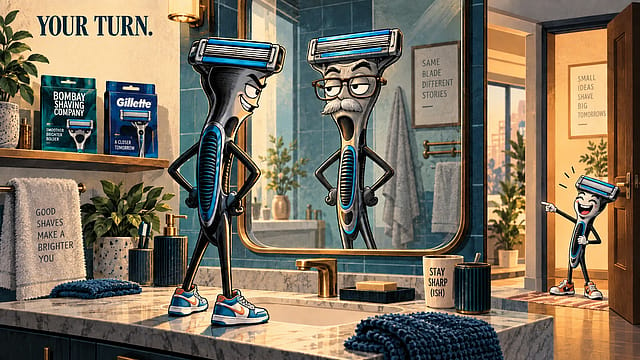
You can survive a rival calling you expensive. There is a discount for that. You can survive being called technologically backward. The product team can assemble a presentation. But “Uncle”? Where, exactly, does the chief marketing officer send that complaint?
The word arrives wearing the clothes of respect and leaves having stolen your youth. In the right Indian conversation, it performs an entire competitive positioning exercise in two syllables. You were experienced. Now you are dated. You were dependable. Now you are the person asking who approved the music. The market leader is suddenly being asked to show its ID.
Bombay Shaving Company has discovered this economical little weapon. Its Switch4 campaign casts the old razor establishment as “Uncle Razor”, with a mock courtroom doing the prosecution. The challenger wants consumers to question a familiar cartridge system and consider switching. Gillette challenged the advertisement; September 17 reporting says the original was taken down under the Delhi High Court’s direction. A revised version was also disputed.

Zeroing In on ECI
09 Oct 2026 - Vol 05 | Issue 41
Constitutional legitimacy versus political opportunism
Why does turning a company into an older relative make its market leadership look suddenly embarrassing? And why, in another advertisement released into the same cultural weather, is Aunty precisely the person a brand wants on its side?
Sima Taparia Finds a Match for Sattva
Sattva Group’s “Wish List” campaign recruits matchmaker Sima Taparia, familiarly packaged as Sima Aunty. The film plays with a demanding list of attributes, allowing the audience to assume that a prospective spouse is being discussed. The reveal moves the search from matrimony to property. The desired match is a home. Sattva claims a “100% match”.
It is a useful companion to the razor quarrel. One advertiser mobilises the older relative as an obstacle to progress. The other hires her to make an enormous decision feel navigable.
Put the two campaigns at the same imaginary family lunch. Uncle Razor wants you to continue with the familiar arrangement. Sima Aunty wants to understand your requirements. The young brand at the table would like everybody to know it is disrupting something. Nobody has yet ordered dessert.
The difference lies in what the customer is being asked to risk. A challenger selling a switch can make familiarity sound like captivity. A property brand selling a consequential commitment can make familiarity sound like reassurance. The relative carries whichever meaning the commercial needs: yesterday’s authority or somebody who knows the ropes.
This is also why the analogy deserves some care. “Uncle” and “aunty” can express affection, belonging, irritation or condescension. Age is doing rhetorical work here. It is not a product specification.
BSC wants the audience to feel that an old arrangement has overstayed its welcome. Sattva wants a familiar cultural broker to shorten the emotional distance to a new one.
Why Challenger Brands Can Get Away With More
Calling the leader Uncle changes the competition before a blade touches a face. A technical argument requires evidence. A social embarrassment requires recognition. Once the caricature lands, the incumbent must defend both its product and its place in the present.
The challenger enjoys a peculiar freedom. It can be rude and call the rudeness energy. The leader’s reply will be scrutinised for dignity, proportionality and signs that the joke hurt. Silence may look remote. Retaliation may look rattled. A legal response, however justified, can be recut into the challenger’s preferred trailer: look how seriously they took us.
That is an interpretation of the communications dilemma, not a verdict on the Gillette dispute. An incumbent can have substantive grounds to challenge an advertisement. A joke does not excuse a misleading comparison, and popularity does not settle a legal claim. Nor does a takedown establish that the challenger’s product proposition is wrong.
Still, the campaign has exposed a delicious asymmetry. The smaller brand can seek attention by making the bigger one the subject. The bigger one must decide whether replying makes the smaller one more important.
There are several ways to leave this family gathering with your dignity intact. The global advertising album contains some instructive photographs.
Microsoft Recasts the PC User
Apple’s “Get a Mac” commercials, launched in 2006, turned computers into two men: Justin Long’s casual Mac and John Hodgman’s more buttoned-up PC. Product choice became social casting. Microsoft’s 2008 “I’m a PC” response widened the cast to a varied community of users. A Microsoft employee resembling the caricature introduced the rebuttal by acknowledging the stereotype.
The strategic move was larger than a comeback line. If the challenger makes your customer look like one embarrassing person, show that the customer can be almost anybody. The response denied Apple exclusive control over what a PC user looked like.
That approach has a lesson for the corporate uncle. You need not spend the entire reply explaining how young you feel. You can question why the challenger believes everybody wants to resemble its definition of youth.
There is power in refusing the casting call. A category leader’s broad customer base can become evidence of relevance rather than an admission that it serves the uncool.
Mercedes Turns Age Into a Punchline
Mercedes-Benz chose another register for BMW’s centenary in 2016. It thanked its rival for a hundred years of competition and observed that the first thirty had been rather boring. The older company made seniority the punchline and the credential.
This was banter between established competitors, rather than a response to a startup’s attack. That distinction makes it useful. A brand can enjoy being older. It can acknowledge a rival’s achievement while quietly reminding the audience that it was already in the room.
The humour requires confidence. An elaborate announcement of how little you care usually suggests considerable care. Mercedes compressed history, rivalry and generosity into a greeting. The birthday guest received the flowers; the sender retained the last word.
An incumbent’s archive need not be a cupboard full of yellowing certificates. In capable hands, it contains ammunition.
How Old Spice Reinvented Its Personality
Old Spice supplies a third response: change the experience of the brand. Wieden+Kennedy’s 2010 work with Isaiah Mustafa, followed by personalised video responses, gave the grooming name a theatrical, absurd and highly participatory voice. Its agency account describes a campaign designed to appeal to men and women, including the women buying the products.
This was reinvention, not a documented answer to one particular challenger’s taunt. It matters because the brand did not have to erase its name to acquire a different personality. Age and stiffness were separable.
For an established company, that is more demanding than issuing a witty reply. It means allowing the brand to behave differently, trusting an unfamiliar tone and then maintaining the energy beyond one celebrated film.
The joke can open the door. Something useful must be waiting inside. “They are looking for more value and benefits at the least price possible,” said marketing professor Ashita Aggarwal of value-seeking smartphone customers in a 2017 Economic Times report.
That observation supplies a necessary interruption to all the banter. Being the entertaining nephew may win a hearing. A consumer still has to live with the purchase after the roast is over.
Congratulations. You are Uncle now
And then comes the turn that every challenger’s brand book would prefer to postpone.
The rebel becomes successful. It builds an installed base, an ecosystem and rules. Its customers accumulate habits. Its managers acquire things to protect. Somewhere, a younger company starts writing a presentation about everything it has stopped noticing.
Apple offers a particularly neat casting reversal. In 2021, Intel hired Justin Long for advertising that compared PCs with Macs. The actor who had personified Apple’s outsider cool was now questioning its products. Intel itself was hardly a youthful startup; the point is how readily the part of the challenger can change hands.
“Uncle” describes your position in somebody else’s argument. No founding myth gives you permanent immunity.
That leaves BSC with a future question more interesting than whether its current jibe travelled. If it becomes the comfortable default, will it welcome the next brand that caricatures its habits? Will it answer with a better offer, a better joke, a lawyer’s letter—or some combination of the three?
The same question applies to every company selling rebellion. Success brings responsibilities and advantages that can make yesterday’s irreverence inconvenient. The insurgent wants customers to question inherited loyalty. The incumbent it hopes to become will want to earn and retain that loyalty.
Perhaps the healthiest corporate uncle can remember being the nephew. Perhaps the smartest nephew realises that familiarity, trust and experience are assets worth inheriting, even while mocking their less attractive relatives: complacency, entitlement and the expectation of automatic respect.
Sima Aunty has one answer: make experience useful. Mercedes has another: enjoy the joke. Microsoft disputed the stereotype. Old Spice changed the performance. None guarantees commercial victory. Each shows that a brand has more than one way to grow older.
So, why so serious, Uncle?
And you, laughing at the other end of the table: enjoy it. Tomorrow somebody will call you Uncle.