Too Many Stars, One Bathroom Shelf: Can India’s Celebrity Men’s Grooming Brands All Find a Market?
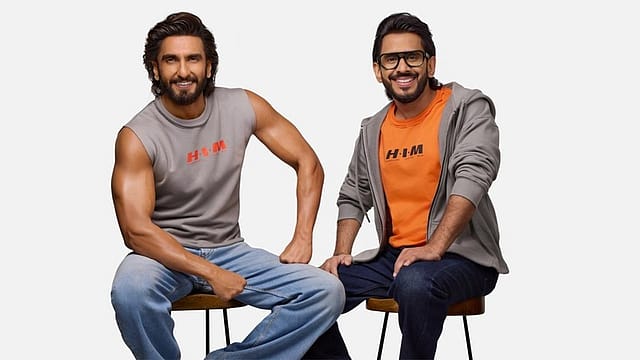
The Indian man who once borrowed his sister's face wash is becoming an increasingly attractive customer for the beauty and personal-care industry. The question is no longer whether men will spend on grooming. It is how much they will spend, which products they will buy and which brands will earn a place in their daily routines.
That is the opportunity Ranveer Singh and boAt co-founder Aman Gupta are attempting to capture with H.I.M. (Handsome Indian Man), launched on November 17. The brand enters with eight products across face, body and hair care, priced between ₹299 and ₹899. Its range includes face wash, face cream, sunscreen, body wash, body lotion, shampoo, hair serum and an exfoliating soap bar. It is available through its website, Amazon and Blinkit.

The Wealth Issue 2026
06 Nov 2026 - Vol 05 | Issue 45
Portraits of Dreamers and Doers under 35
The proposition is built around a familiar observation from Gupta: almost every Indian man has borrowed a face wash from his sister, wife or girlfriend at some point. The insight is commercially interesting because it identifies a consumer who is not necessarily opposed to grooming. He simply has not developed the habit of buying products for himself.
H.I.M. wants to turn that occasional borrowing into a regular purchase.
But the timing of the launch also reveals something about the market. Men's grooming is moving beyond shaving, deodorants and beard maintenance. Skincare, body care, scalp treatments and specialised personal-care products are becoming part of the conversation. At the same time, established companies are strengthening their portfolios, digital-first brands are moving into specialised concerns and celebrity entrepreneurs are entering the category.
H.I.M. is therefore not just trying to create a market. It is trying to claim a position in one that is already being contested.
A growing market, but a bigger opportunity in changing habits
According to Euromonitor International, India's men's grooming market recorded retail sales of ₹18,630 crore in 2025, growing 9% in value terms. Its definition covers men's fragrances, shaving and toiletries, including skincare, bath and shower products, deodorants and hair care.
A separate estimate by Business of Fashion, citing Euromonitor, put the market at $2.1 billion in 2025, up from $1.4 billion in 2019. While the estimates use different reporting conventions, both point to a category that has expanded considerably.
The wider beauty and personal-care industry is considerably larger. Redseer estimates that it is worth approximately ₹2.2 lakh crore and could reach ₹4 lakh crore by FY31. H.I.M. cites men's share of less than 10% of this spending, despite their making up roughly half the population, as evidence of the opportunity.
That gap, however, does not mean half the population is waiting to buy premium skincare. A significant portion of men's spending is already captured through shaving products, fragrances, deodorants, soaps and hair care. The opportunity for newer brands lies in increasing penetration of specialised skincare, body care and treatment-led products.
Harish Bijoor, brand and marketing expert, believes the market has considerable room to expand. He estimates that it is growing at a compound annual growth rate of around 6.7% until 2034, with year-on-year growth in volume and value touching nearly 9%.
India's urban population is around 510 million, and the urbanisation rate is expected to reach approximately 40% by 2030, he says. With penetration of men's care products still low, the addressable market is expanding.
He also attributes the shift to changing social behaviour rather than brands manufacturing insecurities. Instagram, dating apps and workplace expectations are encouraging men to pay greater attention to their appearance. Tier II towns, too, are beginning to follow the consumption patterns of larger cities.
"Self-care is no longer feminine or gender-specific. It is for everyone. If you have skin, you need to care for it. If you have hair, you need to care for it," Bijoor says.
Consumer behaviour is beginning to support this transition. NielsenIQ's June 2025 report, Gen Z & Male Grooming, identifies younger men as important drivers of skincare adoption, ingredient-led purchases and more expressive attitudes towards beauty and self-care. It also notes that Gen X continues to drive overall category spending, even as Gen Z influences its direction.
This distinction matters for H.I.M. The young man comfortable watching skincare videos and discussing ingredients is not necessarily the same consumer who will buy an eight-product routine. The next stage of growth will depend on converting awareness into regular usage.
As Ashita Aggarwal, marketing professor at SPJIMR, observes, the launch has a smart consumer proposition but a potentially overextended product strategy.
"In my view, the entry is smart on positioning and too wide on product. The founders will get H.I.M. trial and early customers leveraging the source's appeal and credibility. However, it won't drive repeat purchases. That is based on product quality and experience. This is a classic reason for using celebrities for new launches," she says.
The competition is no longer just Beardo and The Man Company
The first generation of Indian men's grooming brands helped establish the category. Beardo, Ustraa, The Man Company, Bombay Shaving Company and LetsShave made men's personal care more visible through digital-first distribution and products that went beyond conventional shaving.
But these businesses have evolved. Beardo, acquired by Marico, has expanded into skincare, bath care and fragrances. The Man Company, now part of Emami, has built a broader personal-care portfolio. Ustraa, acquired by VLCC, has also moved beyond its original positioning.
The market is attracting institutional capital, too. In November 2025, Bombay Shaving Company raised ₹136 crore in a funding round led by Sixth Sense Ventures. Its reported annualised revenue run rate at the time was approximately ₹550 crore. Godrej Consumer Products' acquisition of men's grooming brand Muuchstac for approximately ₹450 crore in 2025 was another indication of the category's strategic importance to large FMCG companies.
The competitive response is not limited to acquisitions. Tiger Shroff's PROWL, launched in June 2025 with six products, had expanded its portfolio to 18 SKUs by September 2026, spanning skincare, grooming and fragrances. Its partnership with Amazon.in, including the exclusive launch of four fragrances, reflects an effort to build distribution alongside product expansion.
The established players have advantages that a new entrant cannot acquire simply through advertising: distribution relationships, existing customer databases, manufacturing capabilities and experience with repeat purchases.
The next wave: Selling solutions, not just masculinity
There is another shift worth examining. Men's grooming brands are increasingly moving away from the idea that all male consumers want the same thing.
Mannlich founder Pritam Kudev, for instance, sees an opportunity in needs that conventional grooming companies have overlooked. His experience with a customer buying hair-removal cream for her bedridden son illustrates the point. Personal care, in this instance, was about hygiene and comfort rather than appearance.
Mannlich has built its proposition around requirements such as hair removal, intimate hygiene and other body-care concerns. The company reported gross revenue growth from ₹1.3 crore in FY24 to ₹4.7 crore in FY25, according to figures shared by Kudev, and raised $294,000 in seed funding.
The lesson for H.I.M. is that the market can expand in two ways: by bringing new consumers into familiar categories and by identifying problems for which consumers have not previously had a dedicated product.
There are also brands building around specialised skincare rather than masculinity as a selling point. Ingredient-led labels such as Minimalist and Deconstruct compete for male consumers without necessarily positioning every product as exclusively for men.
This creates a challenge for H.I.M. If a man can buy a well-formulated face wash or moisturiser from an established skincare brand, what makes a men's-only product sufficiently different?
H.I.M. says its products are developed for Indian male skin and conditions, using a proprietary delivery system called IN·XT. Its formulations account for Indian heat, humidity, pollution and hard-water conditions, the brand says. They include familiar active ingredients such as niacinamide, salicylic acid, ceramides and glycolic acid.
The proposition is understandable, but the distinction needs to be demonstrated. Indian men do not have one uniform skin type, and a formulation does not automatically become better simply because it is marketed specifically to men.
The celebrity entrepreneur rush
Perhaps the most interesting development around H.I.M. is the timing of its launch relative to other celebrity-backed businesses.
Singh's association with Bold Care, a sexual-wellness brand, and SuperYou, a protein-focused food and wellness brand co-founded with Nikunj Biyani in November 2024, shows that his commercial interests extend beyond conventional endorsement arrangements. He is also identified as a co-founder of H.I.M. and has said he worked with Gupta and scientists on product development and tested formulations.
But he is not alone in seeing an opportunity in consumer businesses.
Ranbir Kapoor entered the broader lifestyle business with ARKS in February 2025, initially with sneakers before expanding into apparel. In September 2026, he entered FMCG with Flux Theory, a shower-care brand launched with entrepreneur Advay Jhunjhunwala and venture-building platform Think9. The brand launched with five body-wash variants, targeting soap users and first-time body-wash consumers.
Vijay Deverakonda has also entered skincare with Unhype, while Tiger Shroff's PROWL has been expanding its grooming and personal-care proposition.
These recent examples show how personal care, fashion, food and wellness are becoming important destinations for celebrity entrepreneurship. The move is also part of a larger shift from being the face of a brand to owning a stake in one.
But celebrity visibility does not guarantee commercial success. Katrina Kaif's Kay Beauty, built with Nykaa, has established a presence in the cosmetics market. On the other hand, Deepika Padukone's 82°E has faced financial pressure, with revenue declining to ₹14.7 crore in FY25 and losses of ₹12.26 crore, according to reporting by Mint.
The question for this new crop of male celebrity entrepreneurs is whether their involvement can translate into durable consumer equity.
Can Ranveer and Aman build the next boAt?
For Gupta, H.I.M. is an opportunity to apply the boAt playbook to an entirely different category. boAt understood how to make a functional product desirable to younger consumers. It built a strong price-value proposition, used digital channels aggressively and made everyday electronics part of a lifestyle statement.
Aggarwal sees this as an important part of Gupta's contribution.
"What Aman brings is credibility in how he built the business of boAt. It's price-value credibility, fast marketplace distribution, and turning a boring utility into a badge a 22-year-old is happy to be seen with," she says.
That experience could help H.I.M. acquire consumers, establish distribution and build a recognisable identity. But there is a fundamental difference between electronics and personal care. Skincare requires a more sustained experience. Texture, fragrance, compatibility with the consumer's skin and efficacy all influence whether he will purchase the product again.
Bijoor is particularly cautious about the economics of the category. He identifies three challenges for new players: high customer acquisition costs, the difficulty of securing repeat purchases and the limited volumes that many niche brands achieve.
Digital marketing is no longer inexpensive, he points out. Brands have to invest considerably in celebrities, influencers and multiple channels to acquire customers. For digital-first businesses operating through e-commerce and direct-to-consumer platforms, building repeat purchases also comes at a cost.
"Most of these brands have become niche players with limited volumes, making profitability a distant prospect," he says.
This is where celebrity appeal has its limitations. A star can create awareness, but the consumer's decision to buy and continue using a product depends on its performance.
"The celebrity's influence, therefore, tends to fade after creating awareness. Interest, desire, the decision to purchase and eventual satisfaction are all related to the product itself and what consumers are willing to say about it within their peer groups," Bijoor says.
Aggarwal, meanwhile, questions H.I.M.'s decision to launch eight products simultaneously. Building an anchor product could help the brand establish a stronger identity before expanding into a wider routine.
She also believes the advertising is doing an important job. "The brand shows real customer concerns and tries to convince men why they need their products and not women's products. The storytelling is smart, weaving functional benefits with actual latent need," she says.
But the campaign will have to lead to a product experience that supports the promise.
For H.I.M. to become an enduring brand, it will need more than the attention of two high-profile founders. It will need a recognisable product, a clear reason to switch, pricing that encourages regular use, distribution that makes replenishment easy and a reason for consumers to remain loyal when competitors offer similar products.
Bijoor believes men will be discerning about the grooming products they use and will test whether brands deliver on their promises. Ultimately, who promotes a product will matter less than whether it works.
Ranveer Singh can bring the consumer to the shelf. Aman Gupta can help build the business around him. The harder task is making sure the consumer comes back.