Move Over, Bro: Why Royal Enfield Still Cannot Get Enough Women Behind the Bullet
Two men climbed on two Royal Enfield motorcycles and rode approximately 11,000 kilometres through Nepal, China and Mongolia. The journey lasted 45 days.
Royal Enfield converted it into Wandering Sombarais, a streaming series on JioHotstar. The road became the script. The motorcycles became the production budget. The advertisement stretched across three countries and returned with 1.28 million views.
It also returned with one revealing number: 84% of the audience was male.
On Rakhi Day, when India celebrates brothers and sisters, Indian motorcycling may want to count how many sisters have actually entered its most celebrated brotherhood.
Royal Enfield has spent years opening doors for women riders. It has organised women-only expeditions, celebrated female adventurers, launched riding apparel for women and taught women overseas to build and race motorcycles. While women are visible in the brand’s world, they remain remarkably difficult to find in its audience data.
Zeroing In on ECI
09 Oct 2026 - Vol 05 | Issue 41
Constitutional legitimacy versus political opportunism
The new series reportedly reached 694,705 people on JioHotstar. And men accounted for 84 per cent of viewers. The number does not establish how many women buy Royal Enfield motorcycles. Viewership is not ownership. A man may watch without riding; a woman may ride without watching.
But when a brand turns an epic journey into entertainment and still draws an audience this overwhelmingly male, the imbalance deserves more than a celebratory press release. Pulsar once described itself as “Definitely Male”. Royal Enfield never used the line. Its audience appears to remember it anyway.
The Tagline That Escaped Its Advertisement
Bajaj Pulsar’s famous positioning belonged to another advertising era.
Motorcycles were sold through power, aggression, muscular bodies and masculine rebellion. Engines did not purr. They roared. Roads had to be conquered. Every traffic light apparently required a testosterone test.
“Definitely Male” did more than position one motorcycle. It articulated the culture of India’s performance-bike market.
The machine belonged to men. A woman could sit behind one, admire one or occasionally surprise the advertisement by riding one. But the default customer remained male.
Much has changed since then. Women lead riding clubs, cross mountain passes, compete on racetracks and document solo journeys across India. Social media has made female motorcyclists more visible. Rising incomes, urban mobility and changing family structures have expanded the possibility of women buying machines for themselves.
Advertising has also learned the language of empowerment. The product category has been slower to lose its male default setting. A campaign can place a woman on a motorcycle within a day. Creating a large and sustainable market of women riders requires years of work across product design, training, dealerships, safety, family resistance and riding culture.
Royal Enfield Has Not Ignored Women
It would be unfair to treat Royal Enfield as a brand that discovered women this Rakhi.
Its efforts have been real and, in several cases, ambitious. The company created a women’s edition of its Himalayan Odyssey. In 2018, 20 women rode approximately 2,200 kilometres across some of the Himalayas’ toughest terrain. The following year, another 20 participants were scheduled to undertake the women-only expedition, according to Royal Enfield.
This was not a Women’s Day photoshoot around a city block. The riders had to negotiate altitude, difficult roads, weather and physical exhaustion.
Royal Enfield also launched an exclusive women’s apparel and protective-gear collection titled “She Rides Her Way”. The range acknowledged something motorcycle culture had long treated as an afterthought: women riders need equipment designed for their bodies, not smaller men’s jackets accompanied by an inspirational hashtag.
Overseas, the company went much further.
Its North American Build. Train. Race. programme taught women to prepare their motorcycles and compete in flat-track and road racing. Royal Enfield described it as the first all-women initiative of its kind. Participants did not merely pose beside the machines. They learned, built and raced them. In the 2021 road-racing edition, seven riders trained under professional racer Melissa Paris before entering competition. Royal Enfield’s programme attacked the stereotype at its mechanical core.
Women were not decorative passengers. They understood the machine. They altered the machine. They raced the machine. These initiatives matter. They create role models, communities and evidence. A woman watching another woman cross the Himalayas or compete on a racetrack can imagine a different relationship with motorcycling. But exceptional women cannot carry the entire market on their helmets.
The Celebrated Rider and the Missing Buyer
Motorcycle brands love the extraordinary woman rider.
She crosses borders alone. She repairs a puncture in the wilderness. She rides through snow, heat and social judgement. She gives the campaign a face, the brand a halo and the audience an uplifting film.
The ordinary prospective buyer poses more troublesome questions. Can she comfortably lift the motorcycle from its stand? Can her feet reach the road? Will the salesperson address her or the man accompanying her? Can she find beginner training without being patronised? Is properly fitted protective gear available at an acceptable price? Will her family accept the purchase? Will she feel safe riding alone? Does the brand speak to her throughout the year, or only when an expedition needs participants?
Royal Enfield has been better at celebrating the exceptional woman rider than creating the ordinary woman buyer. That is not merely an advertising failure. It is a market-development challenge.
India has women who want the freedom, community and identity that motorcycling promises. Yet desire must travel through an ecosystem still built largely around men. The brand can organise a women-only Himalayan expedition. The customer must still survive the neighbourhood, household and dealership before she reaches the Himalayas.
The Weight of Freedom
Motorcycles do not become inclusive because advertisements declare them so. They have dimensions.
Royal Enfield’s heritage is built around machines that feel substantial. The weight is part of the experience. It communicates solidity, road presence and seriousness. It can also become a barrier for many new or shorter riders, irrespective of gender. The difficulty is not always riding at speed. It is pushing the motorcycle out of a parking space, controlling it in crawling traffic, taking a tight U-turn or recovering when the machine begins to lean at a signal.
Seat height, handlebar reach, clutch effort, weight distribution and the ability to place a foot securely on the road shape confidence long before horsepower does. This does not mean women need a “pink motorcycle” or that every female rider wants a small machine. Women race heavy motorcycles and ride them across continents. Men also struggle with tall or cumbersome bikes.
The question is access, not ability.
A serious attempt to attract women must offer more approachable entry points, lower-seat options, thoughtful ergonomics, training and test rides designed around unfamiliar riders. Royal Enfield’s Hunter 350, with its relatively accessible proportions and urban positioning, can perform some of that work. The Meteor’s low-slung stance may suit another set of riders. The wider portfolio gives the company more room than the old Bullet monoculture did.
But product accessibility must become part of the sales conversation. Empowerment cannot compensate for an intimidating first five kilometres.
How the World Woos Women
The global motorcycle industry has learned, slowly and unevenly, that women require more than advertising applause.
A 2018 Motorcycle Industry Council survey found that women constituted 19 per cent of motorcycle owners in the United States. Their share rose to 22 per cent among Gen X owners and 26 per cent among Gen Y owners. The data is old and cannot be applied directly to India, but it shows how significantly the market can change when younger women enter motorcycling. The survey findings also challenged the idea that the woman motorcyclist is an exotic exception.
Different brands have attacked different barriers. Harley-Davidson has used rider-training programmes and beginner guidance to turn curiosity into competence. Honda’s Rebel range sells approachability through low seat heights, manageable power and easy handling rather than treating accessibility as an embarrassment.
Indian Motorcycle has worked with women-rider communities, including The Litas, and developed ambassador-led engagement. The important transition is from selling women the symbolism of freedom to providing the infrastructure required to experience it.
Training removes fear. Product fit reduces physical friction. Community combats isolation. Routine representation makes female riders appear normal rather than newsworthy. And the strongest strategy does all four.
India already possesses an instructive example outside the heavyweight-motorcycle world. TVS did not merely advertise scooters to women. Its Scooty training initiatives taught thousands of women to ride, helping create customers who did not previously possess the skill needed to buy the product.
The lesson is brutally commercial. If the customer cannot ride, teach her. If the product does not fit, adapt it. If the showroom intimidates her, redesign the experience. If society tells her the machine belongs to her brother, hand her the keys.
Where Are Royal Enfield’s Numbers?
Royal Enfield publishes overall sales figures, model launches, ride participation and expansion plans. What remains difficult to find publicly is a clear gender breakdown of Indian customers. How many women enter dealerships? How many take test rides? How many book motorcycles? Which models do they choose? How many remain active owners after the first year? Do women-only rides create measurable purchase interest, or do they mainly produce powerful content?
Without such numbers, it is impossible to conclude that Royal Enfield’s attempts to woo women have failed. The 84 per cent male viewership for one series cannot carry that claim.
It can, however, expose the question. Marketing likes counting kilometres, views and reach because those figures are readily available and flattering. Market creation demands tougher measurements.
Royal Enfield should not merely count the women visible on its expeditions. It should count how many women walk into its commercial ecosystem and leave with motorcycles. The difference is the distance between inclusion as communication and inclusion as business.
Brotherhood Needs Sisters
Royal Enfield’s challenge is unusually interesting because it does not merely sell transport. It sells belonging.
The thump, weekend ride, jacket, roadside tea and shared vocabulary form a culture around the machine. Buyers do not simply purchase an engine. They enter a fraternity.
That word explains part of the problem. A fraternity may welcome women individually while preserving a fundamentally male centre. Women can participate, achieve and even become celebrated symbols without changing who the culture imagines as its ordinary member.
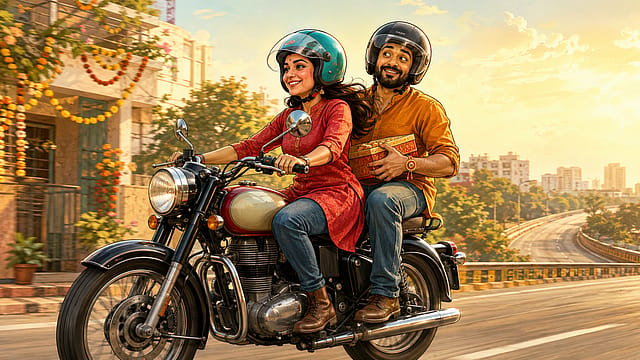
Rakhi Day offers Royal Enfield a better advertising opportunity than another sentimental film about a brother dropping his sister home. Let the sister ride. Let the brother sit behind. Then continue the idea after the festival ends.
Create beginner academies for women across cities. Place trained women riders and sales advisers inside dealerships. Offer extended test-ride programmes. Improve the availability of protective gear. Build communities for riders who do not yet possess expedition-level confidence. Use women in everyday product communication without turning their gender into the headline every time.
Most importantly, treat women as a growth market rather than a social initiative. Women do not need ceremonial admission into motorcycling once a year. They need motorcycles, skills, safety, service and a culture that stops acting surprised when they arrive.
Can the Bullet Lose Its Gender?
Wandering Sombarais was designed to demonstrate how far two motorcycles could travel. Its audience data revealed how far the brand may still need to go.
The 84 per cent male share does not erase Royal Enfield’s work with women. It makes that work more urgent. The company has built credible programmes, equipped women riders and created extraordinary examples.
Now it must make the extraordinary ordinary. The real victory will not be another photograph of 20 women beneath Himalayan peaks. It will be a dealership where nobody assumes the woman has come to choose a motorcycle for her brother.
Pulsar once shouted “Definitely Male” and captured an entire category’s confidence. Indian motorcycling has spent years trying to move beyond it. On Rakhi Day, the Bullet can give the brother a seat at the back. The sister should get the road.