Dear Brands, Culture Doesn’t Follow Your Festival Calendar
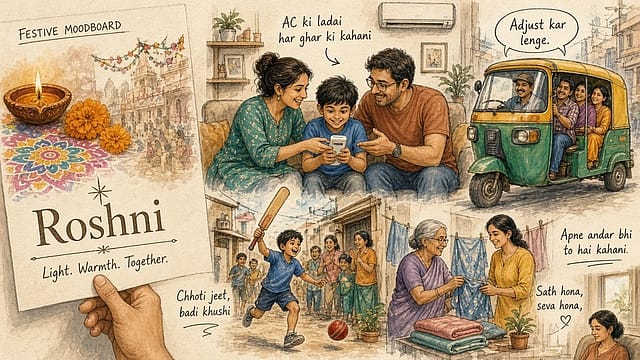
Every October, a certain meeting happens in an ad agency. Someone opens a deck called “Diwali Campaign Ideas”. By slide four, there’s a family lighting diyas, a grandmother smiling wistfully, and a tagline built around “roshni” or “ujaala”: a word that sounded profound in the room and slightly embarrassing on the hoarding.
Everyone nods. The client signs off. The ad runs for eleven days and is dead by Bhai Dooj.
Festival marketing can become a costume brands put on for the party and take off afterwards. Then everyone wonders why the emotional connection lasted roughly as long as the festive discount.
Culture asks for a longer commitment.
Zeroing In on ECI
09 Oct 2026 - Vol 05 | Issue 41
Constitutional legitimacy versus political opportunism
Think of it as water. Fish don’t celebrate water once a year. They live in it. The brands that earn a place in people’s lives understand what it feels like, on a random Tuesday in February, to belong to a family arguing over who controls the AC remote.
That argument will never make the festival calendar. It might make a better brief.
Amul is the obvious place to start, though the interesting thing here is what happens around the butter. For decades, the little girl in the polka-dot dress has commented on cricket, elections, films and whatever controversy has hijacked the national conversation.
Amul follows the calendar people actually live by: news cycles, cricket scores and whatever is currently wrecking the family WhatsApp group. Its advertising joins a country already talking to itself in puns. The product gives the conversation a signature; the conversation gives people a reason to keep looking.
Cricket deserves its own place here. In India, it is a second national language, with a generous vocabulary for heartbreak and grammar nobody wrote down. Buying World Cup ad slots gets a brand airtime. Understanding what people feel while watching gets it closer to belonging.
Cadbury’s “Kuch Khaas Hai Zindagi Mein” understood that distinction. A young woman dances onto a cricket field in celebration, gloriously unconcerned with whether this is appropriate behaviour. The joy is recognisable before anyone has to explain it.
The insight is the permission we give ourselves, in a moment of happiness, to stop behaving. Chocolate has a credible part in that story.
Fevicol found another everyday script: “adjust kar lenge”. We’ll manage. We’ll squeeze in. There’s always room for one more, even when the evidence strongly suggests otherwise.
Its exaggerated images of people packed into improbably crowded transport turn a familiar social habit into a demonstration of adhesive strength. The joke belongs to the audience. The payoff belongs to the product. That connection is what makes it advertising rather than an entertaining observation with a logo attached.
And no festival is required to explain it.
The harder version involves parts of culture that nobody particularly wants to celebrate.
Ariel’s #ShareTheLoad went after the idea that a husband “helps” with laundry, as though washing his own clothes were an act of generosity. The word itself contains the problem. Helping implies that the responsibility belongs to somebody else.
In one film, a father recognises the unequal domestic example he has passed on to his daughter. The discomfort comes from familiarity: a household arrangement so ordinary that people have stopped seeing it as an arrangement at all.
Laundry gives Ariel a direct stake in that conversation. The brand has something useful to say about the work its product is bought to do.
Vicks’ #TouchOfCare approached another familiar institution: the family. Its story of a transgender mother and her daughter asked viewers to recognise parenthood through the everyday work of caring.
The emotional force came from that recognition. A brand associated with care found a way to question who gets recognised as a caregiver. It trusted the relationship to carry the argument.
Even internet-first brands practise a version of this, usually at a higher speed and in a different accent. Zomato and Swiggy’s social voices draw on the Hinglish, complaints and absurdities of everyday online conversation: Monday dread, late-night cravings, the elaborate negotiations around ordering food.
The discipline underneath is listening. Before a brand can talk like someone people know, it has to notice how those people actually talk. A meme template alone cannot do that job. Neither can adding “bro” to a sentence approved by six people.
The useful distinction here is between cultural shorthand and cultural understanding. A diya provides immediate recognition. The habits, tensions and expectations around family life offer something deeper to work with.
“Adjust kar lenge”, the emotion invested in a last-ball six, the resentment over who is still doing laundry at 11pm: these are not all “values”. Some are pleasures. Some are compromises. Some are inequalities we have learnt to call normal.
Good advertising notices the difference. It knows what to celebrate, what to tease and, occasionally, what to challenge.
Symbols remain popular because they are easy to brief. Put a diya on a moodboard and everyone recognises it. The meeting moves along.
“Quiet resentment about unpaid domestic labour” is harder to represent with a stock photograph. It also raises awkward questions. Whose resentment? Who benefits from leaving things as they are? What right does the brand have to enter the conversation?
Those questions take more work than choosing a festive colour palette. They also give a campaign somewhere to go.
There is no need to torch the festival brief. Diwali sales exist for a reason. Festivals themselves contain rich stories about money, obligation, belonging and family politics. A brand willing to look closely can find plenty beyond the smiling grandmother.
The problem begins when the occasion does all the thinking.
A useful test is to remove the diyas, the rangoli and the festive greeting. Is there still an observation about people? Does the product still have a reason to be there? Would anybody recognise themselves?
If the entire idea disappears with the decorations, the brief probably needs another meeting.
The work people carry with them notices what they fight about, laugh about and quietly put up with on ordinary days. It gives that recognition a form, and the brand a meaningful place in it.
Sometimes that happens at Diwali. Sometimes it happens on a Tuesday. The diya burns out by midnight. A good insight is still working the next morning.