#UNTOLD | Bruised, Scarred & Unbreakable: Anshita Mehrotra & the Moment She Stopped Running
Metal slammed into concrete—left, then right, then left again—inside an underpass in Gurugram. The car didn’t just hit the wall. It ricocheted.
It was a little past 11:00 PM. A freezing January night in 2019. The kind of winter cold that doesn't just hang in the air—it settles deep into the glass, the chassis, the bone. The windshield had begun to fog, choking the headlights, and thinning the road ahead into a blur.
Inside the cabin, the atmosphere tightened into a vacuum.
“The last thing I remember, my phone flew out of my hand,” recalls Anshita Mehrotra.
Then came the spin. She was tossed like a ragdoll—back and forth across the upholstery—as the vehicle lost its grip on reality.
Mehrotra, a close friend, and his parents, had just finished a routine dinner. The drive home was supposed to be a formality. The asphalt was clear. In exactly four days, she was scheduled to fly back to Canada.

Rise of the Pivotal Power
18 Sep 2026 - Vol 05 | Issue 38
The BRICS declaration is a strategic victory for Modi
Then the hit came from behind. Fast. Predatory. Unseen.
The chassis lurched forward violently, tires shrieking as the physics of the crash took over. The car spun out of control, quarterbacking straight into the concrete wall of the underpass. Thud. Then again. And again.
Inside the cabin, time dilated. It stretched, slowed, and then snapped. And then she let go. “When we were hitting both sides, I just gave up,” she says. No resistance. No panic. Just a quiet, immediate surrender to the momentum. When the world spins that fast, you lose control.
A hand gripped her jacket. Her friend yanked her across the seat—a split-second, primal instinct—pulling her away from the door taking the brunt of the impact. That fraction of a second changed everything. “Had he not done that, I would have been crushed into the front seat,” she recalls.
The car finally ground to a halt. The engine died, but the collision alarm didn't. It kept blaring its mechanical scream into the dark underpass as they crawled out—shaken, bruised, and miraculously alive. The phantom vehicle that hit them had been traveling at lethal speed. The driver? Underage. Drunk.
Her First Panic Attack, and the Years It Took to Understand It
But the anger didn't register. Not yet. “I was like, okay, I’m alive. Everything’s fine,” she says.
Shock is a narcotic. It flattens the landscape. It mutes the terror.
Through the haze of smoke and flashing hazards, a second set of headlights cut through the underpass. Doors threw open. Her parents rushed toward her.
“Sit in the car, let’s go home,” they said.
Mehrotra didn’t move. The words reached her ears, but they refused to land in her brain.
“Sit in the car,” they repeated, sharper this time.
Mehrotra tried. She dragged her frame forward—slow, unsteady—as if the verbal command had to travel through inches of wet cement before reaching her muscles. Her legs resisted. Her mind went dark.
The car stood there. Door open. So did she.
When she finally reached the handle, her biology flatly refused. She couldn’t sit. She couldn’t draw oxygen. She couldn’t execute a single movement. Control, once surrendered, does not return just because you order it to.
And this wasn’t the first time her body had staged a mutiny.
She was in ninth grade. An economics exam. The classroom sat in suffocating, hyper-disciplined rows of wooden desks. The air was wrapped in the heavy, scratching silence of pens on paper.
And then, out of nowhere, it struck. Her breath broke first. Not gradually, not with a warning wheeze. It came apart like a frayed rope. Her chest seized, the air in the room suddenly turning solid, refusing to drop into her lungs. “This was my first panic attack,” she recounts. “I was finding it tough to breathe.”
At home, the diagnosis was painfully simplistic. In a world without a vocabulary for mental health, her mother looked for a physical culprit. “She said my iron must be low,” Mehrotra recalls.
At fourteen, that bloodless explanation made sense. There was no alternative language available. Around her in the exam hall, the ecosystem remained perfectly undisturbed. Pens clicked. Pages turned.
But inside her ribs, everything was coming undone. There was no clinical name for the monster back then. No way to articulate the terrifying certainty that something was fundamentally broken—and the paralyzing fear that the air might never return.
Back then, the wave eventually receded. Slowly. Unevenly. She thought she had survived it. But school left scars. She remembered a classmate—a boy dealing with ADHD and dyslexia. During the high-stakes board exams, the system granted him two extra hours to finish his papers.
She watched him from across the row. And quietly, desperately, she found herself wishing for the exact same diagnosis. Not for the extra points. Not for the academic advantage. But for the sanctuary of the clock. “If I just had a bit more time, maybe I could calm myself down,” she remembers thinking.
By then, the realization had hardened: this wasn't a fluke. Her body was keeping a ledger.
Years later, as an undergraduate student in Canada, the monster returned, and this time, it brought its luggage.
The panic didn't just visit; it followed her. It stalked her out of the fluorescent lecture halls and directly into the Canadian winter. It struck without an invitation, exploding in the dead centre of ordinary days that had absolutely no reason to fall apart.
One regular afternoon, Mehrotra stepped off a transit bus. Virgin snow lined the concrete pavement. The northern air cut like an icy razor. Her breath hung briefly in a white plume, then vanished.
Then, the drop. Sudden. Violent. Intimately familiar.
Her heart slipped its gears, racing faster than her pulse could track. Her chest contracted, tightening from the inside out into an iron knot. The steady breath she had taken seconds ago collapsed into a short, shallow gasp that refused to settle in the sub-zero air. “It felt like a heart attack,” she says. “I thought, something is wrong with my heart.”
When Panic Stayed, and the Insecurity That Started It
Mehrotra dropped straight into the snow. Her knees didn't buckle; her body simply lowered its centre of gravity because it could no longer sustain her weight. The freezing slush seeped through her wool coat, through her denim, straight into her skin.
She stayed there, anchored to the frozen pavement. Commuters passed by. The city continued its rhythm. Nothing on the outside matched the cataclysm happening within. She didn’t get up. Not for a long time.
The panic didn’t retreat with the setting sun. It lingered through the nights, occupying the quiet stretches where self-distraction ceased to work. “For the first time, I couldn’t run away from it,” she says.
There was no exit route. When your biology stops cooperating, the dominoes fall fast: Breath, thought, focus, and control. None of it stays where you left it. Later, she would learn the word for it: Panic Attack. At the time, on that snowy Canadian curb, it felt like an ending.
But this hadn’t started in Canada. The fuse had been burning since childhood.
Long before the panic possessed a name, it had already violently sculpted her self-worth.
In second grade, in a classroom on what should have been a routine day, she was quietly pulled aside for a counselling session. Not for failing grades. Not for disruptive behaviour. But for the way she looked in the mirror.
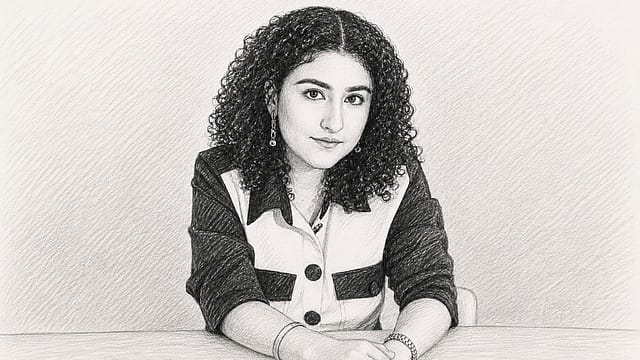
Even as a young child, Mehrotra despised her own reflection. The reasons were visual, brutal, and repeated often enough by the world to become her absolute truth: her hair.
It was curly. In her ecosystem, curly wasn’t a texture. It was a defect. It was wrong.
“Why me?” she would whisper to herself. The question led nowhere, but it circled her mind as she grew. With adolescence, it turned sharper, more vindictive: “Why did I have to get something so unattractive—so unruly, so difficult to tame?”
The world offered no answer to soften the blow. So, she went to war with it. Not occasionally. Not for special events. Constantly.
She burned it straight. She hid it under caps. She tried to keep it out of sight, especially when the stakes felt high—new friendships, first impressions, early relationships. Anything to make herself palatable. Anything to minimize her footprint.
“I never wanted my curly hair to be a part of my relationship or my identity,” she says.
At her lowest point, the self-loathing turned radical. “I just wanted to chop it off.” Not a haircut. An erasure. “I thought, I’ll just shave it. Go bald. Wear a wig… anything.” Anything to stop managing the defect.
For a while, the masquerade worked.
Mehrotra blended into the background noise of the crowd. She looked like the group, she moved like the group, and acceptance came easy. But beneath the straightened hair, a dangerous psychological blueprint was hardening: a compulsive habit to alter herself, to fit the mould, to choose what was socially frictionless over what was fundamentally true.
She carried that defense mechanism directly into university. By the time she arrived on campus, it wasn’t a conscious strategy anymore. It was pure, unthinking instinct. “I was a people pleaser,” she confesses. “I thought—how else would I make friends? This is the only way, right? I must do what everyone is doing.”
So, she conned her own boundaries. Drink when the crowd drank. Stay out until dawn when the crowd stayed out. Pay whatever emotional tax it took to belong. On the outside, it looked like brilliant social adaptation. It felt like supreme control.
When Panic Took Over, and She Finally Asked for Help
Mehrotra adjusted her posture everywhere she could. But her nervous system was silently keeping receipts. It was tracking every single tiny compromise, every minimized boundary, every single second she forced herself to smile through something that felt entirely wrong.
The bill didn't arrive immediately. It accumulated interest. Until one day, her body flatly refused to negotiate another compromise. When the system finally pushed back, it felt as though an infrastructure held together by sheer willpower for two decades had finally begun to fracture.
Back in her Canadian apartment, the panic refused to stay confined to moments. It bled across days, flooded into her nights, and saturated the quiet spaces where there was no noise left to drown it out.
What had once been an occasional visitor had now moved in. It wasn’t always screaming. But it never left the room.
At first, she tried to outwork the dread. Push through. Stay busy. Keep moving.
But a fragmented mind cannot be managed like a corporate project. The harder she ran, the sharper the whiplash. Then, the ceiling fell down: she began to dissociate. “I felt like I’m not in my body,” she says. “Like I’m just watching myself from the outside.”
Lecture halls turned into sensory overloads. Conversations became white noise. The routine cracked. Desperate, she abandoned Canada and fled back home to India for winter break--not because she possessed a grand plan, but because she had run completely out of oxygen.
But geography doesn’t cure a chemical storm. She thought going home might help. That the panic would ease. It didn’t. If anything, it became harder to ignore.
In India, without the rigid architecture of university schedules to hide behind, the void expanded. There was only raw time, empty space, and the terrifying inability to explain her own unravelling. “How do you explain something you don’t even understand yourself?” she asks.
So, she did something she had never dared to do: She asked for help. The first attempt with a generic therapist evaporated into nothing. She pushed deeper. A psychiatrist. Someone who didn't patronize her pain or rush her through a clinical checklist.
For the first time, her trauma was given a structural framework. A clinical vocabulary. Session after agonizing session, she began to assemble the jigsaw puzzle of a breakdown twenty years in the making. Slowly, the internal tectonic plates shifted. The storm began to settle. A fragile normal appeared within reach.
She booked her return flight to Canada. Four days left. She was ready to claim her life back. And then, the underpass in Gurugram claimed her car.
After the Crash, Panic Changed, and So Did Everything Else
The human body remembers every trauma the conscious mind tries to evict. The night of the crash didn’t terminate when the ambulance arrived—it moved into her bedroom.
Getting out of the wreckage was a medical miracle; getting back into a vehicle was psychological warfare. Her body flatly locked down at the sight of a car door. Her breath would vanish. Her ribs would seize.
It took two months of absolute paralysis before she could sit in a vehicle again. Even then, it required an airtight security blanket: the back seat only, with a driver she trusted implicitly. Distance from the windshield was her only proxy for control.
Sleep became a battlefield. The silence of the Gurugram night magnified the phantom sound of crushing metal. The intrusive loop began its mechanical replay: “The crash has already happened. I’m already dying. There’s nothing I can do.” Logic is completely useless when your nervous system is convinced it is currently expiring.
The panic had mutated from a wave into a permanent resident. It attached itself to stillness.
Exhausted from being a passenger to her own terror, Mehrotra forced herself into the driver’s seat. Not out of courage—out of pure, desperate necessity. If the world was going to crash, she needed her hands on the wheel. “If it crashes, it’s my fault,” she says. It wasn't a cure. It was a tactical grip on a life spinning out of control.
But the crash did something else. It permanently shattered her illusion of time. Before that night, existence felt long, linear, and infinitely forgiving. There was always another semester, another year, another decade to delay the truth.
After the impact, that certainty dissolved. “Life is terrifyingly short,” she realized. Death was no longer an abstract concept reserved for the elderly. It was a drunk driver in an underpass.
The question aggressively shifted from “How do I survive this day?” to “What am I actually doing with this life?”
How Fix My Curls Began, and Why No One Believed in It
She had no blueprint. So, she turned to the only weapon she had always carried but never deployed: her pen. Within weeks, a manuscript materialized. Within two months, she self-published a raw collection of poetry—crossing off a sacred bucket list item she had written as a terrified schoolgirl. For a moment, the accomplishment offered a temporary truce.
Until the silence returned, bringing the old, stubborn ghost back into the mirror. Her hair.
The lifelong defect was about to become her empire.
Looking for a solution to her own untameable texture, she began tracking down curly hair formulations. There was no massive business plan—just an unserved personal need. “And that,” she says simply, “is how the whole Fix My Curls journey began.”
By 2021, the kitchen table experiment had scaled into a high-stakes investment pitch.
The digital boardroom was packed. Eleven venture capitalists on one side of the screen; Mehrotra on the other. To prove her thesis, she went on camera live, styling her own curls in real-time, demonstrating the raw efficacy of the product. The presentation was sharp, the numbers were clean, the energy was electric.
There was only one devastating problem. “Almost 70% of the investors in that room were completely bald,” Mehrotra recounts.
She was effectively trying to pitch a luxury comb to a room that had long since abandoned the mirror. To them, hair styling was an alien luxury; textured hair care was a microscopic niche not even worth a casual punt. Their institutional logic was primitive: India is a mass shampoo market. Period.
It wasn't just that room. It was forty distinct boardrooms. Forty consecutive, exhausting, soul-crushing rejections.
On paper, the institutional scepticism was completely irrational. The company’s growth wasn't a projection—it was a rocket ship. From 2020 to 2021, Fix My Curls generated ₹1.2 crore. The very next fiscal year, the top-line exploded to ₹7.2 crore—a staggering 500% hyper-growth curve. The business was bootstrapped, lean, and highly profitable, sustained entirely on a lean ₹50 lakh infusion from her mother over two years.
From there, things began to take shape. Mehrotra started hiring. Built a team of fifteen. She moved into an independent office—on the same floor as her parents, but behind her own door. Her space. Her vision.
Yet, inside the institutional funding ecosystem, the metrics meant nothing. The suits couldn't see the retention rates or the category creation. They just saw a bottle of cheap shampoo. The answers never changed, and neither did the outcome. The psychological chasm between her reality and the world's belief widened into an abyss.
When Rejection Turned into Self-Doubt, and She Chose to Go All In
At first, she blamed her delivery. She re-drafted the decks, sharpened the terminology, and practiced the pitch until her throat was raw. But the wall didn't move. At thirty-five rejections, the feedback ceased to feel like market commentary—it began to taste like personal failure. “I started second-guessing everything,” she confesses. The old ninth-grade exam panic crawled back under her skin. The self-doubt wasn't outside anymore. It had breached the perimeter.
A year and a half earlier, she had faced a different crossroads. There were no investors then—just her, alone in a room, trying to resolve an unfinished chapter: Canada.
Her degree was sitting there, incomplete on paper. One final semester. A socially approved version of her life waiting to be claimed. She tried to live a double life—running a scaling startup by day, pretending to finish an undergraduate degree by night, delaying the ultimate execution of the choice.
The compromise fractured one afternoon during a desperate run. “I’m not a runner,” she says. She was just trying to outpace the noise in her head. When she crossed her threshold, she collapsed onto the floor, sobbing, heaving, as the armour she had worn for years completely shattered.
The core truth emerged from the tears: her paralyzing hesitation wasn't strategic—it was the terrifying fear of being judged. She could already read the public obituary the world would write for her choice: Another rich kid with an unfinished degree. Another impulsive dropout playing at business with no formal training. She didn’t even view herself as a leader. “I never saw myself as an entrepreneur,” she says. In her mind, founders were mythical creatures manufactured at Harvard. Not a girl who dropped into the Canadian snow because her heart was beating too fast.
Then came the question that cut through twenty years of people-pleasing camouflage:
“If I die in an underpass tomorrow, what will I actually regret? Leaving the degree unfinished, or leaving this business unbuilt?”
The ledger cleared instantly. She chose the business, and she burned the bridge behind her. She marched back into the investor rooms with the exact same pitch, the exact same product, and an unshakeable defiance.
From Funding Rejections to a Failed Deal, and a Hard Reset
But 2022 was a brutal year to be an outsider. The funding boom had reached a fever pitch. It was the era of Shark Tank India. Valuations were climbing into the stratosphere, and every founder on her timeline was raising multi-million-dollar rounds over casual coffee.
She wasn’t.
She didn't even possess a network of founder friends to validate her isolation. “The entire year of 2022, I was met with nothing but rejections,” she says'
Then came January 2023. The market metrics finally forced an investor's hand. They approached her. The macro-data was suddenly undeniable: the Indian curly hair market was projected to become a powerhouse category by 2030.
Institutional due diligence commenced. A term sheet materialized: a $500,000 investment at a $5 million valuation.
On the surface, it looked like a total vindication. Underneath, the hyper-growth had exposed structural flaws. Top-line revenue had hit ₹7 crore, but the cost margins hadn't been engineered for industrial scale. She was operating on a startup myth: capture market share now, fix the unit economics later.
For four agonizing months, the lawyers picked through the anatomy of the business. By month three, the capital was no longer a luxury—it was life support.
And then, the deal vaporized.
A trivial misunderstanding with a junior member of the investment firm escalated into a corporate standoff. Numbers were suddenly interrogated; the institutional tone turned cold. After 120 days of deep-dive access, the firm walked away from the table.
The deal collapsed. “It was one of the absolute worst days of my life,” she recounts. The rejection hit her bone-deep. The ancient imposter syndrome returned with a vengeance: Maybe they’re right. Maybe I’m just an expert storyteller, not a real CEO.
The following Monday, she drafted a raw, transparent email to her team of fifteen. The funding was dead. There would be no raises, no bonuses, no corporate safety net. If anyone needed to jump ship to protect their livelihood, she would sign the release with no bitterness.
Not a single soul resigned. Instead, the team locked the doors and leaned in.
The business refused to die. Revenue ticked upward from ₹7.2 crore to ₹9 crore, but the victory tasted like ash because the four months of diligence had frozen their product pipeline. They had no new launches, no momentum, and her personal capital was completely drained.
But that email catalyzed a structural transformation. The team asked the only question that matters in a crisis: What can we actually control?
The answer was cold math: they were carrying roughly ₹1 crore in operational inefficiencies. If they could aggressively eliminate that deficit, they would hit financial break-even.
They audited the enterprise line by line. They cancelled bloated agency contracts, tore up redundant software subscriptions, and slashed operational costs ₹10,000 at a time. A few strategic redundancies were executed—not as an emotional reaction, but as an absolute structural correction.
From Profitability to Rebuilding the Brand On Her Own Terms
Four months of pure, focused discipline later, the business crossed into net profitability.
Then, the ultimate corporate plot twist occurred: the exact same institutional investors who had abandoned her came crawling back to the table. They reopened due diligence.
But the woman sitting across the table wasn't the anxious founder of 2022. “We have made this business entirely profitable on our own blood,” she informed them. That structural resilience costs premium capital.
She demanded a significantly higher valuation. The investors looked at the new run-rate—which was now aggressively scaling toward ₹15 crore—and they quietly signed the document.
The round took eight gruelling months to close, but Fix My Curls didn't wait for the bank wire. From 2023 to 2024, the top-line crossed ₹15.5 crore, and the company closed the fiscal year solidly in the black.
That phase permanently re-engineered her business philosophy. She realized the startup gospel was a lie: hyper-scaling on venture capital is an illusion. True power belongs to operational control. She bypassed the marketing agencies and began personally calling her customers. She spent hours on the phone asking ordinary women what worked, what failed, and what formulas they actually needed.
The macro-strategy shifted from chasing vanity scale to building fanatical consumer depth. She didn't want a million passive clicks; she wanted a hundred disciples who would defend the brand with their lives. Community wasn't an item on a marketing slide deck—it was the concrete foundation of the empire. “Without it,” she says, “there is no brand.”
By May 2024, the institutional capital finally hit the bank account. It came from the exact same firm that had walked away twelve months prior.
Then came the most dangerous decision of her career: the total identity rebuild of the brand. Every institutional advisor on her cap table offered the exact same clinical advice: Change the name. "Fix My Curls" is far too narrow, too niche, too limiting. If you want to build a mass-market conglomerate, you need a sanitized, mass-market name.
She almost succumbed to the pressure. Branding agencies were retained, capital was deployed, and a glossy, sanitized new corporate identity began to take shape. Yet, every time she moved closer to executing the rebrand, her stomach churned. The internal alarm bells went off. Was this strategic expansion, or was she systematically erasing the raw truth that made the brand a cult favourite in the first place?
The dilemma wasn't about typography or trademarks—it was about identity. She had spent five years learning to accept her own curls, learning to trust her own distinct voice, and learning to stand her ground in hostile rooms. Now, an external committee was politely asking her to straighten her hair all over again.
The psychological loop was intimately familiar.
This time, she stopped the machinery. She ripped up the agency briefs. The name stayed: Fix My Curls. Instead, they went back to the lab. They refined the packaging, elevated the aesthetic, and anchored the visual language in the next forty years of hair care history. She refused to sprint to catch up to the market. She was operating strictly on her own timeline.
The refreshed brand launched globally in June 2025. The market response was instantaneous. The community swarmed the digital storefronts, generating the highest single-day sales volume in the history of the enterprise. “That,” she says, “was one of the greatest days of my life.”
Walking Away From Funding, Calling Her Own Shots
But the market never stays quiet. By April 2025, she was back in the fundraising trenches, pitching institutional allocators for their next growth phase. She knew her runway: by August, the enterprise would require fresh capital in the bank.
This time, she was hyper-focused: she didn't want a syndicate; she wanted one strategic partner. She found them, and she went all-in on the negotiation.
Then, history repeated its cruellest trick.
Through September, October, and November, the institutional signals turned frosty. The conversations slowed to a crawl. The conviction faded. A $3 million check was resting on the table, but the investor refused to budge on a predatory valuation.
The macro-context was working against her. The rebrand had temporarily fractured their operations; packaging modifications had caused a massive supply chain bottleneck. For three gruelling months, the brand was forced to operate at half-capacity—the demand was astronomical, but they literally couldn't ship the bottles. The top-line took a visible hit.
On a bloodless balance sheet, it looked like a broken year. In reality, it was her finest hour. The hard infrastructure work was done, but the investors didn't care about structural foundations. They refused to compromise on the valuation. The line went completely dead.
The ultimate choice was reduced to an absolute razor's edge: accept a predatory valuation to save the runway, or walk away and face potential insolvency. The company's cash reserves were dangerously low. She was currently liquidating her final personal fixed deposits just to process the payroll. The runway was measured in weeks.
But the woman who walked out of the Gurugram underpass didn't panic. “If someone is genuinely excited to build an empire with you, you will feel it in the room,” she says. This room felt like an execution. So, she stood up and left the table. No deal. No funding.
The version of Mehrotra from 2019 would have hyperventilated on the pavement. The 2026 version didn't even blink. “I would much rather struggle on my own terms,” she says, her voice absolute, “than multi-scale on yours.”
Today, Fix My Curls operates entirely on organic cash flow. The losses from the supply chain crisis are being aggressively recovered, but the strategic trajectory is terrifyingly clear. For FY26, the company generated a massive ₹41 crore in gross revenue, delivering a solid ₹25 crore in net revenue. The hyper-growth has calibrated into sustainable depth, but her conviction is ironclad.
She sits at her desk now in the Gurugram headquarters—a space that has acted as a silent witness to every single iteration of her identity. It saw the anxious girl waiting on investor emails; it saw the stressed CEO counting days of remaining runway; it saw the isolated founder wondering why every male peer on LinkedIn was raising capital faster than her. The same four walls, a completely different human being.
For a long time, she mistakenly believed the ultimate validation was out there—in institutional funding rounds, in press releases, in metrics that would finally convince a room full of bald men that her life's work was valid.
The numbers were never going to be enough. She watched rival brands raise ₹100 crore while she bled to close a fraction of that amount. She had allowed the toxic comparison to seep under her skin, constantly interrogating her own value.
At some point in the storm, she stopped asking what she was missing. She drew an iron line on the ledger. A ₹25-crore consumer brand. Built from a kitchen table. At twenty-six years old. That counts. And if the world refuses to acknowledge it, that is the world’s deficit—not hers.
She Stopped Fixing Herself, and Built From It Instead
That specific brand of defiance doesn’t show up in a venture capital pitch deck. It manifests in the way she commands a room, the way she executes strategy, and the way she has chosen to be aggressively visible on the street—even when that visibility invites judgment, even when it makes traditionalists deeply uncomfortable.
She has completely abandoned the defensive posture. She tells her own story, in her own raw voice, every single day across public channels, fully aware that the crowd will always throw opinions at her choices. Let them. The noise doesn't alter the product velocity. Fix My Curls may not possess the loudest balance sheet in the FMCG ecosystem yet, but it is known. Not because of an expensive celebrity endorsement or a synthetic billboard campaign—but because its founder has shown up to the fight, repeatedly, honestly, without a single drop of dilution.
And that strategy is entirely deliberate. For the generation of young women watching her from the sidelines—especially the ones holding their breath, waiting for permission to take up space—her executive directive is explicit: Play the game. Play it fully. Play it fiercely. Ask for exactly what you want, demand your premium, and occupy the space. Do the exact things the handbook claims you are not supposed to do. Never assume you need a separate, softened set of rules to survive.
The systemic divide between failure and an empire is often that simple: men ask; women hesitate.
Mehrotra does not hesitate anymore.
And that is the true, tectonic shift of this story. It was never about the venture funding, the unit economics, or the top-line revenue. It was about the person building it.
For two decades, she tried to fix what the world told her was broken. Her texture. Her dropouts. Her choices. Her timeline. There was always a corporate metric to correct, an action to justify, an identity to apologize for.
That defensive instinct followed her into the classrooms of her childhood, the exam halls of her youth, the boardrooms of her adulthood, and the architecture of her own business. Every rejection was a confirmation of her inadequacy; every comparison was a fresh laceration. Every "no" from a venture capitalist pushed her back into that ancient, suffocating question: “What is it about me that isn’t enough?”
And for a very long time, she tried to answer them by bending her spine. By straightening her hair. By altering her posture to fit their rooms. By chasing what the world rewarded. At some point on the road, she stopped. Not because the noise ceased. But because she finally stopped running from the mirror.
The unruly, untameable curls she once treated like a birth defect didn’t just become a business. They became her universe. The voice she once choked back in that silent ninth-grade classroom didn’t just recover—it became the absolute, uncompromising law of an entire consumer category. The rogue startup she once had to defend to her own flesh and blood became a sovereign fortress she was ready to defend with her life.
She spent two decades trying to fix what the world insisted was broken. In the end, she didn’t fix a damn thing. She unleashed it. Because true power doesn't come when the storm passes. It comes when you realize you are the storm.
Every single day, she drives past that exact same Gurugram underpass. The concrete wall is still there, scarred and indifferent. But the woman who crawled out of the wreckage is gone. The clock is ticking. The market is hunting. The rooms are still full of doubters. Let them come. Somewhere along that asphalt grid, the question didn't just change—it shattered. It is no longer, "Why me?" It is, "Watch me."