From UPSC Aspirant to Drishti IAS CEO: Vivek Tiwari’s Journey
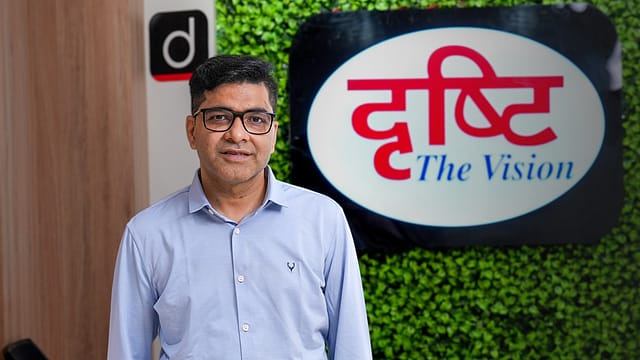
In the crowded classrooms of Mukherjee Nagar, it is easy to disappear.
Hundreds of students sit packed into narrow rows, notebooks open, eyes fixed on the teacher at the front of the room. Some ask questions constantly. Some try to stay visible, hoping the teacher might remember them.
And then there are those who simply sit quietly and listen.
Years ago, Vivek Tiwari was one of those students.
He usually chose a seat in the back row during the Hindi literature classes taught by Dr. Vikas Divyakirti. He rarely spoke in class and never tried to draw attention to himself. Like thousands of others in Mukherjee Nagar, he had come to Delhi with a single hope — to clear the UPSC examination and become an IAS officer.
At that time, there was nothing remarkable about him. He was simply another aspirant among many.
Life, however, had a very different story waiting for him.
Today, Vivek Tiwari is the CEO of Drishti IAS — the same institution where he once attended classes as a student.
Even now, he sometimes finds it difficult to fully believe how that happened.
“The journey still feels like a dream,” he says.
A dream that once seemed straightforward
The idea of civil services had entered Tiwari’s life early, almost naturally.
His father served in the Indian Army, which meant his childhood unfolded across different cities in the country. He studied in Kendriya Vidyalayas in Lucknow and later in Suratgarh, Rajasthan, before completing Class 12 from Kendriya Vidyalaya in Pathankot.

The Liberation of Bengal
05 Jun 2026 - Vol 04 | Issue 74
A silent revolution ends the reign of fear
During his final year of school, a teacher once asked the class a simple question: what did they want to become in the future?
When his turn came, Tiwari said he wanted to join the civil services.
A classmate sitting behind him said the same thing.
“We used to joke that one day we would both become IAS officers,” he remembers.
Years later, that classmate would go on to become a well-known English news anchor at a media house.
For Tiwari, however, the road ahead would unfold very differently.
The years when everything revolved around UPSC
After finishing school, Tiwari moved to Varanasi to study at Udai Pratap College, an autonomous institution affiliated with Purvanchal University. He studied Economics and Geography along with English.
Preparing for the civil services examination seemed like the natural next step.
But like many aspirants, his first attempt came before he fully understood the seriousness of the preparation required.
In 2007, he arrived in Delhi and discovered Mukherjee Nagar — a place where thousands of young people live with the same routine and the same dream.
His optional subjects were Geography and Hindi Literature. For Hindi literature, he enrolled in classes taught by Dr. Vikas Divyakirti.
Inside those classrooms, he remained the same quiet student who preferred listening to speaking.
Between 2008 and 2009, he appeared for the UPSC examination.
“When you prepare for something for years and it does not happen, it feels as if everything collapses,” he says.
Friends suggested he should try state civil services.
But by then, the motivation to continue had faded.
The train to Bhiwani
Life moved on in smaller, quieter ways.
One day, a friend suggested he try teaching.
At the same time, practical realities were becoming difficult to ignore. His father had retired from the Army, and Tiwari felt that he could no longer depend on family support.
“I realised I could not keep withdrawing money from my father’s ATM card forever,” he says.
That is how he began travelling from Delhi to Bhiwani to teach at a small coaching institute.
He usually took a passenger train because the ticket cost only around ₹50.
“I had time,” he says, “but not much money.”
When he reached the institute, he discovered that things were not as stable as he had expected. The owners had taken fees from students and disappeared, leaving behind a handful of confused aspirants whose course had not been completed.
Despite the situation, he decided to continue teaching.
Eventually the institute shut down completely.
But the students did not want to stop their preparation. They arranged a hall themselves and asked him to complete the course.
For five days, Tiwari taught from morning until evening.
He did not charge them anything.
“I just didn’t want their careers to suffer,” he says.
Returning to Drishti IAS
In 2014, during a conversation with friends about possible job opportunities, someone suggested that he apply to Drishti IAS.
The next day he walked into the office.
The moment felt almost strange.
The CEO interviewing him turned out to be a former classmate.
Tiwari joined the organisation and began working in the content team, checking answer sheets, writing model answers and preparing questions for students.
In 2015, he met Dr. Vikas Divyakirti again — this time not as a student in a classroom but as someone working inside the organisation.
Divyakirti recognised him almost immediately.
He remembered the quiet student who used to sit in the back rows of his class.
The turning point
The moment that changed Tiwari’s career came when the UPSC syllabus introduced a large environment component.
Drishti IAS had promised students that it would publish a book they could rely on.
But the timeline was tight.
The book was expected months later, while the exam was approaching quickly.
Tiwari made a proposal. If he was given the opportunity, he would try to prepare the book himself.
For the next fifteen days he barely left the office.
Working with a typist and a proofreader, the small team worked almost continuously.
The book that was originally expected months later was completed and printed within eighteen days.
Soon afterwards, he received his first promotion and was given responsibility for the publication department.
The circle completes itself
Over the next decade, Tiwari’s role grew steadily.
He worked on books used by thousands of aspirants, helped build publication teams and later became involved in expanding the organisation into new cities.
Gradually he learned every part of the institution — academics, operations, hiring, marketing.
Eventually, Dr. Vikas Divyakirti decided to step back from day-to-day operations and focus more on teaching and the organisation’s broader vision.
Tiwari, who had spent more than a decade working across almost every department, was asked to lead.
About a year ago, he became the CEO of Drishti IAS.
When he looks back now, the memory that returns most often is not the boardroom or the title.
It is the classroom.
The back row where he once sat quietly as a student.
“There was a time when I travelled on a ₹50 train ticket just to teach students,” he says.
Today he leads the same institution where he once came to learn.
And in some ways, the quiet student in the back row never really left.