Estée Lauder’s Ayurveda Bet: Buying the Storyteller
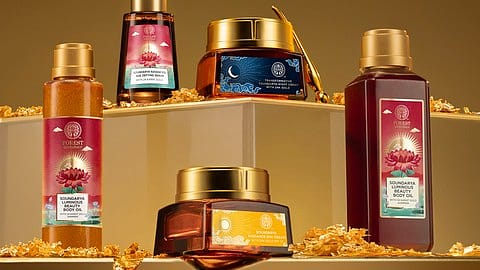
Luxury beauty companies usually prefer to build brands themselves. Buying them is often a last resort.
The logic is simple. Beauty and luxury run on storytelling. Control the story, and you control the brand.
But every rule has a breaking point.
When The Estée Lauder Companies decided to take full ownership of Forest Essentials, it was acknowledging a simple truth: some stories cannot be written from the outside.
The American cosmetics giant first invested in the Indian luxury Ayurveda brand in 2008. In 2020, it raised its stake to 49%. Now it has signed an agreement to acquire the remaining shares, bringing an 18-year partnership to a close.
Financial terms remain undisclosed, and the transaction is expected to close in the second half of 2026.
The Modi Years
02 Oct 2026 - Vol 05 | Issue 40
A Nation Rebuilt
“The acquisition makes strategic sense because Forest Essentials brings something Estée Lauder did not previously have in its portfolio — a culturally rooted Ayurveda-based luxury brand,” said Ashita Aggarwal, professor of marketing at SP Jain Institute of Management and Research. With Estée Lauder’s global distribution network and credibility, the brand could expand beyond India and introduce Ayurveda-led beauty to international consumers, she added.
At first glance, this looks like routine consolidation. It isn’t.
Forest Essentials is not particularly large by global standards. In 2025, it reported revenue of about ₹5.8 billion and operates roughly 200 stores. For Estée Lauder — owner of global labels such as La Mer and MAC — this remains a modest business.
So, why buy it outright?
Because Forest Essentials represents something global beauty companies have struggled to manufacture: credible Ayurveda, which is delivered as luxury.
For years, multinational brands have tried to adapt India’s traditional wellness systems into modern cosmetics. Turmeric, neem and sandalwood slipped quietly into ingredient lists. Campaigns began speaking the language of “ancient wisdom” and “botanical rituals.”
But Ayurveda does not behave like a typical ingredient trend, though a lot of Indian brands make the same mistake.
It is closer to a philosophy than a formula. The system blends medicine, lifestyle and ritual, and its legitimacy in India comes from centuries of cultural memory.
That makes it difficult for global brands to imitate convincingly.
Forest Essentials solved that problem by doing something deceptively simple: it treated Ayurveda not as herbal medicine but as luxury. Brand like Kama Ayurveda is on the same path.
The brand packaged traditional formulations in ornate bottles, placed them in boutique stores, and built a retail experience that felt closer to a spa than a pharmacy. In effect, it translated a classical Indian wellness tradition into the language of global luxury beauty.
That translation is what Estée Lauder is buying.
Aggarwal said the partnership is complementary. While Forest Essentials brings authenticity and heritage, Estée Lauder provides the capital, scale and global distribution required to take the brand beyond India’s relatively small luxury beauty market.
The company has used a similar approach before. It followed a staged acquisition strategy with Deciem, the Canadian skincare company behind The Ordinary—investing first, increasing its stake later, and eventually buying the brand outright in 2024.
Forest Essentials appears to have followed the same trajectory: observe, partner, then absorb.
The timing also says something about the beauty industry.
Over the past decade, regional beauty philosophies have begun travelling globally. Korean skincare routines reshaped the industry. Japanese fermentation-based cosmetics found international audiences.
Ayurveda could be the next such narrative.
If that happens, the companies that already control credible Ayurvedic brands will have a head start.
Which is why the Estée Lauder deal matters.
It is not simply about India, though India’s premium beauty market is growing quickly and remains relatively underpenetrated.
It is about something larger: the recognition that in beauty, cultural authority is often more valuable than scientific novelty.
And when a tradition is too old, too complex, or too deeply rooted to imitate, the easiest strategy is the oldest one in business.
You buy the storyteller.