“Reimagine the Business Model” — Inside Tredence with Shub Bhowmick
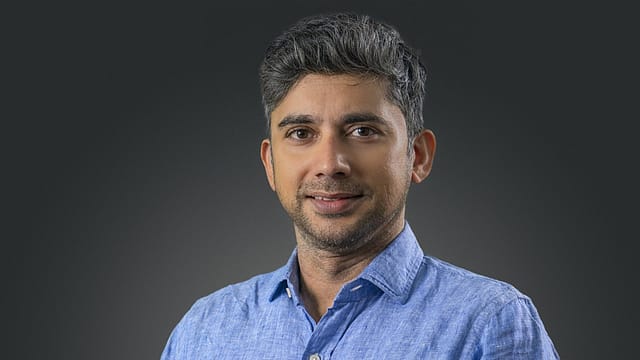
Can AI take the job of a CEO? It’s the kind of question that sounds abstract until you’re sitting across someone who runs an AI and data analytics company, building exactly the systems that are supposed to reshape how businesses work.
So, I asked him.
And then I followed it up with something more direct: “Are you safe?”
Shub Bhowmick didn’t take long. “No. I’m safe.”
It’s a neat answer—confident, almost disarming—but it isn’t dismissive. As the conversation unfolds, it becomes clear that he isn’t thinking about AI in binaries. Not replacement versus survival. Not hype versus denial. The real shift, as he sees it, is more structural, almost invisible at first glance.

The Health and Wellness Issue
25 Sep 2026 - Vol 05 | Issue 39
“Today, I make money doing three things,” says the cofounder and CEO of Tredence, a global data and AI solutions company. He outlines them simply: understanding the problem, building the solution, and driving adoption.
For years, that middle layer—the building—has been the engine. That’s where time, effort, and teams concentrated. But that’s also the layer AI is compressing the fastest. Code is written quicker, systems are assembled faster, and what used to take weeks is beginning to shrink into days.
And yet, the edges don’t move as easily. Framing the problem still requires judgment. Convincing a client still requires trust. Driving adoption inside organisations—messy, political, human organisations—still resists automation.
That’s where the work is shifting. And that’s where Bhowmick is placing his bets.
In December 2022, Tredence raised $175 million in a Series B round led by Advent International. The company is set to close FY26 at around $350 million, with a clear roadmap to reach $1 billion by 2030.
Bhowmick doesn’t believe India will win on pure research, at least not yet. But he’s equally clear that it doesn’t need to. “Our strength has been in services,” he says, “in solving real problems at scale.”
That strength, he argues, doesn’t disappear in an AI-first world. It evolves. The question is whether companies are willing to rethink how they operate—less dependence on headcount, more leverage from capability, and a willingness to move away from the models that worked for the last two decades. Reimagining the business model is the real shift and not whether AI would change things. It’s about who adapts fast enough. Excerpts:
You broke down your business into three parts—problem, solution, adoption. Which of these is AI disrupting the most?
The building layer is where the biggest shift is happening. Code is getting written faster. Systems are getting assembled faster. That entire middle layer is compressing. But the other two? Not as much. Understanding the problem still needs context. Driving adoption still needs trust. Those don’t change as easily.
So, where does that leave companies like yours?
It forces you to rethink the model. If your business is built on headcount, that’s going to get challenged. The question is how much of your value comes from capability versus capacity. That’s the shift we’re thinking through.
You’ve said India may not lead in pure AI research. Does that put us at a disadvantage?
Not necessarily. India hasn’t historically built its strength in research. But it has built it in services—in solving real problems at scale. That doesn’t go away. What changes is how that capability is packaged.
What does “reimagining the business model” actually mean in practice?
Less dependence on adding people. More leverage from what you’ve already built—your IP, your frameworks, your capability. You have to move from linear growth to something more scalable.
You mentioned earlier that failure wasn’t an option in the early days. How does that change how you operate?
You don’t optimise. You go after everything. Every opportunity. You don’t know what will work, so you don’t leave anything unexplored. Optimisation comes later.
There’s a line you used—“playing tilted.” What does that mean in a business context?
It’s when one bad outcome carries into the next decision. You lose something, and that loss starts influencing how you think. You become reactive. Sometimes desperate. And that’s when you make worse decisions.
What did you learn from that phase?
That most mistakes don’t show up as big events. They show up in small delays. Calls you postpone. Decisions you avoid. And over time, they compound.
You started in your late 30s. What changes when you start later?
You’ve seen more. You understand how businesses actually work—how clients think, how decisions get made. So, you’re not experimenting in the same way. You’re more deliberate.
Does that make it easier or harder?
It doesn’t reduce the risk. It just makes the risk clearer.
You’ve spoken about your wife as a big part of this journey. In what way?
There are different kinds of wealth. Financial wealth is one. But there’s also emotional stability, support, the ability to take a risk. She built a lot of that for us.
And today, how do you think about success differently?
You realise there are other things you don’t want to miss. Time with family. Just stepping away. If you spend all your time building something and lose everything else, that’s not success.