#UNTOLD | Tanned by Time, Now Facing Scale: Gautam Sinha, Nappa Dori & the Cost of Instinct
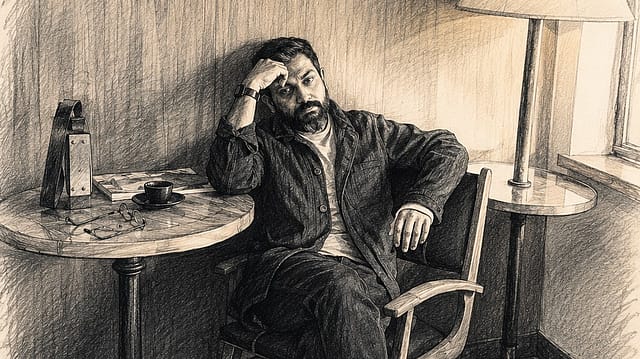
He stands behind a wooden desk that doesn’t feel like a desk.
It’s more like a surface where things gather. Leather trays. A half-burnt candle. A glass of water, untouched. Books—stacked, not arranged. Chanel. Louis Vuitton. Dior. Then suddenly—Kinfolk. Tokyo. Eat NYC. Cities. Objects. Fragments of taste.
Nothing screams for attention. Everything waits.
Gautam Sinha picks up a cap. Turns it in his hands. Not absent-mindedly. Almost like he’s reading it.
He does that often—touch before thought.
Behind him, a wall of warm wood. Not showroom-perfect. Lived-in. A dartboard sits above a row of books. A small wooden mannequin stands still, mid-thought. Coffee machines line the shelf like tools, not props. A clock that feels older than it is. Frames. Objects. Pieces collected, not curated.
The Identity Project
11 Sep 2026 - Vol 05 | Issue 37
Amit Shah leads the mission for a national demographic correction
You don’t walk into this office. You enter a mind.
“People think this is business,” he says, almost shrugging.
A pause.
“It’s not.”
He doesn’t elaborate. Doesn’t need to.
Nothing inside the room in Sultanpur feels like a business. Books lie scattered, half-read. Leather brushes against coffee, against design, against travel. In the corner, a trunk waits—quiet, certain, like it has always been there.
This is not a founder’s office. This is a maker’s room.
And yet, step outside this room, and the numbers begin. Stores. Cities. Countries. A ₹100-crore brand that carries his name without ever needing to say it loudly. The contradiction lingers here too—an artist’s instinct, a businessman’s outcome.
Sinha didn’t plan this. Not the brand. Not the scale. Not the expectation that now follows him into every room like an uninvited guest. For 15 years, he built Nappa Dori the only way he knew—by feel. No capital. No playbooks. No noise.
The brand grew anyway. And now, for the first time, he’s being asked to do something he has avoided all along: Explain it, structure it, scale it, and turn instinct into system. He doesn’t look like someone preparing for that. He looks like someone deciding whether he even wants to.
To understand that hesitation, you have to go back.
Growing Up Without Permanence
He didn’t grow up thinking about brands. He grew up watching things move. “Childhood was basic,” Sinha recounts. “We weren’t an affluent family. My father was in the forces.”
This meant movement. Not the romantic kind but the routine one.
Houses changed every few years. Boxes came out, went back in. Metal trunks travelled with them—dented, marked, dragged from one place to the next. As a child, he watched them closely. Not because they were special. Because they were constant. “Every time we moved, those trunks were there,” says Sinha. “I didn’t realise it then but one of the first products I made later was a metal trunk,” he smiles.
The memory stayed. Quietly.
Then life shifted in a different way.
His parents separated when he was six. His father passed away a few years later. What remained was a small, tight unit—his mother, his brother, and him—moving through Delhi, adjusting, recalibrating, and figuring things out as they went. “Life was not easy as a kid,” he says. “My mother was working, taking care of both of us,” he says, adding that the family was shifting houses every couple of years.
Sinha doesn’t linger on it. He says it plainly. Just recall. But that kind of childhood does something. It sharpens certain instincts early. You watch more closely. You learn to adjust faster. You don’t assume permanence.
And somewhere in that movement, something else was taking shape. School didn’t come easy. “I was not academically strong,” says Sinha. “I flunked…second, third, fourth.”
At the time, there was no diagnosis. No language to explain it. Just labels that stuck quickly. “I was just stupid,” he says, almost casually. “That’s what it felt like.”
Except, that wasn’t entirely true. Because there was one place where things clicked: Drawing. “I used to copy Archie comics,” he says. “I just liked drawing, being visual.”
Sinha didn’t know the word for it then. Dyslexia came much later. But he knew this much—he understood things better when he could see them. When he could touch them. When he could build them.
When Marks Closed Doors
Words didn’t hold. Images did.
By the time he finished Class XII, the system had already made its judgment: 44%. “Everyone was crying over 90s,” he says. “I was happy. I passed.” No Delhi University. No conventional path.
So, he did the only thing that felt remotely aligned. “I applied to NIFT because I liked drawing,” he says. And because with those marks, nothing else was possible.
Sinha got in. Stayed for a while. Then left.
“I had to earn.”
His first job had nothing to do with leather. Or brands. Or anything that would later define him.
He was making Christmas decorations—beads, wire, small crafted objects that would be packed and shipped to homes he would never see. The work was simple, repetitive, almost meditative. ₹14,000 a month.
Sinha didn’t spend much of it. “I opened a trading account,” he says. “Started playing with stocks.” Not out of training but curiosity. He liked watching numbers move. Liked the idea that value could shift, expand, and multiply.
There was something taking shape, even if he didn’t recognise it yet. He liked making things. And he liked seeing how value travelled. It just never reached him.
The shift came without ceremony: A belt. In 2004, someone asked if he could make one. He said yes, without knowing how. “I had no idea about leather,” he recalls. He went to Kanpur, found a craftsman, and started figuring it out. “I kept touching things and figuring it out,” he recounts. That became the method. Not theory. Not training. But touch, trial, and correction. “I figured it out by feel,” says Sinha.
The first order paid more than his monthly salary. That was enough to keep going. He didn’t call it a turning point. Didn’t frame it as a pivot. He just moved to the next order. And then the next.
Starting Without a Playbook
Work began to come in pieces. Belts, then menu covers, then small leather goods for hotels—boxes, holders, things that filled rooms quietly but carried no name. Orders came through others. Exports moved through other companies. He was making. Someone else was selling.
Margins were thin. Effort wasn’t. And slowly, a pattern revealed itself. “I would make a belt for ₹100,” he says. “They would sell it for ₹2,000.” At first, it’s just information. You notice it. You move on.
But repetition does something. It sharpens the gap. Everyone around him seemed to be building value on top of what he created. The product moved. The price changed. The margins expanded. He remained where he started. “Everyone was making money,” he says. “I wasn’t.”
That realization didn’t arrive as a grand idea. It settled in, quietly. And once it did, it refused to leave.
There was no plan for what came next. No blueprint. No roadmap. Just a decision. If value sat outside the act of making, then he would have to step outside it too and build something of his own. Not because he knew how. Because he had seen enough to know what he didn’t want to remain.
He didn’t know what building a brand meant. Not in the way it’s spoken about now. No frameworks. No vocabulary. No sense of positioning or market gaps. Just a simple, almost stubborn thought. If others could sell what he made at ten times the price, why couldn’t he?
“I didn’t know anything about business,” confesses Sinha. “But I knew I wanted to do something of my own.” That was enough to begin. The idea took time to form.
Through those years, he had seen enough factories, enough export houses, enough middlemen to understand how things moved. What sold. What lasted. What didn’t.
The Hauz Khas Garage
He had also seen what was missing. There were Indian brands. There were global luxury labels. But very little that sat in between—rooted here, but designed with a certain restraint. A certain quiet.
Sinha didn’t articulate it like that then. He just knew what he liked. Clean lines. Minimal detail. Objects that didn’t try too hard. The name took longer than the idea. “I was struggling with it,” he says. “For almost two years.” There were options. None of them felt right. Too forced. Too clever. Too disconnected from the work itself. And then, one day, sitting at his desk, he looked around. Leather. Thread. The two things he worked with every day. “Nappa Dori,” he says. “It just came together.”
By then, he had some savings. Not a lot. Around ₹3–4 lakh. Enough to try. Not enough to fail comfortably. In December 2010, he took a space in Hauz Khas Village. A scooter garage. Not the kind of place you plan a brand launch from. A narrow lane, uneven flooring, and bare walls. The kind of space you take because it’s available, not because it’s ideal. “I didn’t have money for interiors,” he says.
So, he improvised. Wooden flooring—bought in bulk because that’s how it was sold. More than he needed. The rest, he used to line trays. Nothing was wasted. Nothing could be.
The first set of products was small. A few belts. Some wristbands. A tray. A trunk. That was the store. No opening event. No marketing. No announcement. He bought a few bottles of wine, called a handful of friends, and opened the door.
The first sale came on day one: ₹3,000. A belt and a wristband. “That was it,” he says. “That was the turning point.” Not because of the money. Because someone walked in, saw what he had made, and paid for it.
The early months were simple. He ran the store himself. Opened it. Closed it. Sold during the day. Made products at night. There was no team. No system. No separation between work and everything else. “First month, I think we did about ₹30,000,” says Sinha. “Then ₹1 lakh. Then ₹2 lakh.”
Growth Without a Rush
The numbers climbed slowly. Steadily. The rent was ₹11,000. He was making more than that. That was enough. The customers came quietly. Not through ads. Not through campaigns. Through curiosity.
Hauz Khas was beginning to change then. A new kind of crowd. Expats. Travellers. People looking, exploring, discovering. “My first customers were mostly foreigners,” recalls Sinha. They didn’t question the price. That part mattered. Because from the beginning, he had made a decision that didn’t make sense to most. He would price his products like international brands. Not based on cost. Based on conviction. “I was very clear,” he says. “If they can sell at that price, why can’t I?”
It was a risky stance. India wasn’t used to it. Not from an Indian name. Not for leather goods that didn’t carry legacy. But he held it. Not out of strategy but out of instinct.
And slowly, something began to happen. People didn’t just buy the products. They remembered them.
There was no grand moment where Nappa Dori “took off.” No spike. No sudden scale. Just accumulation. One product. One customer. One store. And then another.
Sinha didn’t realise it then. But the brand had already begun.
There was no rush to expand. No checklist. No target sheet pinned to a wall. No version of “five stores in three years.”
If anything, there was hesitation. After the second store, he paused. For years. “I didn’t open a third store for four years,” says Sinha. “I got scared.” Not of failure. Of exposure.
Growth meant commitment. More rent. More people. More moving parts. And he wasn’t sure he understood the system well enough to stretch it. So, he did what he knew. He stayed close to the work. Those years didn’t look dramatic from the outside.
Inside, they were dense.
He kept making. Kept refining. Kept experimenting with materials, finishes, details most people wouldn’t notice but would feel. At the same time, he kept supplying. Contract work continued in parallel. Exports. Hotel orders. Small things that kept cash flowing. The brand wasn’t the only engine.
It was one of many. “I was still hustling,” he says. “The store wasn’t my only bread and butter.”
Beyond Retail: Café Dori
That mattered. Because it bought him time.
Sinha used it to learn what he had missed the first time. Hardware. Finishing. Quality. He travelled to Hong Kong. Sourced better buckles, better fittings. Small upgrades. But they changed how the product felt in hand. And for him, that was everything. If it didn’t feel right, it didn’t go out. There was no rush to fill shelves.
The store, though, was already doing something else.
It was building recall. Not loud or aggressive. But just consistent. A certain way things were placed. A certain way leather aged. A certain restraint in design that stood apart in a market that preferred excess. He didn’t articulate it as brand language. But it was there.
Then came a different kind of move.
Not a store. A café. “I’m a coffee addict,” he says. “And I couldn’t find a good cup of coffee in Delhi.”
So, he built one. Not as a separate idea. As an extension: Café Dori.
It didn’t make immediate sense. A leather brand opening a café. But in his head, it did. He wasn’t thinking categories. He was thinking experience. What if someone walked into the store, spent time, had a coffee, stayed longer, looked around, touched things, absorbed the space? What if the store wasn’t just a place to buy? What if it was a place to be?
The Dhan Mill move in 2016 pushed that idea further. A large space. Nearly 7,000 square feet. Far bigger than anything he had done before. In a location that wasn’t even fully defined yet. “It was all mechanic workshops,” says Sinha. “No one knew what it would become.”
He took it anyway. Poured in whatever he had saved. “No contractors,” he says. “We built it ourselves.” It wasn’t just a store anymore. It was a world. Belts could be made there. Coffee could be poured there. People could sit, work, bring their dogs, spend hours without buying anything.
The line between retail and environment blurred. Some didn’t get it. “A lot of people said the café would dilute the brand,” he says. Sinha ignored it. Because for him, the brand was never just the product. It was the feeling around it.
The Shock of the Pandemic
Through all of this, one thing remained unchanged. He didn’t raise money. Not once. “I never even thought about it,” he says. No investors. No external pressure. No growth targets set by someone else.
Everything moved at his pace. This also meant everything was limited by his pace. He didn’t pay himself for years. “I started taking a salary after seven years,” he says. “₹50,000.” Until then, whatever the company made went back into it. New products. New stores. New experiments. Every time there was surplus, it went out again into the next thing.
From the outside, it looked like discipline. Inside, it was instinct. The same instinct that had shaped everything so far. Don’t borrow. Don’t rush. Don’t overbuild. Stay close to the work. And slowly, almost quietly, Nappa Dori expanded. More stores. More cities. A presence that didn’t announce itself but kept appearing—Delhi, Mumbai, then beyond. Even internationally. London. Dubai. There was no single moment where he stopped and said: this is big now. Because he never measured it that way. “I still don’t think we are a brand,” he says. He means it. Even now.
But by then, the structure had already formed.
A product language. A visual identity. A way of building that was unmistakably his. All without a plan. All without a playbook. And then, just as it had begun to feel stable, everything stopped.
It didn’t begin with panic.
When the pandemic shut everything down, it looked like a pause at first. A few days. Then a few weeks. Stores shut. Staff sent home. Rent still ticking. Inventory sitting where it was.
Like everyone else, Sinha waited. For clarity, for timelines, and for some signal that things would return to normal.
They didn’t. One store shut. Then another. Hauz Khas. Select Citywalk. Meherchand. Spaces that had taken years to build, closed in weeks. Revenue didn’t slow. It stopped. Expenses didn’t.
“There was no cash,” he recalls. Not a dip. Not a squeeze. Gone.
Years of building—quietly, carefully, without borrowing—began to drain out in a matter of months. Salaries had to be paid. Rent had to be negotiated. Calls had to be made.
Every day, a new decision. None of them easy. He had never raised money. Never built a buffer through external capital. Never had investors to fall back on. That had always been a choice. Now, it was a condition. “I thought it was over,” he says.
The weight wasn’t just financial. It was personal. The same discipline that had shaped the company now turned inward. Every rupee counted. Every delay stretched. Every uncertainty lingered longer than it should. “I went into a bad phase,” he says. “More or less depression.” He doesn’t stay on it. Doesn’t unpack it. But it sits there.
When Instinct Was Questioned
There’s a version of this story where this is where it ends. Where the brand, built slowly over years, gets taken down by something no one planned for. He came close. “I was very pissed off,” he says. “I felt like just shutting everything.” Not pivoting. Not restructuring. Ending.
But there were people around him. Not many. Not a large corporate team. But enough. People who had been there for years. Who knew the product, the process, the pace. “They stayed,” says Sinha. “They believed in what we were doing.”
That mattered.
So, he did what he had always done. He went back to making. Travel had stopped. So, travel products wouldn’t move.
That part was obvious. What wasn’t obvious—at least immediately—was what would. So, he tested. Within weeks, they built something new: A home line. Candles. Ceramics. Objects designed for spaces people were now spending all their time in.
No long gestation. No elaborate planning. Just instinct, under pressure. “We created it in a month,” he says. Not perfectly. Not completely. But enough to start.
It didn’t replace what was lost. Nothing could. But it did something else. It brought movement back. Orders, small at first. Then steadier. The system, broken just weeks ago, began to find shape again. There was no dramatic comeback. Just a slow return. Piece by piece.
But something underneath had shifted. He could feel it.
For years, instinct had been enough. It had guided everything—what to make, how to price, where to open, when to wait. There were no decks. No consultants. No external voices telling him what the next step should be. Just a sense. Sometimes right. Sometimes not. But always his.
For the first time, the question wasn’t just about building. It was about sustaining. About whether instinct, which had taken him this far, was enough for what came next. He had rebuilt once from nothing. Now he had to rebuild again from something.
Nappa Dori was no longer small. Twenty stores. Multiple cities. A presence outside India. A team that had grown with the brand, many of them over a decade. And a number he still doesn’t say out loud. ₹100 crore. It exists. Even if he doesn’t dwell on it.
Still a Creator at Core
The expectations that come with that kind of scale are harder to ignore. More stores. Stronger systems. A sharper online presence. Decisions that can’t be made on instinct alone. “We have not been able to optimise online,” he says. “That should be our biggest market.” He knows where the gaps are. That’s new. Earlier, the work was the focus. Now, the structure around the work demands attention.
There is also the question he had avoided for years: Capital.
He had never needed it before. Or rather, he had chosen not to. Every store, every expansion, every experiment had been funded internally. Slow growth, but controlled. No dilution. No external pressure. Now, the equation is shifting. “Maybe we will go into the market,” he says. He doesn’t commit. Doesn’t announce. Just leaves it open.
Sinha knows what it means. Money brings scale. But it also brings expectation. Speed. Targets. Structure. And with that, a certain loss of control. “I’m okay with that now,” he says.
A pause. “Sometimes you need to learn from people.”
It’s a different tone from before. Less resistance. More acceptance. Not of the system—but of the need to engage with it. Because the risk now isn’t failure. It’s stagnation. “If we don’t do certain things, other brands will come and take over,” he says.
He has seen that pattern before. From the outside. Now, he’s inside it. And yet, even here, he doesn’t sound like someone chasing scale for the sake of it.
He still talks about product. About feel. About experience. About what happens when someone walks into a space and stays longer than they intended. “I like creating,” he says. “That’s what I enjoy.” The business sits around that. Not the other way.
This is where the tension holds. Fifteen years of building something on instinct. And now, the possibility of turning that instinct into a system. Sinha still spends time in the store. Still notices the small things. How a product sits. How a customer moves. What they pick up, what they leave behind. Still touches before he decides.
There is no final declaration of what comes next. No roadmap laid out in clear lines. Just a direction. Careful. Measured. And open. “Brands take time,” he says. “You can’t rush it.” He has lived that. Now he has to test it. At scale. And maybe that’s the real shift. Not from small to big, but from instinct to intention.
Back in the room in Sultanpur, not much has changed. The books still lie open. The leather still sits where it does. The trunk hasn’t moved. On the desk, things continue to gather. Outside, the numbers have grown louder. Inside, he is still deciding how much of that noise he wants to let in.
Sinha built it without a plan. He held it without a playbook. What comes next will decide what it is.