Vaseline’s Accidental Rebrand: How a Mispronunciation Became a Marketing Moment
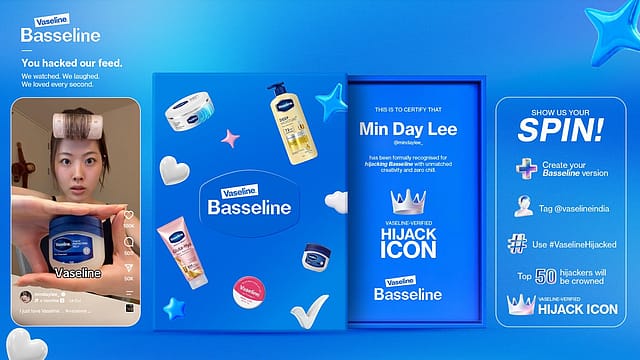
Korean beauty creator Min Day Lee’s Vaseline obsession became a pronunciation meme. The brand’s decision to embrace “Bassline” says something bigger about how old consumer brands are learning to let creators rewrite them. There is a reason Lee’s Vaseline video feels less like an accidental viral moment and more like the internet doing what it does best. Lee is not a creator who happened to pick up a jar of Vaseline one day. Vaseline is her content. Her feed is filled with Vaseline skincare, tips, hacks and demonstrations. She has been turning the humble petroleum jelly into content long before one particular pronunciation turned her into the internet’s “Baseline girl”. One of her earlier posts, for instance, is explicitly framed as a Korean Vaseline skincare series, with the creator walking viewers through her experience using the product.
So when she appeared on social media enthusiastically showing off her Vaseline collection and saying the brand name in a way that many viewers heard as “Baseline”, the joke had something to attach itself to. The internet did not just find a funny word. It found a character. “Baseline” became “Bassline”. The audio travelled. People repeated it, remixed it and inserted it into completely unrelated videos. “Addicted to Baseline” became part of the joke. A skincare creator’s product showcase had escaped skincare altogether. Vaseline could have watched from the sidelines. Instead, it joined its own joke.

Zeroing In on ECI
09 Oct 2026 - Vol 05 | Issue 41
Constitutional legitimacy versus political opportunism
The best thing Vaseline did was not create the meme
There is a temptation in brand marketing to describe every viral moment as something a brand has leveraged. That is not quite what happened here. Vaseline did not create “Bassline”. It did something arguably more difficult: it recognised that the internet had created something useful for the brand and resisted the urge to over-engineer it. The brand started playing with the pronunciation on its own social channels, responding with posts such as “BASELINEEEEEEE”.
For Ashita Aggarwal, Marketing Professor at SPJIMR, the appeal of the move lies precisely in its speed and restraint. “It’s a genuinely smart piece of reactive marketing. It is not about being clever, but about making the most of timing,” she says. “Most brands take weeks to get a meme through legal and creative review, by which point the moment is dead.” Vaseline moved while the moment was still hot. More importantly, it did not try to turn the joke into a conventional advertisement. “It didn’t try to own it or over-produce it. Instead, it amplified what was already funny rather than replacing it with a polished ad,” Aggarwal says.
That distinction explains why the response feels native to the internet rather than manufactured for it. The old model of brand marketing was relatively straightforward. The brand made the content, creators distributed it and consumers reacted. The new model is considerably messier. Consumers create the behaviour, creators give it a personality, the internet mutates it, and the brand’s job is to decide whether it can contribute without killing what made the thing interesting in the first place. Vaseline’s response is essentially: Fine. We’re Baseline now. That is probably why it works.
This is bigger than a pronunciation joke
The irony is that Vaseline has been moving towards this model for a while. The brand’s recent marketing has increasingly treated creators as more than a distribution channel. Its Vaseline Verified initiative was built around the thousands of hacks people were already sharing online. Instead of simply borrowing those hacks for advertising, Vaseline put viral claims through scientific testing and used its credibility to distinguish what worked from what did not. The campaign turned the brand into something closer to a referee for the enormous community that had grown around its product.
Then came Vaseline Originals. Some of those community hacks moved in the opposite direction, from social media into actual products. Hacks shared years ago by creators such as Jen Chae and Lauren Luke eventually inspired Vaseline products, turning old creator behaviour into something the brand could manufacture and sell. That makes the “Bassline” moment rather revealing. Vaseline has spent years listening to what people do with its jelly. Now it is listening to what people call it. Both are versions of the same strategy: the brand is becoming less interested in telling people what Vaseline means and more interested in watching what Vaseline means to them.
From petroleum jelly to internet material
That is a useful position for a 155-year-old brand. Vaseline does not have the novelty advantage of a new skincare startup. It has the opposite problem. Almost everyone already knows what it is. The opportunity, therefore, is not necessarily to introduce the product. It is to keep finding new reasons to talk about it.
Creators have been doing that for years. They have turned Vaseline into a brow tamer, makeup hack, glow trick and part of countless skincare routines. Some of those behaviours have become so widespread that the brand has begun turning them into formal innovation. Min Day Lee’s content belongs to that same ecosystem. Her appeal is not simply that she said “Vaseline” differently. It is that she has made the product part of her internet identity. The collection, the hacks, the enthusiasm and eventually the pronunciation all collapse into one recognisable piece of creator culture.
That is why the brand’s response feels unusually natural. It is not parachuting into somebody else’s meme. It is joining a conversation that was already happening around its product.
The curious thing about “Bassline” is who owns it
There is another reason this moment is worth watching. Brands have historically been extremely protective of their names. They spend years building recognition and then spend even more money protecting the meaning attached to those names. The internet is much less respectful. It misspells them, shortens them, turns them into sounds, makes them verbs, and turns logos into jokes and slogans into templates. Most brands see that as a loss of control. Vaseline appears to be treating it as participation.
By officially calling creators, including Lee, “Vaseline-Verified Hijack Icons” and inviting more users to make their own versions under #VaselineHijacked, the brand is effectively giving the meme a home without pretending it invented it. That distinction matters. The internet is very good at detecting brands that arrive after the joke and announce that they were “always part of the conversation”.
Vaseline is doing something slightly different. It is saying: You hijacked us. Fair enough. We’ll take part.
Aggarwal points out that the brand also credited the person who created the original moment rather than quietly absorbing her work into its own marketing. “They credited the actual person who created the moment, instead of the brand quietly absorbing her work for free,” she says. That is particularly important in an ecosystem where brands routinely borrow from creator culture after a meme has already done the hard work of becoming popular.
And yet the virality here is not really about Vaseline. “It is about how a mispronunciation caught up with the audience,” Aggarwal says. That may be the most useful way to understand the campaign. Vaseline did not manufacture the cultural moment. It recognised one, participated in it and gave it enough oxygen to travel further.
Perhaps that is the more interesting future for legacy brands. Not controlling the conversation. Not pretending they started it. Just being self-aware enough to know when the internet has handed them something they could never have written in a brief.