That ₹100 Can of Soda? You're Mostly Paying Taxes and Middlemen
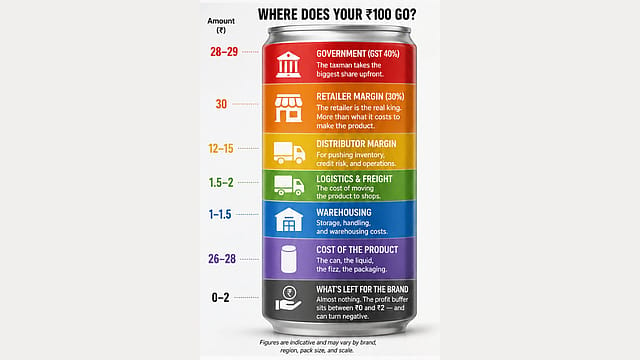
Next time you crack open a chilled can of your favourite carbonated beverage, here's an uncomfortable thought: of that ₹100 you just spent, the actual drink — the can, the liquid, the fizz — cost somewhere between ₹26 and ₹28 to produce. Everything else went to the government, the retailer, the distributor, and a logistics chain that barely breaks a sweat.
Before anyone makes a single rupee, the taxman has already taken his cut. A flat 40% GST on carbonated beverages means ₹28–29 of every ₹100 is gone before the brand, the retailer, or the distributor sees a thing. India places sugary aerated drinks in the same "sin goods" bracket as tobacco — a categorisation that makes this one of the most heavily taxed FMCG categories in the country, and a structural headwind that squeezes every player in the chain.
The Retailer is the Real King
Here's what will genuinely surprise you: the retailer pockets ₹30 on that ₹100 can — a 30% margin, more than what it costs to actually make the product. This isn't an anomaly; it's the structural reality of India's retail economy. According to IMARC Group, the offline channel accounts for 76% of India's FMCG market in 2025, underpinned by the widespread presence of traditional kirana stores, supermarkets, hypermarkets, and organised retail outlets ensuring product accessibility nationwide. That's a lot of mouths to feed — and shelf space, refrigeration, breakage, and unsold stock all add up to justify the premium.

Youth Issue 2026
24 Apr 2026 - Vol 04 | Issue 68
50 Portraits of Icons and Achievers
The Distributor, the Truck, the Warehouse
Add another ₹12–15 for the distributor, ₹1.5–2 for logistics and freight, and ₹1–1.5 for warehousing. The supply chain is not cheap, and it is not simple. According to an India FMCG Outlook 2025 survey of over 100 industry professionals, 48% of FMCG leaders cite the adoption of advanced technology to streamline supply chain and logistics as a pivotal growth driver — a clear signal that the cost and complexity of distribution remains one of the sector's biggest pain points. Every link in the chain — from factory to distributor to truck to shelf — is a cost centre, and together they add up to more than the product itself.
What's Left for the Brand?
Almost nothing. The profit buffer sits between ₹0 and ₹2 — and can turn negative. That's before accounting for the hidden costs the infographic flags but doesn't quantify: marketing, trade promotions, expiry losses, last-mile delivery, and admin. NielsenIQ data shows India's FMCG market grew 13.9% in value in Q2 FY26, yet even amid this growth, companies continue to battle rising input costs, logistics pressures, and margin compression. Growth at the top line doesn't automatically translate to profit at the bottom.
So How Do They Make Money At All?
Volume. Pure, relentless volume. According to IMARC Group, India's carbonated soft drinks market reached USD 11.7 billion in 2025 and is projected to grow at a CAGR of 4.64% through 2034, reaching USD 17.6 billion, driven by Tier 2 and Tier 3 retail penetration and rising urban incomes. Grand View Research pegs the market at USD 15.4 billion in 2025, projecting growth to USD 22.4 billion by 2033, with India identified as the fastest-growing carbonated soft drinks market in the Asia Pacific region. At ₹1–2 per can, you need to move billions of units to make the math work. Scale, distribution, and execution are not optional — they are existential, exactly as the infographic states.
The Bigger Picture
What this breakdown really reveals is how brutally thin the economics of everyday consumer goods are in India. Carbonated beverages dominate India's soft drinks landscape with a 52.3% market share in 2025, anchored by decades of brand loyalty and a vast product portfolio — yet the segment's very dominance is built on volume, not margin. The government, retailer, and distributor together absorb nearly 70–75 paise of every rupee spent. The brand making the product keeps the rest, and bets the farm on scale.
So yes, you're paying ₹100 for a can of soda. But really, you're paying for an entire economy in a single sip.
Sources: IMARC Group, NielsenIQ; BeatRoute / Industry Survey.