Holy Cow! RiRi Has Done It Again
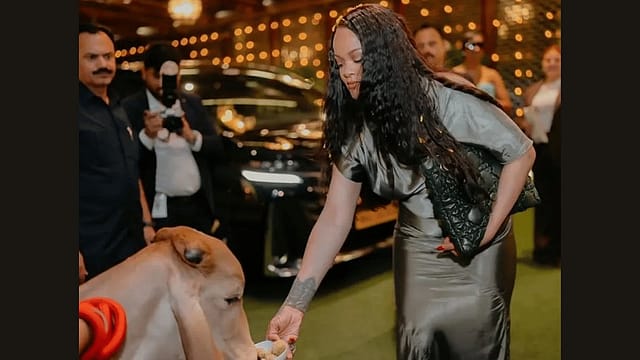
Rihanna has never been one to apologise. Whether it's showing up fashionably late to her own comeback arc or launching a billion-dollar beauty empire while the world waited on a studio album, RiRi does things on her own timeline and on her own terms. So when the internet erupted last week over a viral photo from her Mumbai visit — showing the pop icon performing gau seva (cow feeding) with one hand while cradling what social media users alleged is a calfskin Dior bag worth ₹4.3 lakh in the other — nobody really expected a statement, a sorry, or even a smirk. And predictably, there was none.
But just because Rihanna is unbothered doesn't mean the conversation isn't worth having.
The Photo That Broke the Internet (Again)
Rihanna was in Mumbai recently, and a photo of the singer went viral, showing her performing gau seva — feeding a cow — a gesture considered highly respectful and sacred in Indian culture. However, eagle-eyed netizens noticed something in the same image: the green Dior bag on her arm, which social media users alleged was made using calfskin and lambskin, reportedly priced at around ₹4.3 lakh.
Rise of the Pivotal Power
18 Sep 2026 - Vol 05 | Issue 38
The BRICS declaration is a strategic victory for Modi
The conversation quickly escalated across platforms like Instagram, X, and Reddit, with users pointing out the stark irony of the optics: a woman who leads a brand that markets itself on cruelty-free and ethical values, simultaneously feeding a cow while potentially carrying one. Whether or not the bag is genuinely calfskin has not been officially confirmed, but in the age of viral outrage, perception is everything — and the perception here was damning.
The Fenty Beauty Ethics Playbook — and Its Fine Print
Let's be clear about what Fenty Beauty actually claims. According to their FAQ section, "Never. Fenty Beauty is cruelty-free. We do not allow any suppliers or affiliates, or partners to test our products on animals." On paper, that's commendable. But the vegan claim is where things start to unravel. Fenty Beauty is not vegan. Some of their products contain animal-derived ingredients such as beeswax and carmine. Fenty Beauty is cruelty-free but not 100% vegan, meaning that some of their products contain animal-derived ingredients.
There's also a structural contradiction that often gets glossed over in the brand's marketing. Fenty Beauty is owned by LVMH, which is not a cruelty-free brand. LVMH is the same conglomerate that owns Christian Dior — yes, the very brand whose bag is now at the centre of this controversy. So Rihanna, in a single photograph, managed to encapsulate the tension at the heart of modern celebrity ethics: the cruelty-free beauty mogul, backed by a luxury conglomerate that profits from animal products, feeding a sacred animal while potentially clutching a product made from one.
If it wasn't so on the nose, you'd struggle to write it.
The India Play: Business Over Ethics?
Let's not pretend Rihanna's India visit was a spontaneous cultural pilgrimage. In April 2026, Fenty Beauty created a massive cultural event in Mumbai — a themed experience described as "Fenty Beauty ki Haveli" — blending Indian culture and global branding, with Rihanna herself appearing to turn it into a headline moment. This came after Fenty Beauty and Fenty Skin officially launched in India in August 2025 through an exclusive partnership with Sephora and Tira, available across 50+ stores in 16 cities.
The commercial motivation is transparent and entirely understandable. India's beauty and personal care market was valued at $23.99 billion in 2023 and is projected to reach $66.9 billion by 2034, growing at a CAGR of 10.8%, as per various market research firms. India has moved decisively into the beauty industry's top tier of priority markets, with premiumisation accelerating, digital commerce maturing, and organised retail scaling rapidly. Global brands want their share, and Fenty is no different.
But here's the rub: when your brand identity is built on values — inclusivity, ethics, cruelty-free formulations — your personal conduct becomes part of the brand story whether you like it or not. You cannot separate Rihanna-the-billionaire-mogul from Fenty-the-ethical-beauty-brand when you are literally the face, the founder, and the cultural engine of that brand. The two are inseparable, and so are their contradictions.
Celebrity Ethics and the Accountability Gap
What this moment really exposes is the broader, industry-wide problem of ethical celebrity branding that doesn't translate into personal lifestyle choices. Rihanna is hardly alone in this. The fashion and beauty industry is littered with stars who champion sustainability in their brand messaging while touring in private jets, wearing luxury leather, and partnering with fast fashion labels. The difference is that Rihanna's brand has been particularly loud about values — and the Indian cultural backdrop made the contradiction far more visible and symbolic.
Rihanna wore designs inspired by Indian couture and jewellery reflecting local craftsmanship during her Mumbai visit — a gesture that was widely praised for cultural sensitivity. And most of her visit genuinely won hearts. But that goodwill makes the Dior bag incident even more jarring. It is precisely because the rest of the visit was so thoughtfully curated that this one detail feels less like an accident and more like a blind spot. A well-managed PR machine that remembered to organise cow-feeding and saree moments but forgot to brief the client on what bag to carry.
The Bigger Question
The viral outrage will fade, as it always does. Rihanna will sell a lot of Pro Filt'r foundations at Sephora India. The Indian beauty market will continue to boom. And somewhere in a Parisian design studio, another luxury bag made of animal skin will be lovingly crafted for the next event. None of this will change.
But the moment is worth sitting with because it represents something larger: the uncomfortable performance of ethics in an industry that profits from contradiction. Fenty Beauty's cruelty-free positioning is real in parts and marketing in others. Rihanna's personal choices are hers to make. But the two colliding in a single photograph — in a country where the cow is sacred, no less — is the kind of symbolism that doesn't need a caption.
The internet called it hypocrisy. Rihanna didn't respond. In some ways, the silence said everything.