Inside Libas’ Fast-Fashion Playbook: How Sidhant Keshwani Is Building India’s Zara for Indian Wear
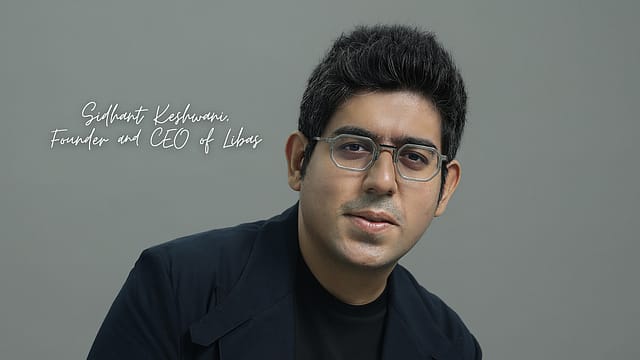
There's a photograph Sidhant Keshwani doesn't need to show you. You can picture it from the way he talks, a young man, fresh off a flight from Manchester, sitting in his family's Delhi office, surrounded by swatches, export orders, and the quiet hum of a manufacturing business that had seen better days. He was 21. He had plans.
"I initially wanted to be an investment banker," he admits, laughing. "I accidentally got into entrepreneurship."
That accident has turned out rather well. Today, Sidhant is the Founder and CEO of Libas, one of India's fast fashion ethnic wear brands for women, and among the first direct-to-consumer fashion labels in the country to clock an Annual Run Rate of ₹1,000 crore, as the company claims. But the story begins not with ambition and scale, but with a dinner table and a gap in the market.

Losing Memory
16 Oct 2026 - Vol 05 | Issue 42
The making of a medical and social emergency
Libas reported revenue of ₹609.1 crore in FY25, up 25% from ₹486.5 crore in FY24, but slipped from a ₹4.8 crore profit to a ₹16.5 crore loss, largely due to offline expansion, as per Inc42.
Built at the Dinner Table
Sidhant grew up with business in his blood. His father, Sunil Keshwani, a first-generation entrepreneur, built the family's apparel manufacturing business from nothing. Evening conversations at home were rarely about school or cricket, they were about fabric, fashion trends, and supply chains.
"Business and fashion were core to my DNA," Sidhant says. "I grew up seeing that on a daily basis."
When he left for the University of Manchester to study Economics, he carried that instinct with him. What the UK gave him, in addition to a degree, was a ringside view of e-commerce accelerating across the West, Amazon, ASOS, and the broader digital retail shift. He returned to India in 2012 with one conviction, that e-commerce would define his generation.
"Every ten years there's a boom," he explains. "The dot-com boom, then real estate, then e-commerce. Whoever catches the bus early is the one who ends up making something big."
He caught the bus.
In 2014, Sidhant set up a separate company, separate office, and a focused e-commerce play, with his father's manufacturing unit as the exclusive supplier. But before he listed a single product, he spent months researching the market with unusual discipline for a 21-year-old.
The question he kept asking was simple, what will people actually buy online?
The sweet spot for e-commerce spending at the time was ₹500 to ₹800. Heavy, embellished garments were out, too expensive and too risky for a new medium. But he noticed something else. Women who worked in offices wore kurtas frequently, not once a year for a wedding, but once a week, sometimes more.
"We launched as a pure workwear brand," he says. "That was our first trip, target the working woman, give her something she needs every week, at a price she's comfortable spending online."
Within six months, Libas had become one of the largest sellers on Flipkart. Within eighteen months, it was the number one brand in the ethnic category. Within four years, the number one brand in all of women's fashion on the platform. The parent company's other businesses quietly wound down. The future was here.
The Pivot That Changed Everything
By 2017, Libas had crossed ₹100 to ₹150 crore in revenue. But Sidhant saw a ceiling. Great products alone, he realised, would not build a ₹1,000 crore company.
He looked at what was happening in the West, brands like Zara and H&M launching new trends every week, pulling from social media and putting it on racks before the moment passed. He looked at Indian wear and saw the opposite, repetition with minor variation.
"I asked myself, if there is so much innovation happening in the Western wear space, why is no innovation happening in the Indian space?"
The answer became Libas's defining pivot. The brand stopped thinking of itself as an ethnic wear label and started operating like a fast fashion engine. Today, Libas launches 100 to 125 new designs every week. It has cut down production lead times from 120 to 140 days to 50 to 60 days, with a target of 30 to 45 days. Its catalogue runs over 10,000 live SKUs at any given time.
"Our USP is not just great products," Sidhant says. "Our USP is speed. We are the fastest at whatever we do."
That speed, however, introduces a different set of pressures. As Ashita Aggarwal, Professor of Marketing at SP Jain Institute of Management & Research, notes, the model inherently rewards volume and responsiveness, while long-term growth and a potential IPO demand brand equity, pricing power, and stronger margins. In Libas’ case, she points out, the growing emphasis on SKU expansion over storytelling risks weakening brand identity even as omnichannel expansion begins to strain profitability.
For years, Libas was almost entirely an online business, with 90 to 95 percent of revenue coming from e-commerce. That, Sidhant decided, was both a strength and a vulnerability.
"A customer is in a mall on weekends, if I'm not there, she buys from another brand. The same customer is in office during weekdays, shopping online. The same customer has a last-minute dinner, she goes to quick commerce. If I'm not across all those channels, I lose her."
The offline journey began in 2021 with Shoppers Stop and large format stores. The first exclusive Libas store opened about two years ago. Today the brand runs over 50 stores, with 35 to 40 of those opened in the last year alone. The target is 80 to 100 stores by the end of this financial year, with a longer ambition of 200 stores.
The stores, Sidhant says, are not just retail, they are storytelling. "The way you can express yourself as a brand in your own store is incomparable to any multi-brand outlet."
That is also where execution will be tested. Aggarwal argues that physical stores need to function as brand-building spaces that create intent, not just transact. She adds that as Libas scales across channels, rising costs, marketplace dependencies, and SKU proliferation could dilute positioning unless the brand sharpens what it stands for and how it connects with its core consumer.
Quick commerce is the newest frontier. Libas is already live on Zepto and Myntra's M-Now, with Instamart in the pipeline. The intent is not to replace e-commerce or offline, but to serve a distinct use case, last-minute and impulse purchases.
"Tomorrow there's a festival at your house. You have no option but to open quick commerce and see what's available."
Revenue today stands at ₹600 to ₹650 crore for FY25, with ARR at ₹1,000 crore. The channel mix has shifted from 95 percent online to roughly 65 percent e-commerce and 35 percent offline, with a target of reaching 55 to 45 by year end.
A Father, A Son, A Business
The Keshwani partnership is quietly structured. Sunil, the father, handles the entire supply chain, manufacturing, sourcing, and production timelines. Sidhant handles marketing, technology, retail, finance, legal, and operations.
"He's been a hustler his whole life. He still works harder than me," he says. "He's built fashion from scratch. First-generation entrepreneur. That's not nothing."
The company raised ₹150 crore from ICICI Venture in 2024, after bootstrapping its way to ₹500 crore in revenue. An IPO is on the horizon in two to three years, and the corporate structure is being aligned accordingly.
Ask Sidhant where Libas is headed in ten years, and he answers without hesitation, but corrects the framing first.
"We don't call ourselves ethnic wear internally. We call it Indian wear," he says. "We want to make Indian wear a global phenomenon, not just for Indians abroad, but for people everywhere. We want to build the first Indian global brand."
It is an ambitious claim. The scale is already visible. The question now is whether the brand can keep up.