“Health Can’t Come at 50% Discount”: Saurabh Kapoor on Building Wellbeing Nutrition Like a Modern Consumer Brand
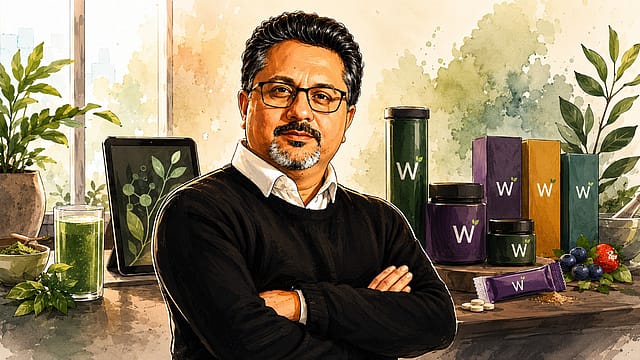
At a café in Aerocity before the pandemic, Saurabh Kapoor sat across from Avnish Chhabria listening to a pitch about science-backed nutrition, clean ingredients and the future of wellness in India.
Kapoor had one immediate thought.
“I’ve never taken supplements in my life,” he recalled saying.
Ironically, that unfamiliarity felt familiar.
Nearly every major career decision Kapoor had taken until then had followed the same pattern — entering industries he knew little about and learning them while building inside them. Banking, media sales, digital advertising, fashion e-commerce, branding — none had been planned. Yet each became a stepping stone toward building what would eventually become one of India’s most visible premium nutraceutical brands.

The Vanguard
21 Aug 2026 - Vol 05 | Issue 34
BJP Rearmed for 2029
Today, Wellbeing Nutrition sells everything from collagen and magnesium to oral dissolvable supplement strips across India, the GCC, Europe and the US. The company recently crossed roughly ₹250 crore in revenue before a majority acquisition by USV Private Limited, and is now targeting ₹400 crore net revenue this year.
Wellbeing Nutrition’s revenue from operations grew from ₹5.3 crore in FY21 to ₹118.5 crore in FY25, while net losses widened from ₹1.7 crore to ₹38 crore during the same period, as per regulatory filings accessed by Tofler.
But Kapoor’s journey into wellness began far away from health supplements.
From Selling Magazine Subscriptions to Selling Pizza Online
Kapoor grew up in a defence household, shaped heavily by his father’s Army career.
“My father gave me the foundation of discipline, integrity and honesty,” he said. “But professionally, my journey was never linear.”
He started at ICICI Bank before moving to India Today to handle subscription sales. He later joined Indiatimes during the early days of India’s SMS economy — when shortcode services and mobile internet businesses were just beginning to emerge.
“I used to run away from tech,” Kapoor admitted. “Then suddenly I found myself inside one of the earliest internet businesses.”
His defining career shift came in 2010 at Quasar, the digital arm of GroupM, when brands were only beginning to understand online commerce.
Kapoor still remembered how unusual the pitches sounded then.
“At that time, we were convincing companies that consumers would actually buy products online,” he said. “We helped build Domino’s online business into a ₹400 crore revenue stream in three years.”
The experience exposed him to the mechanics of consumer internet behaviour long before D2C became fashionable in India.
At Quasar, Kapoor worked across brands including Adidas and Panasonic. He recalled one particular pitch with a tractor company that wanted to sell tractors digitally after discovering nearly a million farmers in Punjab were active on Facebook.
“Logically, it made perfect sense,” he said. “But emotionally, the market wasn’t ready yet.”
The insight stayed with him: consumer adoption rarely depended only on logic. Timing mattered equally.
The Brand Builder Phase
After Quasar, Kapoor joined Koovs as Digital Head, helping scale the business rapidly from around ₹30 crore to ₹200 crore in revenue within a year, according to him.
But somewhere between the agency world and brand-side operations, another realization emerged.
“If you can build brands for others, why can’t you build one for yourself?” he said.
That thought pushed him into entrepreneurship.
Kapoor went on to co-found agencies including Bottle Openers and Hashtag Orange, working with brands such as Forest Essentials, Snickers and Karma Kettle.
At Forest Essentials, Kapoor helped grow the company’s online revenue from virtually zero to more than ₹100 crore before exiting.
The experience taught him how premium Indian consumers behaved online — what made them trust brands, repeat purchases and emotionally connect with products.
Those learnings would later become foundational to Wellbeing Nutrition.
Building a Wellness Brand During Covid
Founded in 2019, Wellbeing Nutrition originally intended to focus on international markets, where nutraceutical consumption was already mature.
Then Covid changed everything.
As immunity and wellness became mainstream concerns almost overnight, the company pivoted aggressively toward India.
Its first breakout product — Daily Greens, an effervescent nutrition tablet — arrived at precisely the right moment.
“People were suddenly searching for multivitamins and nutrition online,” Kapoor said. “At the same time, nobody wanted products that felt medicinal anymore.”
That gap became the company’s opportunity.
Instead of positioning itself like a pharmaceutical business, Wellbeing Nutrition attempted to behave like a modern lifestyle brand — clean packaging, flavoured formats, convenient delivery systems and heavily design-led branding.
Its biggest breakthrough came through “Melts,” oral dissolvable nutraceutical strips for sleep, vitamins, gut health and energy.
The product format itself became a differentiator.
“We wanted supplements to feel modern and intuitive,” Kapoor said. “Not something hidden inside a medicine cabinet.”
That thinking also shaped distribution.
Rather than relying entirely on pharmacies, the company pushed Melts into cafés, airports and checkout counters.
Kapoor recalled an early experiment at W. H. Smith airport stores.
Initially, the products sat unnoticed on regular retail shelves.
“We asked them to move the strips to the cash counter,” he said. “The stock sold out in two days.”
The insight reshaped their retail strategy entirely.
Sleep strips were positioned as travel companions for flights. Energy strips targeted frequent travellers. Gut-health strips addressed digestion issues caused by constant travel.
The company later replicated the model across Barista cafés, airports and Apollo Pharmacy stores.
Why the Brand Chose to Stay Expensive
Unlike many wellness startups chasing affordability, Wellbeing Nutrition deliberately leaned premium.
“We are expensive by design,” Kapoor said. “You cannot build genuinely high-quality health products while discounting them endlessly.”
The company imports most of its ingredients internationally, emphasizes clinical validation and uses delivery technologies such as liposomal formats, delayed-release capsules and dissolvable strips.
The bet was risky in India’s traditionally price-sensitive supplement market.
But Kapoor believed repeat behaviour mattered more than aggressive acquisition.
Nearly 60% of the company’s website revenue now comes from repeat customers, according to him.
“In D2C, the first purchase usually loses money,” he said. “Profitability only comes when people trust you enough to come back repeatedly.”
That retention-first approach also influenced the company’s marketing strategy.
In the early years, influencer marketing consumed nearly 60% of Wellbeing Nutrition’s marketing budget. Today, Kapoor said that share has dropped significantly.
“Everyone in wellness says the same functional benefits,” he said. “Eventually, what matters is the larger story you build around health.”
Instead, the company shifted toward experiential discovery — marathons, padel courts, pickleball venues, fitness communities and live wellness events where consumers could physically try products.
The Delhi Marathon alone, Kapoor claimed, generated a threefold increase in sales after the event.
“Once consumers taste the product and experience the packaging, the pricing objection changes,” he said.
The Quick Commerce Wellness Consumer
One of the clearest changes Kapoor observed was how supplements began behaving less like aspirational products and more like recurring household essentials.
The company noticed sales spikes during the first week and third week of every month — similar to grocery buying patterns.
Quick commerce accelerated that behaviour further.
Today, marketplaces and quick commerce contribute significantly to Wellbeing Nutrition’s online revenue mix, with platforms like Blinkit and Zepto driving repeat purchases.
Kapoor believed the category would increasingly move toward convenience-led replenishment.
“The first purchase happens after research,” he said. “The repeat purchase happens because of convenience.”
Interestingly, nearly 45% of the company’s sales now come from Tier-II and Tier-III India — evidence, Kapoor argued, that wellness consumption was no longer confined to metros.
“We’ve stopped thinking in terms of metro versus non-metro,” he said. “There’s an ‘India One’ consumer emerging — health-conscious, digitally aware and present everywhere.”
Scaling Beyond the Founders
The company’s growth eventually culminated in a majority acquisition by USV Private Limited.
Kapoor described the deal less as an exit and more as the next stage of scale.
“USV brings expertise and long-term thinking,” he said. “But they’ve allowed us to continue operating independently.”
The next phase, he said, would be driven by deeper distribution, more innovation-led launches and stronger brand investment.
Yet even after building agencies, scaling brands and helping create a ₹400 crore wellness business, Kapoor believed leadership ultimately came down to one thing: surrounding yourself with people smarter than you.
“My hiring philosophy is simple,” he said. “If someone is better than me at their role, I want them in the company.”
For Kapoor, that mindset may have become the biggest differentiator of all — not just building brands, but building teams capable of scaling beyond the founder himself.