Betting ads, fake hair cures, and 'drinkable sunscreen': Indian advertising had a deception problem in 2025
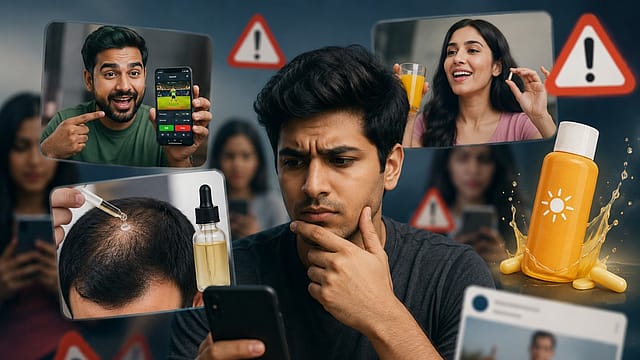
India's advertising self-regulator reviewed more cases than ever before in the last financial year — and found that offshore betting sites were by far the biggest source of rule-breaking ads, accounting for nearly 7,000 of the 11,581 cases examined.
The Advertising Standards Council of India (ASCI) released its Annual Complaints Report for 2025-26, showing a 21% jump in cases compared to the previous year. The ads behind those cases rose even sharper — up 37% to 9,841 advertisements, with 98% of them requiring some form of correction.
The digital problem
Nearly all of it is happening online. Digital media accounted for 97.3% of all ads flagged, and 82% of those were sponsored content on social media. Meta platforms — Facebook and Instagram — were responsible for nearly 80% of digital violations.
Offshore betting, despite being illegal in most Indian states, dominated the numbers with 6,933 cases. The sector has proved difficult to police because of how fast it operates: ads are constantly refreshed, spread through influencers and affiliate networks, and shared across messaging groups. ASCI identified 854 influencer accounts involved in betting promotion between April and December 2025 alone — including some dedicated entirely to the category.

Zeroing In on ECI
09 Oct 2026 - Vol 05 | Issue 41
Constitutional legitimacy versus political opportunism
The influencer reckoning
Influencer marketing more broadly had a bad year. Of the 1,609 influencer ads processed, 97.3% needed changes. Over half were promoting categories that are either prohibited by law or tightly restricted. Illegal betting accounted for 54% of influencer violations, followed by personal care (17%), electronics (8%), food and beverages (6%), and fashion (4%).
Dubious health claims
Beyond betting, the report paints a picture of consumers being bombarded with unsubstantiated health promises.
In personal care, advertisers routinely made claims of near-miraculous results — skin transformations, instant hair growth, "dandruff gone in 1 wash" — most of which fell apart under scrutiny for lacking scientific backing. Superlative claims like "India's No. 1" and manufactured precision like "11.7x stronger hair" were repeatedly flagged.
Food and beverages saw similar issues, particularly around nutraceutical products — supplements and functional foods that straddle the line between food and medicine. Despite being regulated as food under FSSAI rules, these products often carried quasi-medical claims around metabolic health, fertility, child development and organ function. Nutraceuticals alone contributed 52% of food and beverage cases.
A self-regulation system that largely works
Despite the volume, ASCI's compliance numbers are relatively healthy. Overall voluntary compliance rose from 83% to 86%, and TV and print advertisers adhered to rules at a near-perfect 97%. Sixty-one per cent of reviewed ads were modified or withdrawn without being contested — a sign, the council says, that advertisers broadly accept the process.
ASCI Chairman Sudhanshu Vats said the data reflects an ecosystem where "the normalisation of non-compliance as a post-publication correction exercise" is becoming the norm — with brands pushing ads live and fixing them later only if caught.
Manisha Kapoor, CEO and Secretary General of ASCI, credited the regulator's proactive monitoring for the scale of action: "In the digital era, ASCI has constantly pushed the boundaries on consumer protection. Our proactive monitoring system has allowed us to act at a scale and speed that complaint-driven models cannot match. Working closely with the Ministry of Information and Broadcasting has shown how effective stakeholders acting in concert can be when it comes to meaningful consumer protection. Similarly, the partnership with the Telangana Real Estate Regulatory Authority to monitor and curb misleading real estate promotions is helping to reinforce consumer trust in such advertising."