Godrej Tries a Reset. Déjà Vu Follows
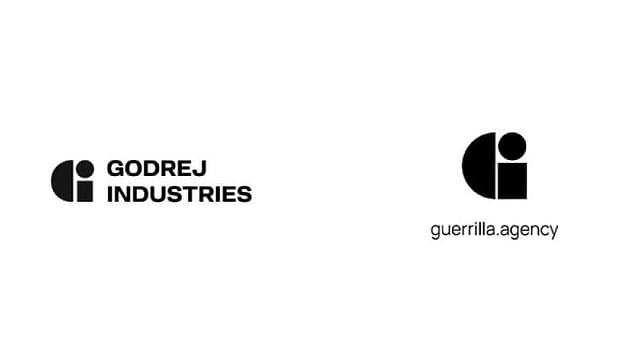
The plan was simple enough. Godrej Industries Group had just completed a major restructuring. Two business entities now operated under the same legendary name. They needed a way to tell themselves apart — professionally, visually, at the level of investor decks and board presentations. So they built one.
The group unveiled a new corporate brand identity at Godrej One: a geometric "GI identifier," a bespoke typeface called GI Sans, a sonic identity, a signature fragrance. The purpose statement — Crafting tomorrow since 1897 — was projected large. The Rs 5 lakh crore market-cap target by 2031 was stated with confidence. The in-house design team DISCO, which built the whole system in collaboration with branding firm Brands&Space, had reason to feel proud.
By the following morning, the GI mark was sitting next to the logo of Guerrilla — a small independent creative agency out of Sydney, Australia — in comparison threads across LinkedIn, Instagram and X. The visual overlaps were hard to unsee: the overall form, the typographic treatment, the geometric bones. Designers started tagging each other. Branding Twitter did what branding Twitter does.
Godrej's response was measured. The GI identifier, the company clarified in a press statement, is not a replacement for the iconic Godrej signature — the one that lives on your locks and your hair colour and your refrigerator. That logo is unchanged, it said, and will remain unchanged across all consumer-facing products. The GI mark is a corporate identifier, not a consumer one. It's for stakeholders, investors, media. It was designed to sit quietly beside the Godrej signature without competing with it. They'd run an extensive design process, explored many options, and done IP due diligence. They found no legal or ethical barrier to using it.

I.N.D.I.A. Falling
12 Jun 2026 - Vol 04 | Issue 75
The Unravelling of an Alliance
All of which may be true. And none of which really answered the question everyone was actually asking.
THE GEOMETRY PROBLEM
There is a particular trap that minimalism sets for brand designers, and Godrej has walked into it in public. Mitul Shah, founder and CCO of Calculated Chaos- an advertising agency, describes it well: "When you strip things down to the bare bones, what you're left with is a very small playground. And if you're not careful, you end up building your castle exactly where someone else already has. Same sand. Same bucket. Same smug little flag on top."
Godrej essentially made this argument themselves. "Resemblance in the category of geometric logos is not just common; it is structural," the company said in the press statement. When you want something elemental, reduced to its simplest geometric form, the available universe of shapes is finite. Overlap is almost mathematically inevitable.
Which is fair. But it also raises the obvious question: if overlap is structurally likely, why didn't the extensive design process catch it? Guerrilla's logo has been in use since 2002. It is not obscure. And in 2026, with design communities operating as a kind of real-time global database, "we didn't come across it," as Shah puts it, "isn't an explanation. It's a plot twist."
THE IN-HOUSE QUESTION
The controversy has stirred up something the Indian branding industry has been quietly arguing about for years: what is actually lost when you bring the work inside?
In-house agencies are built on three pillars — cost, speed, and creative control. DISCO clearly delivers on all three. But Shah identifies the blind spot that comes with the territory: "In-house teams are brilliant at knowing the brand inside out. They live it. Breathe it. Probably dream in its colour palette. But sometimes, that closeness comes with blind spots. The kind that an external agency, sitting at a slightly irritating distance, is paid to spot."
For a logo on a social post, that's a manageable risk. For a corporate identity that will go on buildings and balance sheets and outlive everyone in the room, it's a more expensive one.
THIS HAS HAPPENED BEFORE. IT WILL HAPPEN AGAIN.
Ishan Agarwal, Director of Brand & Creative at CashKaro- a cashback and savings platform, is not interested in singling out Godrej. For him, the company has simply become the latest and most prominent illustration of a structural failure across the industry. "Everyone is fishing from the same visual pond: same Pinterest boards, same Behance references, same Scandinavian geometry, same startup-clean monograms. The result? New logos no longer launch with surprise; they launch with side-by-side comparison threads."
He lists the precedents: Gap's redesign, pulled within a week. Pepsi's expensive circle, met with derision. Make in India's lion and its uncomfortable resemblance to Switzerland's visual. Zomato and a wave of D2C brands becoming indistinguishable from each other in the race to look global. Each one got a news cycle. None of them changed the underlying behaviour.
"Consumers today are not passive," Agarwal said. "They are forensic." The difference now is that audiences don't just react to a logo. They investigate it, timestamp it, and archive the comparison before the brand's own press release has finished loading.
His broader argument is that this moment represents something beyond a single controversy: "It is the beginning of a trust deficit where audiences will increasingly ask of every redesign: is this a fresh identity, or just premium plagiarism with a keynote presentation?"
WHERE THAT LEAVES GODREJ
Godrej Industries Group is not in crisis. The Godrej name — one of India's most durable and trusted — is entirely intact. The consumer-facing brand has not moved an inch. The group's Rs 5 lakh crore ambition is not derailed by a controversy about a mark that most Indians will never see on a product shelf.
But branding is not only about what's true. It's about what sticks. And what's sticking right now, in the minds of designers, marketers and brand watchers, is a specific image: two logos, side by side, looking uncomfortably similar.
Godrej set out to craft tomorrow. The more pressing task now is convincing the room that tomorrow doesn't look quite so much like 2002.