More Screens, Less Spend: Inside PVR INOX’s New Playbook
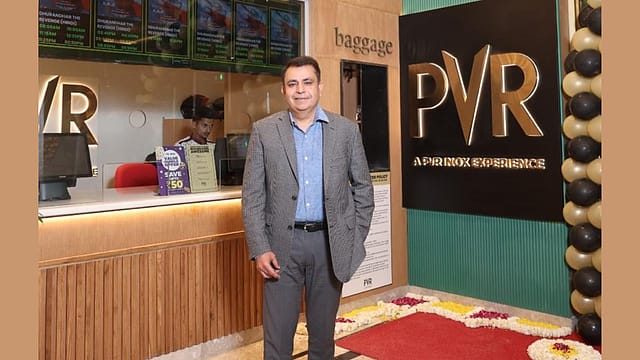
With Dhurandhar: The Revenge pulling audiences back to theatres, PVR INOX’s latest multiplex launch in Agra signals more than just another screen.
The opening at Anjana Central Mall, in partnership with Prompt Planner Group’s PL Sharma, comes as the company balances a content-led recovery with a decisive shift towards capital-efficient expansion.
In a conversation with OPEN Digital, Pramod Arora, CEO (Growth & Investments) at PVR INOX, said the strategy now hinges on widening access without stretching capital.
“India has over 1.4 billion people. If cinema has to become a truly democratic medium, it needs to expand much faster,” Arora said. “If we rely only on our own capital and resources, expansion will always be limited. This model allows us to reach the nooks and corners of the country.”

Losing Memory
16 Oct 2026 - Vol 05 | Issue 42
The making of a medical and social emergency
The company’s recent financial performance underscores how strongly content still drives exhibition.
PVR INOX reported a 166.5% year-on-year jump in consolidated net profit to ₹95.7 crore in Q3 FY26, powered by strong box office traction. But profit slipped 9.4% sequentially, underscoring the volatility of uneven release cycles.
Franchises like Dhurandhar have been key to driving footfalls and consumer spending, reinforcing the outsized role of big-ticket releases for multiplex operators.
FOCO: A Structural Shift in Expansion
Alongside content, the company is recalibrating how it adds screens. The FOCO (franchise-owned, company-operated) model lets developers fund cinema infrastructure, while PVR INOX handles operations, programming and customer experience. Till date, the company has 71 screens (19 Properties) under FOCO model.
The model, Arora said, took shape during the pandemic, when capital allocation turned critical. “We were among the worst hit, with severely constrained cash flows. At that time, we had two choices—either invest in new cinemas or conserve capital to protect our ecosystem,” he said. “We chose to stand by our people and prioritise stability.”
Unlocking Stranded Supply
At the same time, a parallel opportunity emerged.
Several developers had already invested in cinema-ready spaces but were left without operators as the pandemic disrupted the exhibition ecosystem.
“Developers were left with assets that couldn’t be easily repurposed,” Arora said. “These were built specifically for cinemas.” The FOCO model offered a way to bridge this gap—pairing ready infrastructure with an established operator.
Learning from Global Playbooks
While still new at scale in Indian exhibition, the approach draws from asset-light models used globally.
“I spoke with mentors and people from private equity to understand how such models scale,” Arora said. “The examples that came up were Marriott, Hilton and Hyatt.”
It took the company nearly two-and-a-half to three years to build the operational framework for FOCO, he added. Scaling Ahead The Agra launch is part of a broader rollout.
PVR INOX plans to add around 100 screens under the FOCO model by FY27, focusing on markets where demand exists but capex-heavy expansion has held it back.
“This is about reach,” Arora said. “If cinema has to serve the entire country, we need models that allow us to expand faster and more efficiently.”
Balancing Growth Levers
As it moves forward, the strategy rests on two levers—using strong content cycles to drive near-term performance, while building a more flexible, asset-light model for long-term expansion.
If executed well, the combination could help PVR INOX expand its footprint while maintaining financial discipline in a business still shaped by both scale and storytelling.