The Brand That Wants to Be India's Claire's — But Saltier
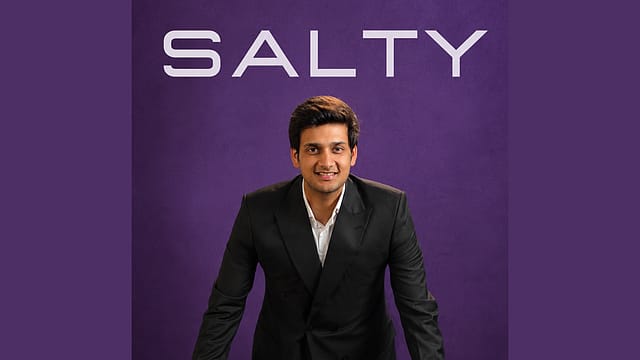
"There is a big lifestyle deflation when you leave a high-paying job to start something of your own. You're not drawing a salary. And for two, three years, you genuinely wonder if you made the right call."
Kanishka Garg says this without a trace of regret. If anything, there is a quiet satisfaction in how he frames it — the kind that only comes from having made it to the other side of the doubt.
Today, Garg is the CEO of Salty, a Delhi-based accessories brand he co-founded in 2022 with his college friends Twishaa Gupta and Sonaal Goel. The three are SRCC, LSR, and ISB alumni respectively — the kind of credentials that open doors in consulting rooms and corporate corridors. Garg spent three years walking through those doors, working at a Mumbai consulting firm on education projects across India and abroad, before choosing to close them behind him.
The pivot was not impulsive. The trio had already built and exited one company — an edtech platform for school-going kids, acquired by Bangalore-based EdVantage. They knew how to build. They knew how to sell. What they were looking for was the right category. They found it, almost by accident, in the one place nobody else seemed to be looking: the everyday accessories shelf. No national brand. No organized player. Just a vast, fragmented market and three friends who had been buying watches and earrings since college.
They called the brand Salty. The name, fittingly, was never meant for this business. It stuck anyway.
Exclusive: To the Heavens and Back
19 Jun 2026 - Vol 04 | Issue 76
Shubhanshu Shukla relives the space odyssey that put India into orbit
They are not, by any traditional measure, fashion people. None of them come from the accessories or jewelry industry. What they came with instead was a consulting lens, a tolerance for experimentation, and a shared frustration: that India — a country of over a billion people with a deep cultural relationship with adornment — had no national brand for everyday accessories.
"If you look at Europe, you have Accessorize. In the US, you have Claire's," says Garg. "Those categories are completely organized there. In India, this space is still almost entirely unorganized."
That observation became the founding thesis of Salty.
From Edtech Exit to Earrings
This is not the duo's first rodeo — or rather, trio's. Before Salty, the three ran an edtech startup, a co-curricular platform for school-going children that was eventually acquired by Advantage, a Bangalore-based B2B education company. The exit gave them both capital and clarity.
"Post the acquisition, the three of us wanted to work on something together again. E-commerce was something we understood. And honestly, all three of us have always been into accessories — from school, from college," Garg says.
They started small — sourcing from Indian wholesalers, building an Instagram page, learning the language of the product. The first year was bootstrapped, funded by their own savings of around ₹20–30 lakhs pooled together. The learning curve was steep. "We made a lot of mistakes early on," Garg admits. "We didn't know what quality really meant in this category, what buying looks like, how supply chains work. But because we weren't from this background, we also looked at things from a completely fresh perspective."
That outsider's eye — combined with a data-first operating philosophy — turned out to be an asset. Salty today runs with over 3,000 SKUs across six to seven categories, and product decisions are driven by sales data rather than design ego. "We don't have very strong opinions on design. We let the data decide," says Garg.
The Blinkit Bet
In January 2026, Salty closed a ₹30.1 crore funding round led by MG Investment, with participation from existing backers Anicut Capital, All In Capital, and JK Group, along with a clutch of new angel investors. The round followed an earlier seed raise of ₹5.4 crore in January 2024. Total funding now stands at approximately ₹41 crore.
But the more interesting number might be this: on Valentine's Day this year, Salty did ₹1 crore in sales on Blinkit alone — in a single day, as Garg claims. That figure, he says, prompted Zepto to immediately re-initiate a partnership conversation. Within weeks, the brand was preparing to double down on Zepto as well.
Garg claims that Salty was one of the first fashion accessories brands to list on Blinkit, and it has since become the market leader in its category on the platform. "Jewelry already accounts for about one percent of Blinkit's overall GMV," he notes. "People are genuinely buying accessories on quick commerce." The brand is currently present across Blinkit, Amazon, Myntra, Flipkart, its own website, and its own app — one of the few brands that can genuinely claim to be omnichannel across all formats.
Currently clocking ₹4–4.5 crore in monthly revenue, Salty is targeting ₹100 crore in the current financial year, with an internal stretch target of ₹150 crore. Jewelry remains the largest category, projected at around ₹60 crore this year. Watches, launched only five to six months ago, are already a ₹2–2.5 crore business and are expected to hit ₹20–25 crore by year end, as Garg mentioned.
The Books Behind the Brand
The ambition is backed by real, if early-stage, financial momentum. Salty E-Commerce's revenue from operations surged to ₹32.3 crore in FY25, up sharply from ₹9.8 crore in FY24 — a three-fold jump in a single year — as per regulatory filings accessed by business intelligence firm Tofler. The net loss, however, widened to ₹1.1 crore in FY25 from ₹40 lakhs in the previous fiscal, reflecting the cost of rapid expansion.
Garg is candid about the trade-off. "FY26 we'll be single-digit EBITDA negative because we deliberately invested in new categories. But FY27 we're targeting a profitable year." For most of the company's history, he says, the business has been EBITDA-positive — FY26 being the planned exception.
Design Without Tradition
Walk through Salty's catalogue and one thing is immediately clear: you will not find a single piece of traditional or Indian-inspired design. That is not an accident.
"Indian or traditional design is something you will not find with us — we've made that a conscious guardrail," says Garg. "Western, modern aesthetics across all categories. That's the design language." The in-house team designs the full range — from passport covers to bag charms to watches. For certain categories like jewelry, manufacturers also pitch designs, but the final call on what makes it to the catalogue rests with the brand.
The pricing is equally deliberate. Everyday jewelry runs from ₹500 to ₹1,500. Watches from ₹1,400 to ₹3,500. The goal is to sit comfortably in the "everyday wear" bracket — not a gifting splurge, not fast fashion junk, but a considered, repeatable purchase for someone in Lucknow or Indore just as much as someone in Mumbai.
"Fifty percent of our buying customers are outside Delhi, Mumbai, and Bangalore," Garg says. "This brand was never only for metros."
The Sassy Brand That Shot a Film in Japan
Salty's marketing has been as unconventional as its category positioning. The entire creative team is in-house — a deliberate choice, Garg says, to maintain brand voice. And that voice, in his words, is "slightly sassy, slightly tongue-in-cheek. Not serious. Not meme-funny. Something in between."
The brand spends roughly 40 percent of revenue on marketing — a significant number, though not unusual for consumer brands in growth mode. Salty uses influencers but has been expanding into brand marketing: offline activations, voucher partnerships with platforms like BookMyShow, and now a full brand film — shot in Japan — built around the idea that "accessories don't lie." The film is currently being amplified on OTT and YouTube.
A brand-level collaboration with Blinkit is also in the works — not a sales promotion, but a brand-to-brand campaign.
The White Space Argument (and Its Challenges)
The story Salty tells investors is compelling in its simplicity: there is no national accessories brand in India. The category is fragmented, unorganized, and underserved by design-forward brands in the affordable segment.
But investors push back, and Garg acknowledges it. "The biggest recurring question is always about brand-building. In jewelry, on-product branding is almost impossible — you can't put a logo on a ring the way you can on a sneaker. So how do you build brand recall?" It remains, he says, an open problem.
What Salty is betting on is a combination of channel ubiquity (be everywhere the consumer shops), design consistency (a clear aesthetic language that becomes recognizable over time), and category breadth (accessories as a lifestyle universe, not just jewelry). The watch launch and the planned bags vertical are both steps in that direction.
Three Friends, One Bet
Salty's 40-person corporate team and 60-person warehouse crew operate from Delhi. The three co-founders each own a clearly defined lane: Gupta on product, Goel on finance and marketplaces, Garg on marketing and growth. The founding team has been friends for over a decade — a fact Garg mentions almost in passing, as though it barely needs saying.
The ₹30 crore raised in January will go toward category expansion, technology infrastructure, and the brand's first physical experience store — expected to open in Delhi within the quarter.
For a brand that started with an Instagram page and some wholesale sourcing, the ambitions have scaled considerably. A hundred crore target. A flagship store. A brand film from Japan. Market leadership on Blinkit.
And through all of it, a name that wasn't even meant for this business — but somehow fits perfectly.
"Salty," Garg says with a smile, "just resonated.