Go Low vs. Go Zero: When an Incumbent's Name Game Exposes a Startup's Narrow Reality
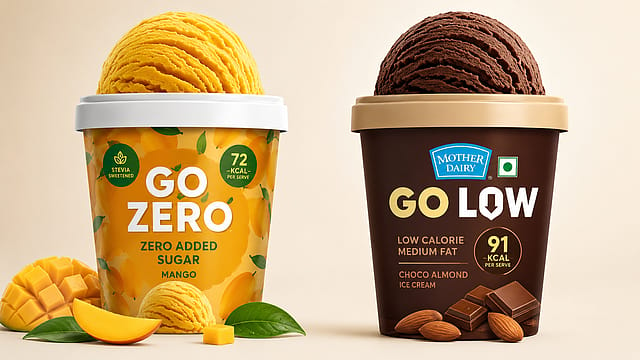
In India's ₹20,000-crore ice cream market, a branding dispute has unpacked something far bigger about health marketing, consumer behaviour, and the fragile promise of guilt-free indulgence. Mother Dairy, the established dairy giant, recently launched Go Low—a low-calorie, medium-fat ice cream range. The name couldn't be more coincidental: it sounds almost identical to Go Zero, a zero-added-sugar ice cream startup that's raised $6 million, gotten Shark Tank India visibility, and after three years, hasn't crossed ₹10 crore in monthly sales.
When a ₹20,000-crore company names its product to echo a startup doing ₹43 crore in FY25 revenue, is that strategy, laziness, or simply how incumbents have always crushed challengers in India before they can scale? The answer reveals more about the Indian consumer than about branding ethics.
THE BRANDING CONTROVERSY: ME-TOO OR MARKET CRUSH?
A brand strategy consultant calls it "a classic case of 'me-too' branding." Harish Bijoor warns that "if you look like someone else or sound like someone else, you may be accused of passing off your brand as something it isn't." The proximity is troubling: "Go Zero," "Go Slow," "Go Low"—they're "too close for comfort," he says.
The Modi Years
02 Oct 2026 - Vol 05 | Issue 40
A Nation Rebuilt
But beyond the legal and ethical debate, the naming strategy exposes something sharper: Mother Dairy isn't trying to be Go Zero. Experts reckon it’s trying to make Go Zero irrelevant by offering a similar promise at mass price points through kirana stores and modern trade, where Go Zero barely exists.
Go Zero's entire distribution is concentrated on quick commerce—70% of its revenue comes from Blinkit and Zepto. This worked when the brand was niche. But when Mother Dairy enters with Go Low at ₹200 for 500ml (compared to Go Zero's ₹70–100 per smaller pack), the startup's addressable market looks suddenly narrow.
HAS THE CATEGORY ACTUALLY ARRIVED?
The more fundamental question: before asking whether Mother Dairy can threaten Go Zero, should we ask whether the low-calorie, sugar-free ice cream category has actually arrived in India?
The category has arrived, according to Prof. D Sriram of Great Lakes Institute of Management, Chennai, who cites five reasons:
First, Health & Wellness food revenue will reach $257 billion by 2033 (ICMR-INDIAB study), driven by disposable income, young demographics, and preventive healthcare focus.
Second, lifestyle medicine is finding roots in India—a new medical stream focusing on nutrition, physical activity, mental state, sleep, and spiritual quotient to prevent doctor visits. Youngsters joining "neo-fitness culture" create gargantuan appetite for healthy food.
Third, the category has arrived, but big players aren't serious yet. Established players like Unilever or Mother Dairy may want a share, but smaller players are curating products for their target groups with limited budgets, spending ad bucks only on social media marketing. This helps wellness-conscious millennials and Gen Alpha see and order online, Sriram notes.
Fourth, India has 100 million diabetics with growing numbers. Why should they change lifestyle drastically when sugar-free options are available through click-and-buy apps? These make nutritionists' lives easier.
Fifth, younger brands are passionate; established brands just fill categories. Go Zero's challenge is mastering distribution infrastructure to reach target groups.
But Sriram also notes a critical weakness: "From the customers' point-of-view, either they consume guilt-free or give in to temptation. 'Low' calorie is a sub-optimal choice." This suggests Go Zero's zero-sugar positioning may be more compelling than Go Low's reduced-calorie approach—yet Go Zero still can't scale.
THE GEOGRAPHY OF GUILT: HOW NARROW IS GO ZERO'S MARKET REALLY?
Go Zero's entire brand architecture rests on the guilt-free promise—but guilt is a metropolitan, upper-middle-class emotion around food. Stevia-sweetened, high-protein ice cream at a D2C price point is still a very specific lifestyle product for a very specific consumer: gyms, calorie-counters, protein-bar enthusiasts in Delhi, Mumbai, Bangalore.
When Mother Dairy enters with Go Low at mass price points through kirana and modern trade, does it expose how narrow Go Zero's actual addressable market always was?
The data suggests yes. Go Zero's 70% reliance on Blinkit and Zepto means it's capturing only urban, app-dependent consumers who can afford premium pricing and wait for quick delivery. This is a fraction of India's ice cream consumers. Mother Dairy's Go Low, available in neighbourhood stores at 60% lower prices, targets the mass market that actually buys ice cream regularly.
This tells us something crucial about the difference between a brand that creates cultural noise and a brand that creates a real business. Go Zero has played a significant role in popularising the low-calorie ice cream category through strong digital marketing, Shark Tank visibility, and founder-led storytelling. But as the category expands, Mother Dairy brings a very different advantage: a distribution network that reaches hundreds of thousands of kirana stores across Tier 2 and Tier 3 markets where low-calorie ice cream has had limited presence so far.
THE INDIAN CONSUMER'S TRUTH: HEALTH ASPIRATION VS. INDULGENCE REALITY
In categories where health positioning is the core claim—sugar-free beverages, low-fat snacks, protein ice cream—there is consistent historical evidence that consumer behavior and consumer aspiration diverge sharply at the point of purchase. People say they want healthy; they buy indulgent.
Given this pattern, which business model is actually more honest about the Indian consumer?
Go Zero's premium guilt-free promise assumes consumers will consistently choose sugar-free over sugary, protein-rich over creamy, premium pricing over mass pricing. It's betting on a behavioural shift that hasn't materialized at scale after three years and $6 million in funding.
Mother Dairy's approach is different: quietly adding a low-calorie option to a portfolio anchored in pleasure and nostalgia. Mother Dairy's core brands (Vanilla, Kesar Pista, Butterscotch) aren't health products—they're indulgence products. Go Low is just an option for the occasional health-conscious moment, not the entire brand identity.
The observation that "'Low' calorie is a sub-optimal choice," according to Sriram, suggests Go Zero's zero-sugar positioning is actually more compelling. But Go Zero's failure to scale despite superior positioning reveals the real constraint: price and access, not product preference.
THE INCUMBENT'S PLAYBOOK: HOW MOTHER DAIRY CRUSHES BEFORE GO ZERO SCALES
This is how incumbents have always crushed challengers in India:
The playbook is simple. First comes name similarity, which creates market confusion: "Go Low" sounds like "Go Zero," creating ambiguity for consumers who may not know the difference. Then comes distribution dominance aka flexing footprint muscle. Mother Dairy's presence in kirana stores everywhere versus Go Zero's quick-commerce exclusivity. Third element is price compression: ₹200 for 500ml versus ₹70-100 for smaller packs makes Go Low accessible to mass market. And finally, it’s all about portfolio anchoring. Go Low doesn't need to be the star. It's just one option in a portfolio of indulgence brands
While Bijoor's warning about "me-too branding" makes sense, strategically, it's a smart move. Mother Dairy isn't trying to differentiate from Go Zero—it's trying to enter into Go Zero’s turf by offering the same promise (healthier ice cream) at 60% lower prices in 100x more locations.
THE CATEGORY'S FUTURE: NICHE OR MASS?
The low-calorie ice cream category in India remains tiny despite significant startup activity from Go Zero, NOTO, Minus 30. This suggests the category hasn't arrived at mass scale yet.
Sriram believes it will: "Health and Wellness segment is here to stay." But the constraint isn't demand—it's the fundamental mismatch between health positioning and Indian consumer behavior at the point of purchase.
Go Low vs. Go Zero is not really a branding battle. It's a stress test for the entire health-food category in India. Go Zero proves that wellness-conscious consumers exist and will pay premium prices. Mother Dairy proves that those consumers are too few to sustain a business at scale without incumbents entering the space.
The real question isn't whether Mother Dairy's naming is ethical. It's whether Go Zero's entire thesis—that Indians will consistently choose guilt-free over indulgent—was built on a market that was always too small to support a ₹100-crore business.
Time will tell if new-age wellness brands succeed. If they don't, Sriram predicts they'll be acquired by larger brands. For consumers, the hope is that favorite brands don't run out of stocks or go out of business.
But one thing is clear: when an incumbent names a product "Go Low" to sound like "Go Zero," it's not just branding. It's the beginning of a market consolidation that will define which health brands survive in India—and which become case studies in overestimated demand.