Durand Line Tensions Explained: How Did Kabul and Islamabad Reach “Open War”?
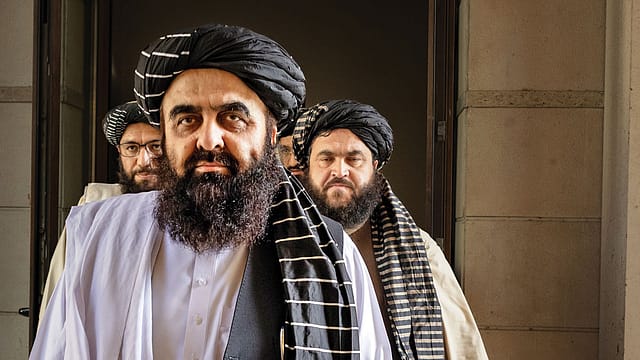
Tensions between Afghanistan and Pakistan have spiralled into one of the most serious military escalations in recent years, with cross-border airstrikes, retaliatory ground operations, and both sides claiming heavy casualties along the disputed Durand Line. Former Afghan President Hamid Karzai has condemned the strikes, declaring that Afghans will defend their “beloved homeland,” as Islamabad announced what it termed an “open war.”
How did the latest Afghanistan–Pakistan escalation begin?
The latest confrontation erupted after Kabul accused Pakistani forces of violating Afghan territory and carrying out airstrikes on civilian areas. According to Afghanistan’s Ministry of National Defence, retaliatory operations were launched at 8:00pm on the 9th of Ramadan (February 26) along the 2,611km Durand Line, a border Afghanistan has never formally recognised.
Look Who's Talking Regime Change
23 Oct 2026 - Vol 05 | Issue 43
In a press release, the ministry said, “A few days ago, the Pakistani military circles, with great audacity, violated Afghan territory, breached our borders, and martyred women and children here.”
Afghan forces said they targeted Pakistani military posts in eastern and southeastern sectors near Paktika, Paktia, Khost, Nangarhar, Kunar and Nuristan.
“In these retaliatory operations along the Durand Line, a total of 55 Pakistani soldiers were killed, two bases and 19 posts were captured,” the statement said.
The ministry further claimed that the four-hour operation destroyed two Pakistani bases and 19 posts, with soldiers fleeing from four additional positions. It also alleged that an enemy tank was destroyed, a large military transport vehicle was captured, and “dozens of light and heavy weapons, ammunition, and military supplies were seized by Afghan forces.”
Afghanistan acknowledged its own losses, stating, “In this retaliatory operation, 8 of our Mujahideen achieved the high status of martyrdom, and 11 others were injured.”
It also alleged that 13 civilians were injured in a missile attack on a refugee camp in Nangarhar.
What did Hamid Karzai and Taliban leaders say?
Former President Hamid Karzai strongly condemned what he described as renewed Pakistani airstrikes on Kabul, Kandahar and Paktia.
In a post on X, Karzai wrote: “The Pakistani aircraft once again bombed Kabul, Kandahar, and Paktia. The Afghans will defend their beloved homeland with complete unity in all circumstances and will respond to aggression with courage. Pakistan cannot free itself from the violence and bombings--those problems it has created itself--but must change its own policy and choose the path of good neighborliness, respect, and civilized relations with Afghanistan.”
Taliban spokesperson Zabihullah Mujahid also condemned the strikes, calling them cowardly.
He posted: “The cowardly Pakistani military has carried out airstrikes in certain areas of Kabul, Kandahar, and Paktia; fortunately, there have been no reported casualties.”
Earlier, Mujahid had announced the launch of major retaliatory operations:
“In response to the repeated instances of rebellion and assaults by Pakistani military circles, extensive offensive operations have begun against Pakistani army centers and military facilities along the Durand Line.”
Deputy spokesperson Hamdullah Fitrat said: “Along the so-called Durand Line, heavy retaliatory offensive operations have been launched against the enemy by the Islamic Emirate of Afghanistan through the 203 Mansouri Corps and the 201 Khalid bin Walid Corps at various points in the provinces of Paktia, Paktika, Khost, Kunar, Nuristan, Nangarhar, and at the Torkham Gate.”
He added: “To date, one headquarters and nineteen outposts have been captured; four outposts were abandoned and vacated, and the positions were completely set on fire. Up to fifty-five Pakistani soldiers have been killed, of whom twenty-three bodies and a number of others have been taken alive into the custody of the Mujahideen. Dozens of light and heavy weapons have been seized as spoils, one tank has been destroyed, and one International Harvester vehicle has also been captured. Retaliatory offensive operations remain ongoing.”
Fitrat also claimed: “The major headquarters of the Pakistani regime located at Anzar Sar, under the Babrak post in the Alisher-Terezi district of Khost Province, has just been captured. Dozens of soldiers are killed and wounded, and a large quantity of weapons has fallen into the hands of the Afghan forces.”
How has Pakistan responded to the Afghan claims?
Islamabad responded forcefully, announcing a major military campaign named ‘Ghazab Lil Haq’ targeting the Afghan Taliban regime.
According to ARY News and Geo News, Pakistan claimed that 133 Afghan Taliban fighters were killed and more than 200 wounded, with 27 Taliban posts destroyed and nine captured.
Pakistan’s Defence Minister Khawaja Asif issued a stark warning, declaring what he termed “open war” against Afghanistan.
In a post on X, he said: “After the withdrawal of NATO forces, it was expected that there would be peace in Afghanistan and that the Taliban would focus on the interests of the Afghan people and peace in the region...They gathered all the terrorists of the world in Afghanistan and began exporting terrorism. They deprived their own people of basic human rights. They snatched away the rights that Islam grants to women.”
He further added: “Our cup of patience has overflowed. Now it is open war between us and you. Now it will be 'Dama Dam Mast Qalandar'. Pakistan's army did not come from across the seas. We are your neighbours; we know your ins and outs. Allahu Akbar.”
Pakistani security forces reportedly carried out operations across multiple border areas, including Chitral, Khyber, Mohmand, Kurram and Bajaur districts.
Why is the Durand Line central to the conflict?
At the heart of the confrontation lies the Durand Line, the 2,611-km frontier drawn during British colonial rule in the 19th century. While Pakistan recognises it as the official international border, successive Afghan governments have refused to formally acknowledge it.
The disputed boundary has long been a flashpoint for cross-border militancy, airstrikes and retaliatory shelling. The latest escalation, marked by air power, ground offensives and sharply worded political statements, signals one of the most serious breakdowns in ties since the Taliban returned to power in Kabul.
With both sides trading casualty figures and accusations, the situation remains volatile, raising fears of a broader military confrontation in the region.
(With inputs from ANI)