Can Animal Panic Stop Poachers? Inside the Icarus Space Tracking Project
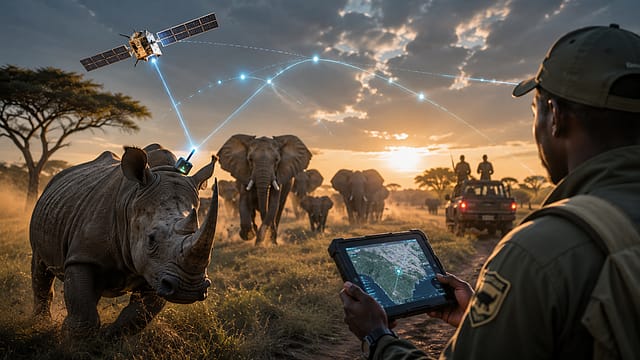
For decades, conservationists have struggled to monitor wildlife across the planet's most remote landscapes.
That challenge may now have a solution. The Icarus satellite system, developed by the Max Planck Institute of Animal Behavior in Germany, is building what its creators call the Internet of Animals: a global, real-time network that tracks wildlife movement from space and decodes the hidden signals buried inside animal behaviour.
What Is the Icarus Satellite System?
Icarus is a space-based wildlife tracking project designed to receive data from thousands of animal-mounted tags simultaneously.
The project aims to have six satellite receivers in orbit by mid-2027. The first satellite launched in late 2024 aboard a SpaceX Falcon 9 rocket.
A second microsatellite, named Raven, launched in May 2025 and is currently in its testing phase.

Losing Memory
16 Oct 2026 - Vol 05 | Issue 42
The making of a medical and social emergency
How Does Icarus Track Animal Behaviour From Space?
Animals carry miniature ear-mounted tags that record GPS location, movement, heart rate, body temperature, and atmospheric pressure.
These tags transmit data to Icarus receivers in orbit. The shift from ground-based receivers to satellites is like moving from landlines to mobile phones, expanding coverage from a handful of reserves to truly global monitoring.
Can Animal Panic Catch Poachers?
Researchers at Namibia's Okambara reserve have been simulating poaching events to record how different species react to human threats.
Zebras scatter, springbok bounce, and wildebeest race hundreds of metres, while giraffes remain still and face the direction of danger.
By training an algorithm on these panic signatures, scientists aim to send real-time alerts to rangers the moment unusual behaviour patterns appear.
Where Is the Technology Already Making a Difference?
Kruger National Park in South Africa has deployed roughly 3,000 ear tags across 1,500 animals. More than 80 wild dogs have already been freed from snares using tag-based alerts, and the system has helped reconstruct poacher movements before rhino attacks.
Could Icarus Answer Conservation's Biggest Questions?
Martin Wikelski, the ecologist leading Icarus, says the system will have its greatest impact in places like the Congo Basin and the Amazon, where animals cross unmonitored landscapes daily, as per the BBC.
He aims to tag 100,000 animals globally by 2030. Questions about where wild animals live and die have long seemed unanswerable. Icarus is finally changing that.
(With inputs from yMedia)