Pakistan: A Dangling Republic
IF THE INTERNATIONAL Monetary Fund (IMF) is to be believed, 2025 was a good year for Pakistan’s economy. The country posted a primary fiscal surplus of 1.3 per cent of GDP and the January update for the World Economic Outlook (WEO) pegged economic growth in 2026 at 3.2 per cent. This was below the projection for the Middle East and Central Asia group—Pakistan is clubbed in that region by IMF—that stood at 4.5 per cent. Still, it was not bad.
That’s where the positives end and reality kicks in. The IMF spokesperson who revealed the news about Pakistan’s “green shoots” added that the primary fiscal surplus had been posted for the first time in 14 years. In 11 of those 14 years, Pakistan received money from IMF. Since 1958, the country has been under 23 IMF programmes and currently it is under an Extended Fund Facility (EFF) amounting to $7 billion negotiated in 2024. This is on top of a Stand-By Arrangement (SBA) worth $3 billion in 2023. An EFF is a longer-term programme to help countries with serious Balance of Payments (BoP) problems while an SBA is a short-duration, typically 12-18 month, programme meant to immediately bail out a country.
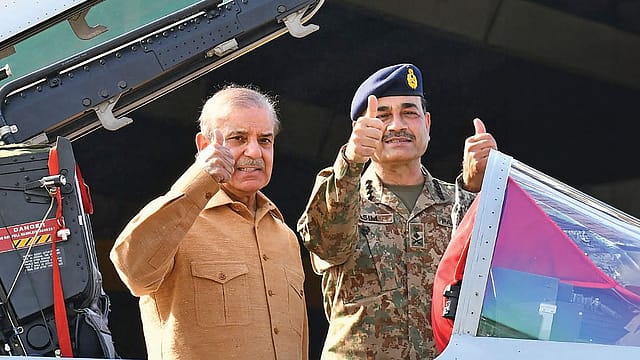
It is then not surprising that Pakistan Prime Minister Shehbaz Sharif could not contain his angst while speaking to military officers at Quetta on June 1 when he said that even allies were less than keen to respond to pleas for bailouts. “China is the most time-tested friend of Pakistan. Saudi Arabia is one of the most reliable and trustworthy friends of Pakistan. This applies to Turkey, Qatar and the UAE,” he said and added that these nations are looking to engage in trade, innovation and research. “They no longer expect us to go there with a begging bowl,” Sharif said and added that he and Chief of Army Staff Field Marshal Asim Munir would be the “last persons” to carry this burden and called for the development of Pakistan’s natural resources. His remarks, while revealing the reality of Pakistan as a civilian-military “hybrid state”, came in the presence of Munir. Was there an oblique suggestion that the military had a role in Pakistan being repeatedly reduced to a parlour state of affairs? It would be hard to tell.
The IMF spokesperson, interestingly, added, “And also, maybe just to highlight that the Governance and Corruption Diagnostic Report was recently published, and it includes proposals for reforms, including simplifying tax policy design, levelling the playing field for public procurement, and improving asset declaration transparency.” These are not new findings and such advice has been offered to Pakistan several times in the past. The Pakistan military and the Sharif government believe they have “dealt” themselves back into the game with the US by flattering President Donald Trump, endorsing his claims to a Nobel Peace Prize, and offering public and private deals that please the American leader. But there are other problems, such as the Taliban regime in Afghanistan refusing to stamp out the Pakistani Taliban given the deep ethnic ties they share. While China is ever willing to prop up Pakistan against India, this is also a limiting factor in Pakistan-US ties.
That diagnostic report, issued in November last year, gives a much better picture of Pakistan’s economic realities than any GDP, BoP, debt and deficit statistics can. The ‘Pakistan: Governance and Corruption Diagnostic Report’ noted that “Pakistan’s governance indicators consistently rank poorly, reflecting weaknesses in controlling corruption, enforcing contracts and protecting property rights. The state’s dominant role in the economy, including extensive ownership of enterprises and control over critical sectors, creates systemic vulnerabilities to rent-seeking and regulatory capture.”
That was not all. The report went on to add, “AML/CFT frameworks have improved, enabling Pakistan’s removal from the FATF grey list, yet enforcement remains weak, especially in prosecuting corruption-related money laundering and in international cooperation for asset recovery. Judicial institutions are fragmented, overburdened, and perceived as corrupt, with significant delays in adjudicating commercial disputes and protecting property rights.” A reason some commentators feel the Pakistan military—clearly the hand that holds the whip—is not interested in directly governing is that it would rather this unenviable task fell to political parties it chooses to prop up. The balance is tenuous as public discontent runs high and can spill over into street protests which the state can quell but at further cost to its legitimacy.
These are classic political economy problems that used to haunt many developing countries that have moved ahead of Pakistan by improving the quality of their institutions. There is no sign that Pakistan is even willing to do so. The country’s borrowing spree does not end there. In fiscal 2023, it received $14 billion in foreign loans; the next fiscal—2024-25—this figure was more than $12 billion. In addition, Pakistan also has another feature: ‘rollover’ of loans/sums borrowed from friendly countries like Saudi Arabia, the UAE, and China. In recent years, these rollovers have amounted to $3 billion each from Saudi Arabia and China and another $2 billion from the UAE. That cycle continues. Then there are borrowings from foreign commercial banks. This might be a good example of the adage that if you owe the bank a large enough sum it may never be able to act against you. Pakistan’s creditors may well have written off the amounts on grounds that they may never see the money.
The question that ought to be asked is how Pakistan manages this never-ending game of musical chairs when its economic fundamentals in no way make it a reasonable, let alone attractive, investment prospect. The answer lies not in economics but in the global political economy. There are three features that go some way in explaining Pakistan’s economy. First and foremost, Pakistan is considered “too important a country to fail” by key states. The monies deposited by countries like China and Saudi Arabia in Pakistan’s banks are not dictated by economic rationale but put there purely on a political basis so that it imparts confidence to other lenders who give money to Pakistan.

The second feature of Pakistan’s economy is its boom-and-bust cyclicity. Its annual growth rates and growth slumps do not indicate “plateaus of stability”. For example, India had its much-maligned “Hindu rate of growth”. In Pakistan, there are booms followed by busts. For example, from 1962 to 1965, Pakistan grew at a rapid clip, then growth collapsed, picking up again from 1969 to 1970. The same pattern can be seen from 1979 to 1980. Again from 2002 to 2004. Each of these cycles corresponds to a series of geopolitical events from which Pakistan earned ‘rent’ due to its geographic location. In recent years, these boom-and-bust cycles have become much more pronounced.
The period from 2018 to 2024 has been particularly intense from this perspective. But unlike externally driven events of the past, this time there is an internal element as well. Pakistan is now in the throes of acute internal security challenges coupled with very hard limits on how fast it can grow. The result is that the moment growth crosses 3.5 per cent of GDP in a year, inflationary pressures swell up rapidly, necessitating extreme tightening of money supply. Not that Pakistan has done this willingly. In the 2024 IMF EFF agreement, Pakistan had to swallow extremely bitter medicine. It is the draconian crunching of expenditure and money supply that led to the “green shoots” alluded to by IMF. There is no reason to believe Pakistan will persevere with the entire course of treatment. Soon enough, it might renege on IMF demands and exit its programme only to return a few years later.
The final feature that explains Pakistan’s economic chaos is the pattern of its military expenditure. In recent years, these expenditures have been clamped down. For example, in 2024 defence expenditures were 2.7 per cent of GDP compared to the highs seen in the 1980s. In 1986, for example, the figure was 7 per cent of GDP. But any conclusion based solely on this figure will be misleading. The army always had business interests but now some of the biggest companies in sectors like cement, fertilisers, telecom, banking, and real estate are owned directly or indirectly by the army. The dictum that in Pakistan the army owns the country is coming true in a stark economic sense.
These features of the Pakistani economy, which cannot be divorced from its domestic and global political realities, will ensure that Pakistan will muddle along for the foreseeable future, bobbing between periodic bursts of growth and extended periods of misery for its people.