Dyson Wants to Make Toothbrush the Next Status Symbol. Will the Dyson Effect Work?
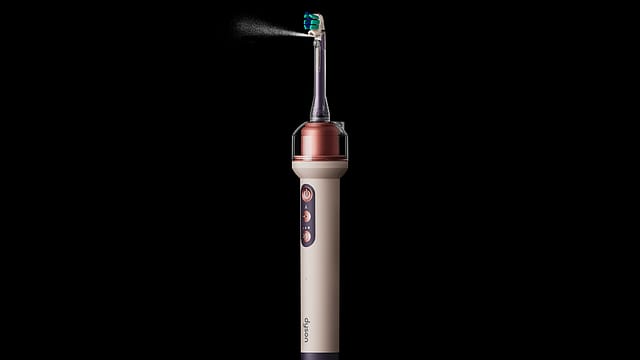
There is something almost absurd about a ₹50,000 toothbrush.
A vacuum cleaner can justify a Dyson premium by cleaning better. An Airwrap can justify it by promising a visibly different hairstyle without extreme heat. But a toothbrush? It sits in a bathroom, disappears into a routine and does its most important work somewhere nobody can see.
That is precisely why Dyson’s new CameraJet is such an interesting business bet.
The company is not merely entering oral care with another electric toothbrush. It is trying to apply the Dyson formula to one of the most ordinary objects in the home: take a mundane chore, load it with engineering, wrap it in distinctive design and technology, and persuade consumers that the experience is worth paying dramatically more for.

Zeroing In on ECI
09 Oct 2026 - Vol 05 | Issue 41
Constitutional legitimacy versus political opportunism
As per the company, CameraJet has a 100,000-pixel macro camera that looks inside the mouth, uses machine learning to identify interdental gaps and fires a precision jet of mouthrinse at them. The camera connects to the MyDyson app, where users can see a live view and receive feedback on their brushing. Dyson says the system has been developed over six years, involving 661 engineers, 38 patents and training on more than 470,000 dental images. The product is priced at $499.99 in the US, while India availability and pricing are yet to be announced.

The technology is impressive. But technology is not really the question.
The question is whether Dyson can make oral care feel like a category worth upgrading into.
That is a much bigger challenge than selling another piece of hardware.
The Airwrap made the invisible expensive. The Airwrap made the visible irresistible
From what it looks like, Dyson already knows how to make people spend irrationally on everyday routines.
The Airwrap is the obvious example. In India, Dyson continues to sell the Airwrap range, including the connected Airwrap i.d. It is not simply positioned as a hair dryer or curling device. It is sold as a beauty technology product, complete with app-based personalisation.
The genius of the Airwrap is that its value is visible for some.
You can see the curls. You can see the smoothness. You can compare your hair before and after. You can watch someone use it on Instagram and immediately understand why they might want one.
Experts believe that CameraJet has to sell something considerably more abstract.
Nobody looks in the mirror after brushing and thinks, That interdental gap was 17% cleaner today.
That creates a fundamental difference in the premiumisation equation, but it has all the possibilities to create a new obsession.
The Airwrap sells an outcome you can see. CameraJet has to sell an outcome you cannot immediately see, even though the reason for wanting it can be deeply personal.
Harish Bijoor, Brand and Business Strategist, makes precisely this distinction. “What Dyson did to the Airwrap category was really humongous. But out there, please note that it was about everything you could see because the hair space is cosmetic and it what it did to the outside world. The tooth space is very internal. It's about you and it's about oral hygiene, which tends to affect everything else.”
But there is another side to oral care that makes Dyson's bet more interesting.
Teeth may be inside the mouth, but the desire around them is hardly invisible.
People spend on whitening, aligners, braces, veneers and cosmetic dentistry because a smile is one of the most visible things about a person. The cosmetic dental industry exists precisely because consumers do not think of teeth merely as a health issue. They care about how they look, how they feel about their smile and how that smile is perceived by others.
That gives Dyson an opening.
CameraJet does not have to make oral care cosmetic from scratch. The aspiration is already there. Its challenge is to connect that aspiration with the less glamorous side of oral hygiene: the gaps between teeth, plaque removal and the daily discipline that produces the smile in the first place.
That difference matters enormously.
The most valuable outcome of good oral care is often precisely that nothing goes wrong. But unlike a basic toothbrush, CameraJet attempts to make the process itself visible, measurable and technologically engaging.
Dyson therefore has to make the technology itself desirable.
And it has some experience doing exactly that.
The real competitor may be the ₹100 toothbrush
Dyson's problem is not necessarily Oral-B, Philips or another premium electric toothbrush.
It may be the perfectly functional toothbrush already sitting in millions of Indian bathrooms.
India's electric toothbrush market is growing rapidly, with Grand View Research estimating it at $76.3 million in 2024 and projecting it to reach $143.8 million by 2030. The broader Indian oral care market is substantially larger, estimated at $3.18 billion in 2024.
So the opportunity is real. But a growing category does not automatically mean consumers will leap from a few hundred rupees to a luxury-tech purchase.
Dyson may not need to convert everyone. It needs something more valuable initially: a tribe of people who believe that ordinary toothbrushes are no longer good enough.
That is where the brand's existing cultural capital becomes important.
Shubham Gune, Founder & CEO of advertising agency Hinglish, puts it bluntly: “Men have been waiting on the sidelines for this. It's been quite some time since we men have gifted, admired, or even just judged our female counterparts for their craze for Dyson. Finally, they can experience their design magic. And settle the argument once and for all: Is Dyson really good or just hype? I totally feel like, like the weekend ticket sales of a Superstar, Dyson will sell like hotcakes at first. But eventually, it will boil down to whether the product is really worth its salt.”
That last sentence may be the most important one in the entire CameraJet story.
Dyson can manufacture desire once. It cannot manufacture repeat belief.
The first buyers will almost certainly include Dyson loyalists, technology enthusiasts and consumers for whom design and novelty are part of the purchase. Bijoor himself says he would be “in line to pick this up” when it becomes available.
But early adoption is not the same as mass adoption.
Bijoor sees that expansion as potentially much larger than a toothbrush launch. “I do believe gum health and oral care could be as big, if not bigger, than what Dyson did with cleaning up dust and muck,” he says. “Dyson I believe has cracked open a Pandora's box of opportunity that rests out there.” But he is also clear about the immediate limitation: “This is an expensive proposition, for sure. I can't think of somebody paying ₹48,000 at one shot to acquire a Dyson in the oral care category. But it's going to be a niche. There are going to be early adopters all across the world who will want to reach out and pick one up.”
Dyson is no longer selling products. It is selling a worldview
There is a larger shift hiding inside the toothbrush.
Dyson has spent years expanding beyond the vacuum cleaner that made its name. Floorcare, air treatment, haircare, headphones, lighting, robotics and now oral care are increasingly connected by one proposition: engineering can improve the objects that consumers have stopped questioning.
That gives Dyson permission to enter categories where it has no obvious historical right to play.
And the business opportunity is potentially much larger than the toothbrush itself.
CameraJet comes with proprietary toothpaste and mouthrinse, a charging dock, travel case and replaceable brush heads. The company has designed the toothpaste and rinse to produce less foam so the camera can function properly. That turns the product from a one-off hardware purchase into a system of hardware, software and consumables.
This is where Dyson's oral-care experiment becomes strategically interesting.
A vacuum is replaced after years. A hair tool can sit on a dressing table for years. Oral care creates a daily habit and recurring need for consumables.
If Dyson can establish itself inside that routine, the toothbrush becomes an entry point rather than the destination.
But there is an uncomfortable question hanging over the entire proposition.
How much technology does a toothbrush actually need?
Dyson's answer is essentially: enough to make you understand what you have been missing.
The consumer's answer will come after six months of brushing, charging, refilling and replacing.
That is why CameraJet is less a toothbrush launch than a referendum on the Dyson brand itself. The company has already proved that people will pay a premium to make cleaning the house feel better and styling their hair feel more sophisticated.
Now it wants to make brushing your teeth feel like a high-tech ritual.
If it works, Dyson will have demonstrated something far more powerful than its ability to sell expensive toothbrushes. It will have shown that luxury is no longer necessarily about what a product is made of. It can be about how intelligently an ordinary moment is engineered.
If it does not, CameraJet could expose the limit of the Dyson effect.
Because there is a difference between making consumers want something and making them believe they need it.
The Airwrap conquered the first.
The toothbrush has to conquer the second.