EXPLAINED | Why Has FSSAI Sanctioned Prosecution Against Bisleri, And Is Its Packaged Water Safe?
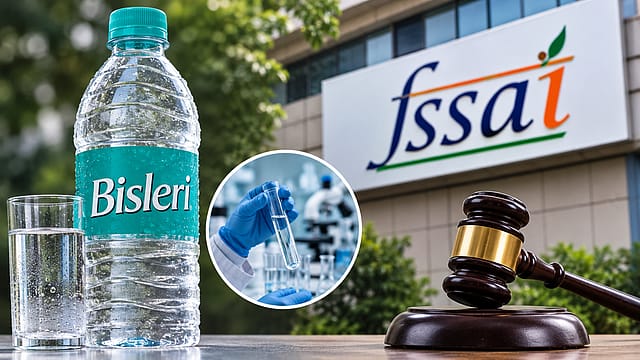
The Food Safety and Standards Authority of India (FSSAI) has sanctioned prosecution against packaged drinking water manufacturer Bisleri International Pvt. Ltd. after a sample collected from its Goa facility was declared unsafe. The company, however, has challenged the regulatory findings and said it has not received an official notice from the food regulator.
The dispute centres on a sample collected in September 2025, the levels of two chemical substances detected during laboratory testing and the different results reported by the laboratories involved.
Here is what the case involves, what the substances mean and what the regulator's action implies for consumers.
WHY HAS FSSAI TAKEN ACTION AGAINST BISLERI?
FSSAI said a regulatory sample of packaged drinking water was collected from Bisleri International's premises for testing. The sample was found to be non-compliant with prescribed bromate limits and was declared unsafe under the Food Safety and Standards Act, 2006.

The Wealth Issue 2026
06 Nov 2026 - Vol 05 | Issue 45
Portraits of Dreamers and Doers under 35
After the company appealed, the sample was sent to a referral laboratory. FSSAI said the laboratory also declared it unsafe after detecting polynuclear aromatic hydrocarbons (PAHs).
Based on these findings, the regulator has sanctioned prosecution against the company under the Food Safety and Standards Act, 2006.
WHAT IS BROMATE AND WHY IS IT A CONCERN?
Bromate is a chemical compound that can form during the treatment of drinking water, particularly when ozone is used for disinfection in the presence of naturally occurring bromide.
Its presence is regulated because prolonged exposure to elevated levels can pose health risks. The prescribed limit for bromate in packaged drinking water cited in this case is 10 micrograms per litre.
According to Bisleri, the initial test of one sample from its Goa facility recorded 12 micrograms per litre, exceeding the limit by 2 micrograms. The company says the other five samples collected on the same day met the applicable standards.
WHAT ARE POLYNUCLEAR AROMATIC HYDROCARBONS?
Polynuclear aromatic hydrocarbons, commonly called PAHs, are a group of chemical compounds containing multiple linked aromatic rings. They can be produced during the incomplete burning of materials such as coal, oil, wood and other organic substances.
Some PAHs are known to pose health risks, including an increased risk of cancer with sufficient exposure. Their detection in a drinking-water sample can therefore raise food-safety concerns.
FSSAI said the referral laboratory detected PAHs in the sample and declared it unsafe on that basis as well.
WHY DOES BISLERI DISPUTE THE FINDINGS?
Bisleri says the regulatory matter dates back to September 2025, when FSSAI collected six samples from its Goa manufacturing facility, one of 143 plants in its network.
The company said five samples met the prescribed standards, while the sixth recorded bromate at 12 micrograms per litre against the permitted limit of 10 micrograms.
Bisleri appealed against the initial result on November 22, 2025. The sample was subsequently sent to a referral laboratory, which found bromate within the prescribed limit but separately flagged PAHs.
The company said the difference between the laboratory findings required clarification. It then arranged for the same sample to be tested at an independent FSSAI-approved laboratory, which, according to Bisleri, also found bromate within the prescribed limit.
WHAT DOES THE COMPANY SAY ABOUT THE LABORATORY RESULTS?
Bisleri said it submitted the independent laboratory results to FSSAI's Western Regional Office through a formal letter dated February 2, 2026.
The company claimed it received no further communication from the regulator after that submission and understood the matter to have been closed.
It also said it had not received the reported prosecution notice either by email or in hard copy and could not locate it on FSSAI's website.
Bisleri maintains that its manufacturing process includes more than 90 quality tests across 10 stages and that its products remain safe for consumption. It has also said it will cooperate with the regulator.
DOES THE PROSECUTION SANCTION MEAN BISLERI HAS BEEN FOUND GUILTY?
No. A sanction to launch prosecution is not the same as a court conviction.
It allows the regulatory authorities to initiate legal proceedings under the Food Safety and Standards Act, 2006. The allegations and laboratory findings will have to be examined through the legal process, where the company can present its defence.
The prosecution sanction does, however, indicate that FSSAI considers the laboratory findings serious enough to pursue the matter.
SHOULD CONSUMERS STOP DRINKING BISLERI WATER?
The information released so far does not establish that every Bisleri bottle or batch is unsafe. The regulatory action described by FSSAI concerns a sample collected at the company's Goa facility in September 2025.
Bisleri has maintained that its products remain safe, while FSSAI has declared the tested sample unsafe based on its laboratory findings.
Consumers should distinguish between the findings concerning this particular sample and a conclusion about the company's entire product range. The regulatory proceedings and any further official clarification will be important in establishing the outcome of the dispute.
With inputs from ANI